Gregory Fried - Böcker
Visar alla böcker från författaren Gregory Fried. Handla med fri frakt och snabb leverans.
12 produkter
12 produkter
555 kr
Skickas inom 5-8 vardagar
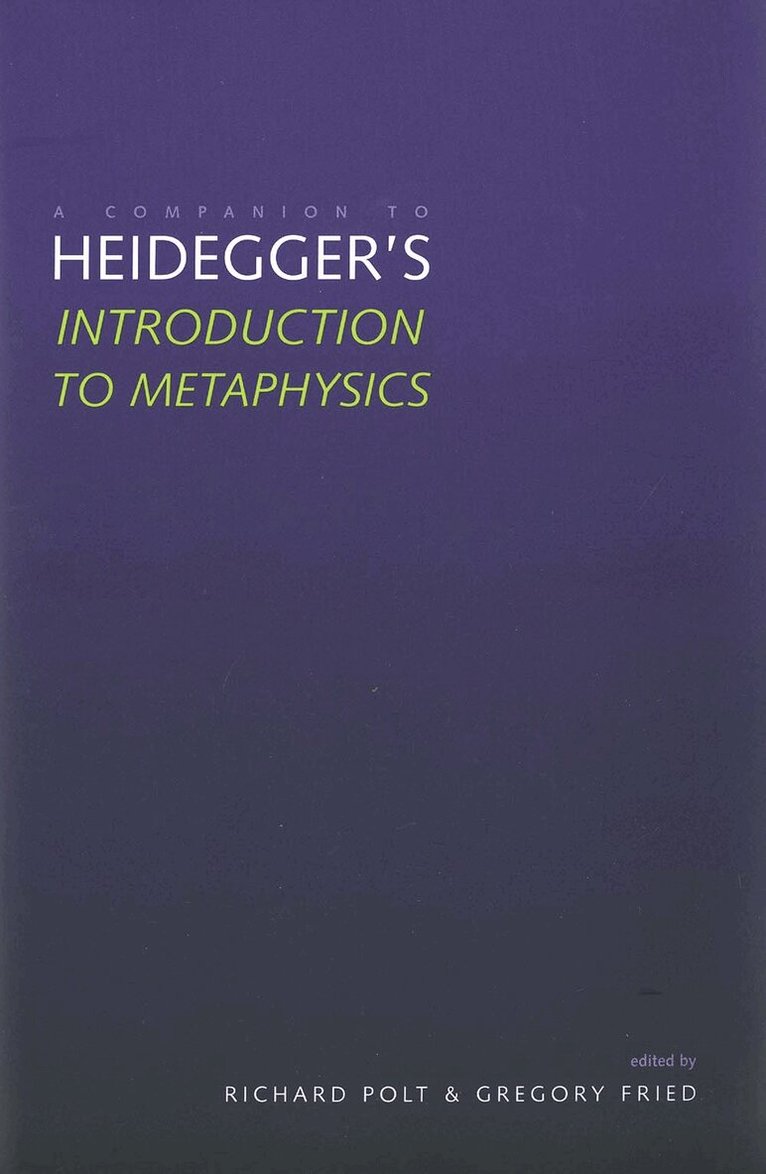
Martin Heidegger’s Introduction to Metaphysics, first published in 1953, is a highly significant work by a towering figure in twentieth-century philosophy. The volume is known for its incisive analysis of the Western understanding of Being, its original interpretations of Greek philosophy and poetry, and its vehement political statements. This new companion to the Introduction to Metaphysics presents an overview of Heidegger’s text and a variety of perspectives on its interpretation from more than a dozen highly respected contributors. In the editors’ introduction to the book, Richard Polt and Gregory Fried alert readers to the important themes and problems of Introduction to Metaphysics. The contributors then offer original essays on three broad topics: the question of Being, Heidegger and the Greeks, and politics and ethics. Both for readers who are approaching Heidegger for the first time and for those who are studying Heidegger on an advanced level, this Companion offers a clear guide to one of the philosopher’s most difficult yet most influential writings.
503 kr
Skickas inom 5-8 vardagar
Gregory Fried offers in this book a careful investigation of Martin Heidegger’s understanding of politics. Disturbing issues surround Heidegger’s commitment to National Socialism, his disdain for liberal democracy, and his rejection of the Enlightenment. Fried confronts these issues, focusing not on the historical debate over Heidegger’s personal involvement with Nazism, but on whether and how the formulation of Heidegger’s ontology relates to his political thinking as expressed in his philosophical works. The inquiry begins with Heidegger’s interpretation of Heraclitus, particularly the term polemos (“war,” or, in Heidegger’s usage, “confrontation”). Fried contends that Heidegger invests polemos with broad ontological significance and that his appropriation of the word provides important insights into major strands of his thinking—his conception of the human being, understanding of truth, and interpretation of history—as well as the meaning of the so-called turn in his thought. Although Fried finds that Heidegger’s politics are continuous with his thought, he also argues that Heidegger’s work raises important questions about contemporary identity politics. Fried also shows that many postmodernists, despite attempts to distance themselves from Heidegger, fail to avoid some of the same political pitfalls his thinking entailed.
1 406 kr
Kommande
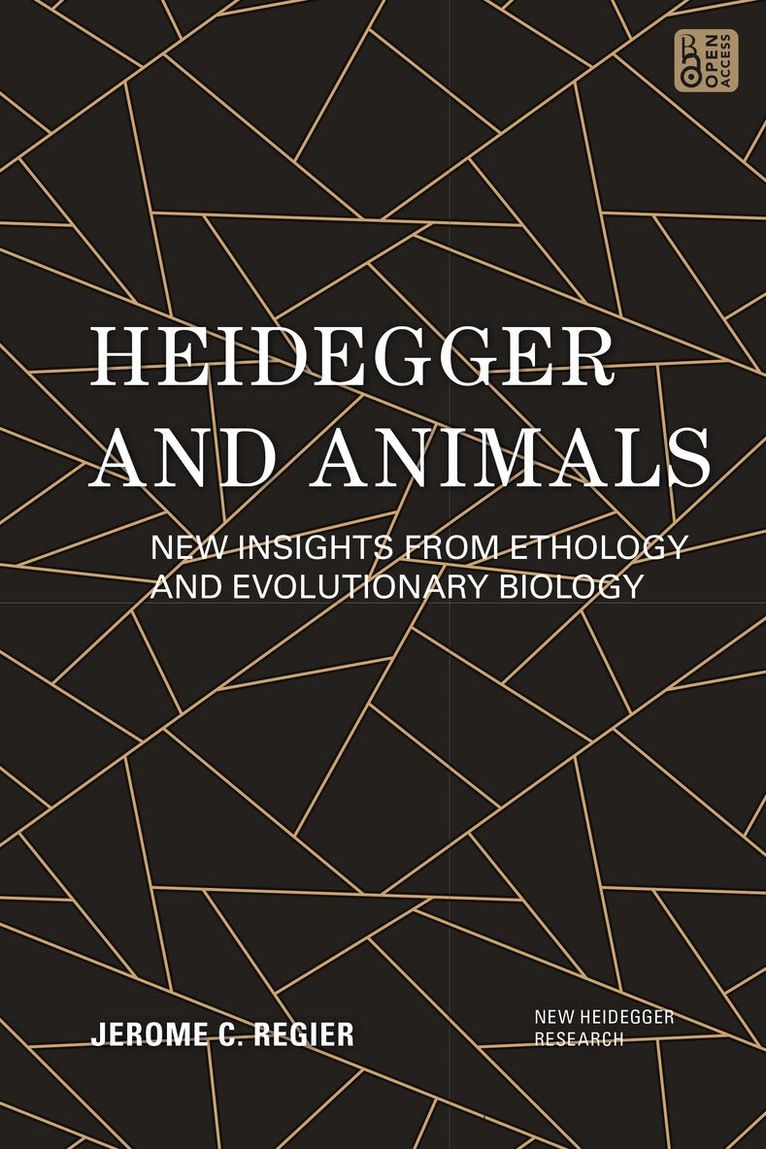
In this open access volume, Jerome C. Regier provides a comprehensive exploration of Heidegger’s animal philosophy throughout the Gesamtausgabe, challenging its key ontological claims, whilst also updating the discussion to incorporate new insights from evolutionary biology and ethology.Heidegger and Animals offers a new way of thinking about the relationship between humans and our fellow animals. It does this by exploring Heidegger’s philosophical writings and oft-cited claim that there is an ontological abyss separating humans and human Dasein (whose way of being Heidegger calls "existence") and animals (whose way of being he calls "captivation"). Scrutinizing Heidegger’s emphasis on human Dasein’s distinctive way of being and his approach to ethology, experimental biologist Regier challenges Heidegger’s ontological interpretation of animal behavior. In particular he does this by drawing on and reinterpreting numerous studies of bees and other arthropods, octopuses and other cephalopods, fish, birds, and mammals.Questioning Heidegger whilst continuing to work within his conceptual framework, this book aims to expand Heidegger’s understanding of existence (as Dasein) to include our fellow animals without denying an ontological abyss between existence and captivation. Through a more informed and sensitive understanding of biology, Regier reveals how humans and many animals are, after all, in both existence (as Dasein) and captivation.This innovative study will be of great value to debates around animal rights and environmental protection, in defending the dignity of animals within a tradition of continental philosophy.The ebook editions of this book are available open access under a CC BY-NC-ND 4.0 license on bloomsburycollections.com.
245 kr
Skickas inom 5-8 vardagar
459 kr
Skickas inom 5-8 vardagar
488 kr
Skickas inom 10-15 vardagar
Martin Heidegger held Plato responsible for inaugurating the slow slide of the West into nihilism and the apocalyptic crisis of modernity. In this book, Gregory Fried defends Plato against Heidegger’s critiques. While taking seriously Heidegger’s analysis of human finitude and historicity, Fried argues that Heidegger neglects the transcending ideals that necessarily guide human life as situated in time and place. That neglect results in Heidegger’s disastrous politics, unhinged from a practical reason grounded in the philosophical search from a truth that transcends historical contingency. Thinking both with and against Heidegger, Fried shows how Plato’s skeptical idealism provides an ethics that captures both the situatedness of finite human existence and the need for transcendent ideals. The result is a novel way of understanding politics and ethical life that Fried calls a polemical ethics, which mediates between finitude and transcendence by engaging in constructive confrontation with both traditions and other persons. The contradiction between the founding ideals of the United States and its actual history of racism and slavery provides an occasion to discuss polemical ethics in practice.
1 833 kr
Skickas inom 10-15 vardagar
This unique volume collects more than 30 new essays by prominent scholars on what remains philosophically provocative in Heidegger’s thought. His writings continue to invite analysis and application — ut, particularly in the light of his political affiliations, they must also be critiqued. Philosophy today takes place after Heidegger in that his views should not be accepted naively, and there are new issues that he did not address — but also in that we continue to think in the wake of important questions that he raised.The contributors to this volume ask questions such as:- What does it mean to think “after” Heidegger? - What is valuable in his early work on finite existence, and in his early and late phenomenology?- What is the root of his political errors? Are there still elements in his thought that can yield helpful political insights?- Should we emulate his turn toward “releasement”? - Can he help us understand the postmodern condition?Readers will find thought-provoking echoes and points of contention among these engaging and lively essays.
675 kr
Skickas inom 10-15 vardagar
This unique volume collects more than 30 new essays by prominent scholars on what remains philosophically provocative in Heidegger’s thought. His writings continue to invite analysis and application — ut, particularly in the light of his political affiliations, they must also be critiqued. Philosophy today takes place after Heidegger in that his views should not be accepted naively, and there are new issues that he did not address — but also in that we continue to think in the wake of important questions that he raised.The contributors to this volume ask questions such as:- What does it mean to think “after” Heidegger? - What is valuable in his early work on finite existence, and in his early and late phenomenology?- What is the root of his political errors? Are there still elements in his thought that can yield helpful political insights?- Should we emulate his turn toward “releasement”? - Can he help us understand the postmodern condition?Readers will find thought-provoking echoes and points of contention among these engaging and lively essays.
1 476 kr
Skickas inom 10-15 vardagar
Martin Heidegger held Plato responsible for inaugurating the slow slide of the West into nihilism and the apocalyptic crisis of modernity. In this book, Gregory Fried defends Plato against Heidegger’s critiques. While taking seriously Heidegger’s analysis of human finitude and historicity, Fried argues that Heidegger neglects the transcending ideals that necessarily guide human life as situated in time and place. That neglect results in Heidegger’s disastrous politics, unhinged from a practical reason grounded in the philosophical search from a truth that transcends historical contingency. Thinking both with and against Heidegger, Fried shows how Plato’s skeptical idealism provides an ethics that captures both the situatedness of finite human existence and the need for transcendent ideals. The result is a novel way of understanding politics and ethical life that Fried calls a polemical ethics, which mediates between finitude and transcendence by engaging in constructive confrontation with both traditions and other persons. The contradiction between the founding ideals of the United States and its actual history of racism and slavery provides an occasion to discuss polemical ethics in practice.
1 703 kr
Skickas inom 10-15 vardagar
The question of the relation of Martin Heidegger’s thought to politics has been a subject of controversy since the 1930s, when he became an advocate of the National Socialist regime in Germany. This volume addresses this question in a unique format, as a dialogue among leading Heidegger scholars. That dialogue begins with an exchange between Gregory Fried and Emmanuel Faye about Faye’s contention that Heidegger’s work represents nothing short of “the introduction of Nazism into philosophy.” At stake are issues such as what Heidegger himself understood Nazism to be, whether a thinker’s life and actions define the meaning of his work, the enduring threat of fascism, and the nature of rationality and philosophy itself. Richard Polt, Matthew Sharpe, Dieter Thomä, William Altman, and Sidonie Kellerer join the conversation, with responses from Fried and Faye.
595 kr
Skickas inom 10-15 vardagar
The question of the relation of Martin Heidegger’s thought to politics has been a subject of controversy since the 1930s, when he became an advocate of the National Socialist regime in Germany. This volume addresses this question in a unique format, as a dialogue among leading Heidegger scholars. That dialogue begins with an exchange between Gregory Fried and Emmanuel Faye about Faye’s contention that Heidegger’s work represents nothing short of “the introduction of Nazism into philosophy.” At stake are issues such as what Heidegger himself understood Nazism to be, whether a thinker’s life and actions define the meaning of his work, the enduring threat of fascism, and the nature of rationality and philosophy itself. Richard Polt, Matthew Sharpe, Dieter Thomä, William Altman, and Sidonie Kellerer join the conversation, with responses from Fried and Faye.
568 kr
Skickas inom 10-15 vardagar
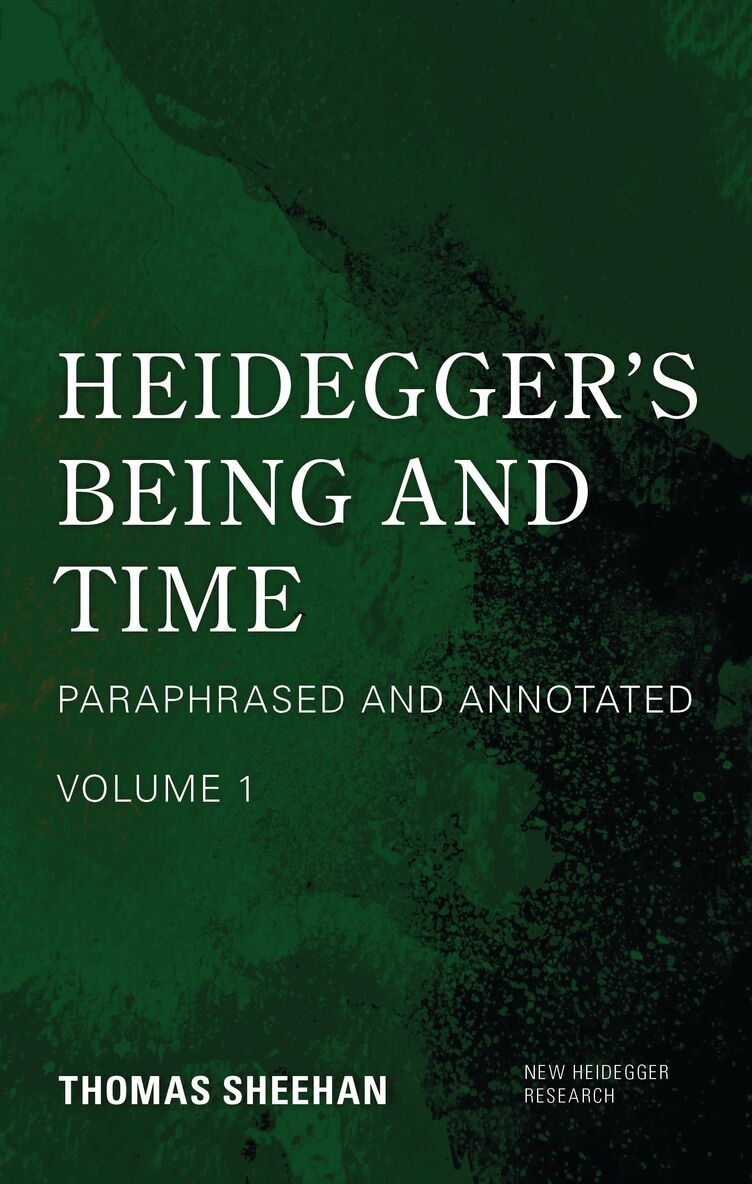
This important new book condenses and rephrases, paragraph by paragraph, the entirety of Heidegger's magnum opus Being and Time. Leading Heidegger scholar Thomas Sheehan renders the text in reader-friendly language that avoids the worst of the Heideggerese that persists in the wider scholarship. He helpfully outlines each of the six chapters and, in turn, each of the eighty-three individual sections of the book, providing a critical and insightful commentary that draws on Heidegger’s comments on Being and Time throughout his career. The book also includes commentary and guidance on the terminology, scope, arguments, achievements, and limitations of Being and Time. This reader's guide is an essential resource for students, scholars and anyone engaging with Heidegger's complex work.