Gregory Heyworth – författare
Visar alla böcker från författaren Gregory Heyworth. Handla med fri frakt och snabb leverans.
2 produkter
2 produkter
459 kr
Skickas inom 10-15 vardagar
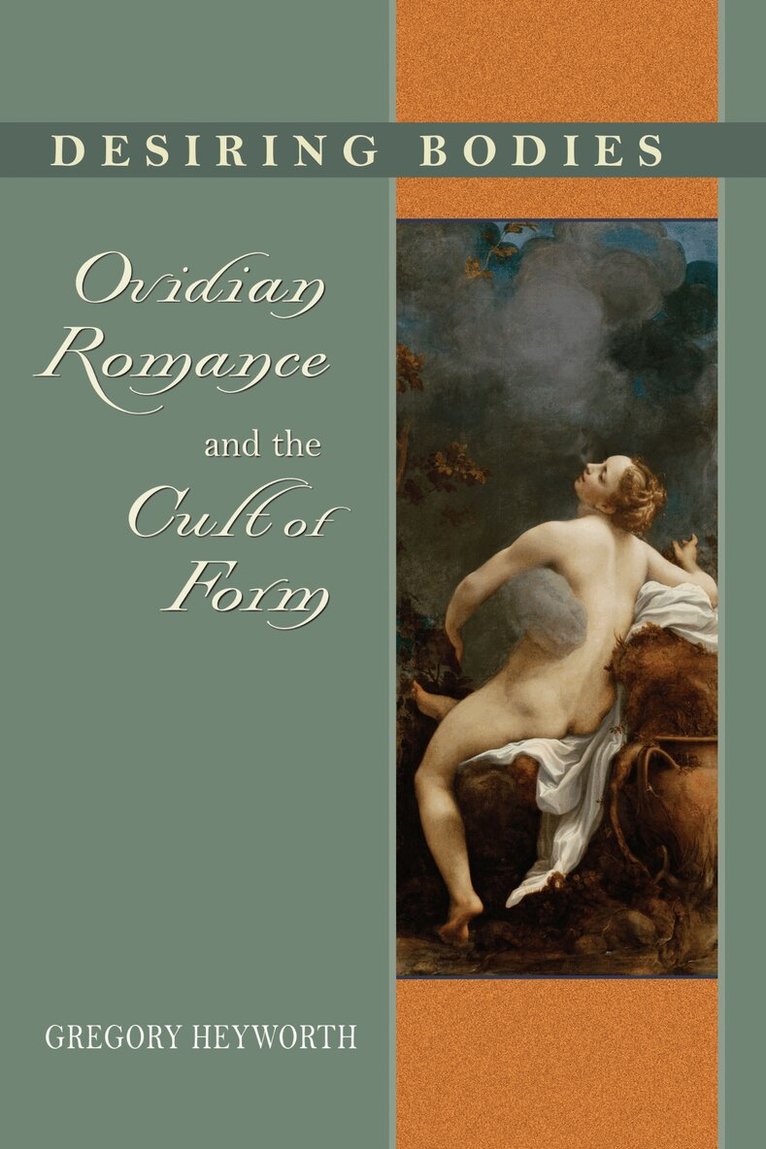
Gregory Heyworth's Desiring Bodies considers the physical body and its relationship to poetic and corporate bodies in the Middle Ages and Renaissance. Beginning in the odd contest between body and form in the first sentence of Ovid's protean Metamorphoses, Heyworth identifies these concepts as structuring principles of civic and poetic unity and pursues their consequences as refracted through a series of romances, some typical of the genre, some problematically so. Bodies, in Ovidian romance, are the objects of human desire to possess, to recover, to form, or to violate. Part 1 examines this desire as both a literal and socio-political phenomenon through readings of Marie de France's Lais, Chrétien de Troyes' Cligès and Perceval, and Chaucer's Canterbury Tales, texts variously expressing social, economic, and political culture in romance. In part 2, Heyworth is concerned with missing or absent bodies in Petrarch's Rime sparse, Shakespeare's Romeo and Juliet, and Milton's Paradise Lost and the generic rupture they cause in lyric, tragedy, and epic. Throughout, Heyworth draws on social theorists such as Kant, Weber, Simmel, and Elias to explore the connection between social and literary form.The first comparative, diachronic study of romance form in many years, Desiring Bodies is a persuasive and important cultural history that demonstrates Ovid's pervasive influence not only on the poetics but on the politics of the medieval and early modern Western tradition.
Del 10 - Medieval and Renaissance Authors and Texts
Les Eschéz d'Amours
A Critical Edition of the Poem and its Latin Glosses
Inbunden, Engelska, 2013
5 055 kr
Skickas inom 3-6 vardagar
Les Eschéz d’Amours may be the last great medieval allegory to find its way into a modern edition. In the tradition of the Roman de la Rose, the Eschéz surveys matters of love, politics, economics, music, medicine, and chess through the lens of classical and Scholastic learning. In addition to the first 16,293 (of over 30,000) verses newly edited out of the manuscripts, the editors present a complete apparatus of literary, historical and linguistic essays that place the poem in the context of the scholarly and courtly life of late 14th century Paris. The important Latin glosses of the Venice manuscript of the Eschéz follow in an edition of their own, with critical notes and translation.