Grzegorz Ekiert – författare
Visar alla böcker från författaren Grzegorz Ekiert. Handla med fri frakt och snabb leverans.
11 produkter
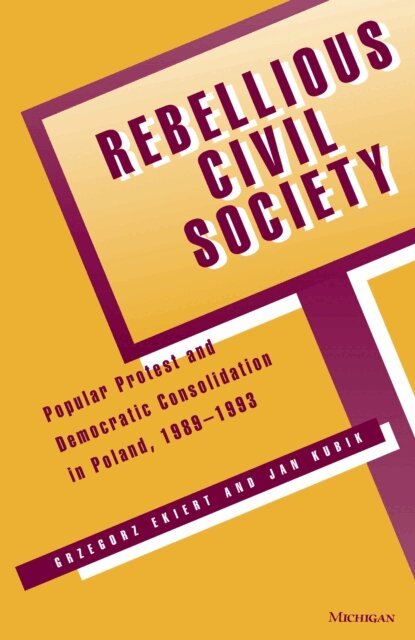
Rebellious Civil Society
Popular Protest and Democratic Consolidation in Poland, 1989-1993
E-bok, 2010
644 kr
Lägg i varukorg
Poland is the only country in which popular protest and mass opposition, epitomized by the Solidarity movement, played a significant role in bringing down the communist regime. This book, the first comprehensive study of the politics of protest in postcommunist Central Europe, shows that organized …
Rebellious Civil Society
Popular Protest and Democratic Consolidation in Poland, 1989-1993
Häftad, 2001
429 kr
Lägg i varukorg
Poland is the only country in which popular protest and mass opposition, epitomized by the Solidarity movement, played a significant role in bringing down the communist regime. This book, the first comprehensive study of the politics of protest in postcommunist Central Europe, shows that organized …
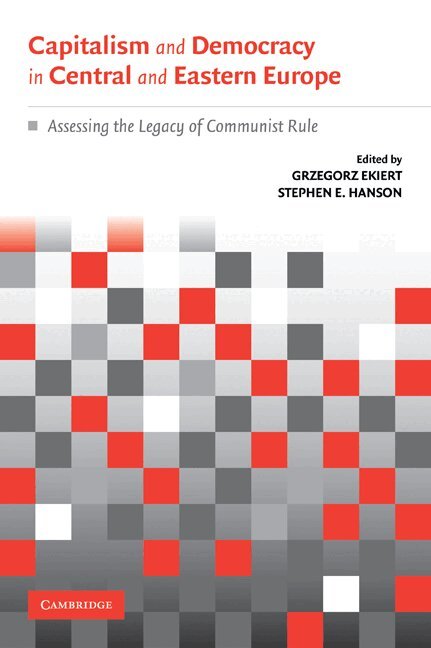
Capitalism and Democracy in Central and Eastern Europe
Assessing the Legacy of Communist Rule
Av Grzegorz Ekiert, Stephen E. Hanson
Häftad, 2003
569 kr
Lägg i varukorg
This volume presents a shared effort to apply a general historical-institutionalist approach to the problem of assessing institutional change in the wake of communism's collapse in Europe. It brings together a number of leading senior and junior scholars with outstanding reputations as specialists …
Capitalism and Democracy in Central and Eastern Europe
Assessing the Legacy of Communist Rule
Av Grzegorz Ekiert, Stephen E. Hanson
Inbunden, 2003
1400 kr
Lägg i varukorg
This volume presents a shared effort to apply a general historical-institutionalist approach to the problem of assessing institutional change in the wake of communism's collapse in Europe. It brings together a number of leading senior and junior scholars with outstanding reputations as specialists …
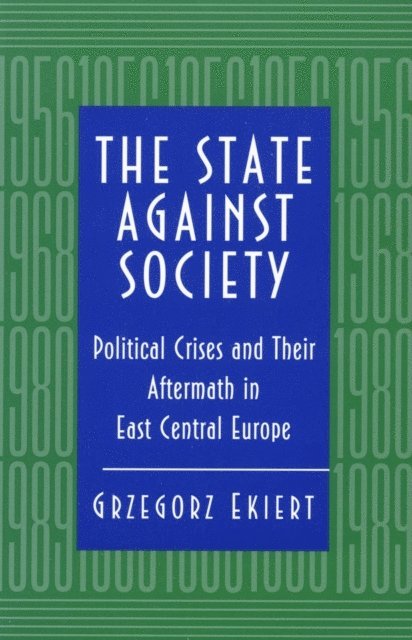
State against Society
Political Crises and Their Aftermath in East Central Europe
Häftad, 1996
677 kr
Lägg i varukorg
Classical images of state-socialism developed in contemporary social sciences were founded on simple presuppositions. State-socialist regimes were considered to be politically stable due to their pervasive institutional and ideological control over the everyday lives of their citizens, impervious …
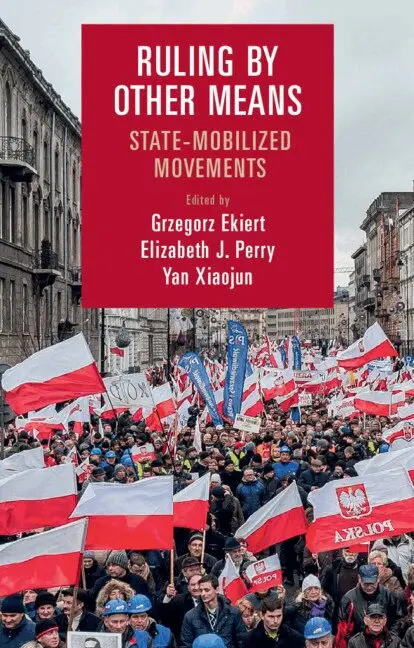
Ruling by Other Means
State-Mobilized Movements
Av Grzegorz Ekiert, Elizabeth J. Perry m. fl.
Inbunden, 2020
1563 kr
Lägg i varukorg
What do states gain by sending citizens into the streets? Ruling by Other Means investigates this question through the lens of State-Mobilized Movements (SMMs), an umbrella concept that includes a range of (often covertly organized) collective actions intended to advance state interests. The SMMs …
Ruling by Other Means
State-Mobilized Movements
Av Grzegorz Ekiert, Elizabeth J. Perry m. fl.
Häftad, 2020
569 kr
Lägg i varukorg
What do states gain by sending citizens into the streets? Ruling by Other Means investigates this question through the lens of State-Mobilized Movements (SMMs), an umbrella concept that includes a range of (often covertly organized) collective actions intended to advance state interests. The SMMs …
Ruling by Other Means
State-Mobilized Movements
Av Xiaojun Yan, Elizabeth J. Perry m. fl.
E-bok, 2020
555 kr
Lägg i varukorg
What do states gain by sending citizens into the streets? Ruling by Other Means investigates this question through the lens of State-Mobilized Movements (SMMs), an umbrella concept that includes a range of (often covertly organized) collective actions intended to advance state interests. The SMMs …
Ruling by Other Means
State-Mobilized Movements
Av Xiaojun Yan, Elizabeth J. Perry m. fl.
E-bok, 2020
555 kr
Lägg i varukorg
What do states gain by sending citizens into the streets? Ruling by Other Means investigates this question through the lens of State-Mobilized Movements (SMMs), an umbrella concept that includes a range of (often covertly organized) collective actions intended to advance state interests. The SMMs …
State against Society
Political Crises and Their Aftermath in East Central Europe
E-bok, 1996
927 kr
Lägg i varukorg
Classical images of state-socialism developed in contemporary social sciences were founded on simple presuppositions. State-socialist regimes were considered to be politically stable due to their pervasive institutional and ideological control over the everyday lives of their citizens, impervious …
Rebellious Civil Society
Popular Protest and Democratic Consolidation in Poland, 1989-1993
Inbunden, 1999
1266 kr
Tillfälligt slut
Poland is the only country in which popular protest and mass opposition, epitomized by the Solidarity movement, played a significant role in bringing down the communist regime. This book, the first comprehensive study of the politics of protest in postcommunist Central Europe, shows that organized …