Gudni G. Hardarson - Böcker
Visar alla böcker från författaren Gudni G. Hardarson. Handla med fri frakt och snabb leverans.
5 produkter
5 produkter
Molecular Microbial Ecology of the Soil
Results from an FAO/IAEA Co-ordinated Research Programme, 1992–1996
Inbunden, Engelska, 1999
1 064 kr
Skickas inom 10-15 vardagar
Grain legume crops, e.g. common bean (Phaseolus vulgaris L.), and soyabeans (Glycine max L.) are amongst the main sources of protein in Africa, Asia and Latin America. Their high protein content derive from their ability, in symbiosis with Rhizobium bacteria, to fix atmospheric nitrogen. Incorporating contributions from molecular biologists, microbiologists, plant breeders and soil scientists, this volume reports the results of an FAO/IAEA Co-ordinated Research Programme (1992-1996), whose main objective was to develop molecular biological methods to study rhizobial ecology. Use of better tracking methods will help enhance biological nitrogen fixation and thus grain legume yields, while reducing their reliance on soil- and/or fertilizer-nitrogen. This volume will be invaluable to scientists working on biological nitrogen fixation, soil microbial ecology and legume production.
Del 99 - Developments in Plant and Soil Sciences
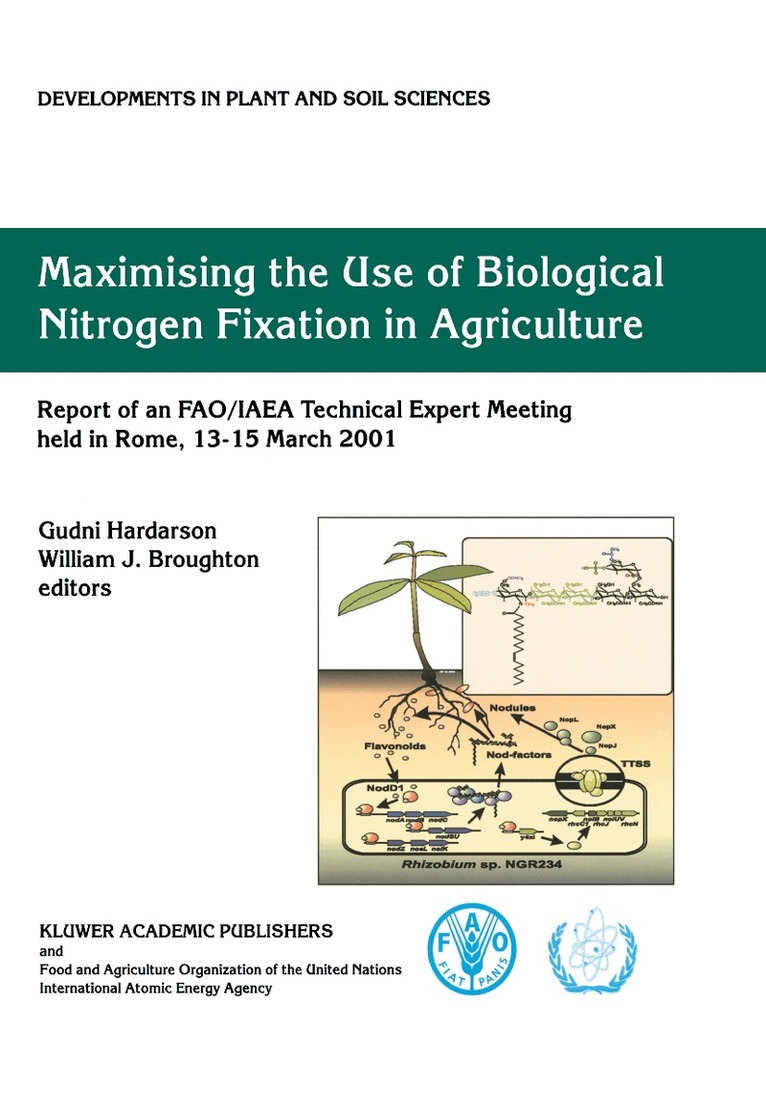
Maximising the Use of Biological Nitrogen Fixation in Agriculture
Inbunden, Engelska, 2003
1 593 kr
Skickas inom 10-15 vardagar
Incorporating contributions from microbiologists, molecular biologists, plant breeders and soil scientists this volume reports the results and recommendations of an FAO/IAEA meeting of twelve experts on biological nitrogen fixation. The text: reviews the latest thinking on various aspects of biological nitrogen fixation technology and applications; reviews the possibilities in enhancing nitrogen fixation in various cropping systems; shows ways how biological nitrogen fixation can be used to enhance crop production; considers the applicability of these technologies to small farmers in developing countries.
Molecular Microbial Ecology of the Soil
Results from an FAO/IAEA Co-ordinated Research Programme, 1992–1996
Häftad, Engelska, 2010
1 064 kr
Skickas inom 10-15 vardagar
Grain legume crops, e.g. common bean (Phaseolus vulgaris L.), and soyabeans (Glycine max L.) are amongst the main sources of protein in Africa, Asia and Latin America. Their high protein content derive from their ability, in symbiosis with Rhizobium bacteria, to fix atmospheric nitrogen. Incorporating contributions from molecular biologists, microbiologists, plant breeders and soil scientists, this volume reports the results of an FAO/IAEA Co-ordinated Research Programme (1992-1996), whose main objective was to develop molecular biological methods to study rhizobial ecology. Use of better tracking methods will help enhance biological nitrogen fixation and thus grain legume yields, while reducing their reliance on soil- and/or fertilizer-nitrogen. This volume will be invaluable to scientists working on biological nitrogen fixation, soil microbial ecology and legume production.
Enhancement of Biological Nitrogen Fixation of Common Bean in Latin America
Results from an FAO/IAEA Co-ordinated Research Programme, 1986–1991
Häftad, Engelska, 2012
1 064 kr
Skickas inom 10-15 vardagar
The common bean (Phaseolus vulgaris L.) is the most important pulse crop in Latin America, as well as in large parts of Asia and Africa. It is particularly important due to its ability, in symbiosis with Rhizobium bacteria, to fix atmospheric nitrogen and due to its high nutrient value.Incorporating contributions from plant breeders, microbiologists, plant physiologists and soil scientists, this volume reports the results of an FAO/IAEA Coordinated Research Programme (1985--1991), whose main objective was to enhance yield and biological nitrogen fixation in common bean by reducing its reliance on soil and fertilizer nitrogen.The volume will be invaluable to scientists working on biological nitrogen fixation and legume production.
Breeding Legumes for Enhanced Symbiotic Nitrogen Fixation
Proceedings of an FAO/IAEA Consultants' Meeting, held in Vienna, 26–30 September 1983
Häftad, Engelska, 2011
536 kr
Skickas inom 10-15 vardagar
Adequate nitrogen fertilization is needed to obtain maximum crop yields. Without sufficient nitrogen available to the plant, other inputs are wasted. There are great differences between developed and develop ing areas of the world with regard to nitrogen-fertilizer production and application, resulting in serious food deficits in some of the most needy areas. Although nitrogen fertilizer is an inexpensive input in comparison to the resulting yield increases, chemical fertilizers must be purchased and do represent a direct cash outlay, sometimes the only cash require ment for the peasant farmer, often an insurmountable obstacle in subsistence farming situations. If present economic trends continue, poor farmers may find it increasingly more difficult to pay for nitrogen fertilizers. Biological nitrogen fixation offers the most promising alternative or supplement to chemical nitrogen fertilizers. Furthermore, nitrogen fixation does not present any hazard to the environment which may be the case with excessive application of chemical nitrogen fertilizers. It is there fore of utmost importance to promote the use of nitrogen fixing crops, especially grain legumes which are also an important source of dietary protein. Although legumes only account for some 9% of the combined world dry matter yield of cereals and legumes, they con stitute as much as 24% of the total protein yield of these crops because of the high protein content in legumes.