Gunther Grewendorf – författare
Visar alla böcker från författaren Gunther Grewendorf. Handla med fri frakt och snabb leverans.
27 produkter
Remnant Movement
E-bok, 2015
1865 kr
Lägg i varukorg
This book addresses two crucial problems associated with the phenomenon of Remnant Movement: First, what evidence can be brought to bear in favor of, or opposing, Remnant Movement analyses of linguistic phenomena? Secondly, what does the presence or absence of Remnant Movement in the syntax tell us …
Discourse and Grammar
From Sentence Types to Lexical Categories
Av Thomas Ede Zimmermann, Gunther Grewendorf
E-bok, 2012
2416 kr
Lägg i varukorg
Bringing together papers from various subfields of theoretical linguistics, this volume gives a representative glimpse of current research on form and function in grammar. Its overarching topic is as old as it is hot: the relation between the major clause types as determined in syntax, and their …
Discourse and Grammar
From Sentence Types to Lexical Categories
Av Günther Grewendorf, Thomas Ede Zimmermann
Inbunden, 2012
2390 kr
Lägg i varukorg
Bringing together papers from various subfields of theoretical linguistics, this volume gives a representative glimpse of current research on form and function in grammar. Its overarching topic is as old as it is hot: the relation between the major clause types as determined in syntax, and their …
Remnant Movement
E-bok, 2015
1865 kr
Lägg i varukorg
This book addresses two crucial problems associated with the phenomenon of Remnant Movement: First, what evidence can be brought to bear in favor of, or opposing, Remnant Movement analyses of linguistic phenomena? Secondly, what does the presence or absence of Remnant Movement in the syntax tell us …
Remnant Movement
Inbunden, 2015
1844 kr
Lägg i varukorg
This book addresses two crucial problems associated with the phenomenon of Remnant Movement: First, what evidence can be brought to bear in favor of, or opposing, Remnant Movement analyses of linguistic phenomena? Secondly, what does the presence or absence of Remnant Movement in the syntax tell us …
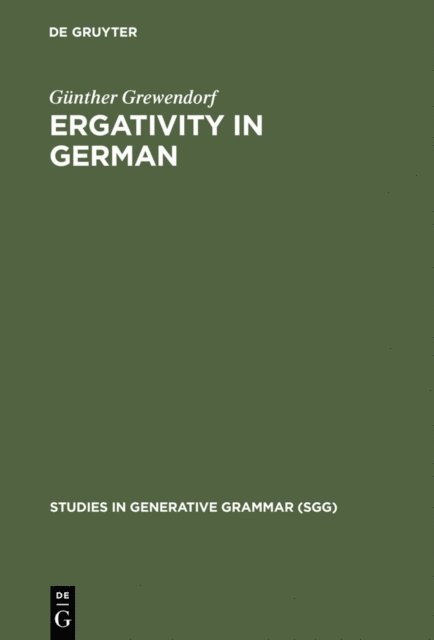
Ergativity in German
Inbunden, 1989
1266 kr
Lägg i varukorg
No detailed description available for "Ergativity in German".
Formal Linguistics and Law
Av Günther Grewendorf, Monika Rathert
Inbunden, 2009
2135 kr
Lägg i varukorg
This volume explores new interfaces between linguistics and jurisprudence. Its theoretical and methodological importance lies in showing that many questions asked within the field of language and law receive satisfactory answers from formal linguistics.The book starts with a paper by the two …
Formal Linguistics and Law
Av Monika Rathert, Gunther Grewendorf
E-bok, 2009
2158 kr
Lägg i varukorg
This volume explores new interfaces between linguistics and jurisprudence. Its theoretical and methodological importance lies in showing that many questions asked within the field of language and law receive satisfactory answers from formal linguistics. The book starts with a paper by the two …
Ergativity in German
E-bok, 2012
1516 kr
Lägg i varukorg
No detailed description available for "e;Ergativity in German"e;.
Linguistische Berichte Heft 285
Av Arnim von Stechow, Gunther Grewendorf m. fl.
E-bok, 2026
761 kr
Lägg i varukorg
Beiträge aus Forschung und Anwendung– Linda Stark: Künstliche Intelligenz und Kommasetzung: Wie normkonform interpungieren KI-basierte Programme?Abstract: The use of commas in German is an orthographic area in which deviations from the official standard and variants are frequently observed. They …
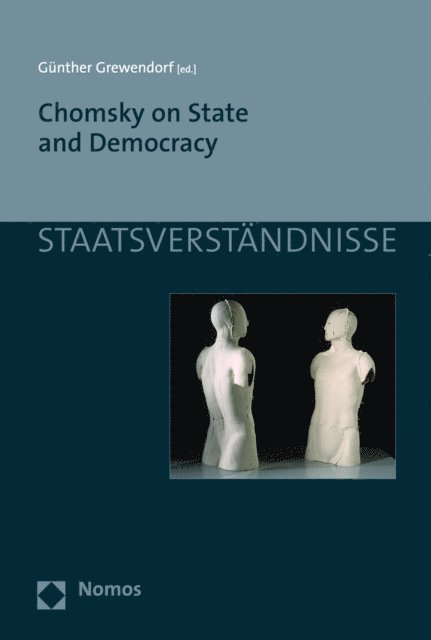
Chomsky on State and Democracy
E-bok, 2021
563 kr
Lägg i varukorg
Noam Chomsky, der laut New York Times bedeutendste Intellektuelle der Gegenwart, hat nicht nur die Wissenschaft von der Sprache und die Theorie des menschlichen Geistes revolutioniert; seine Annahmen über die Natur des Menschen haben ihn zu vehementen Plädoyers für Freiheit und Demokratie …
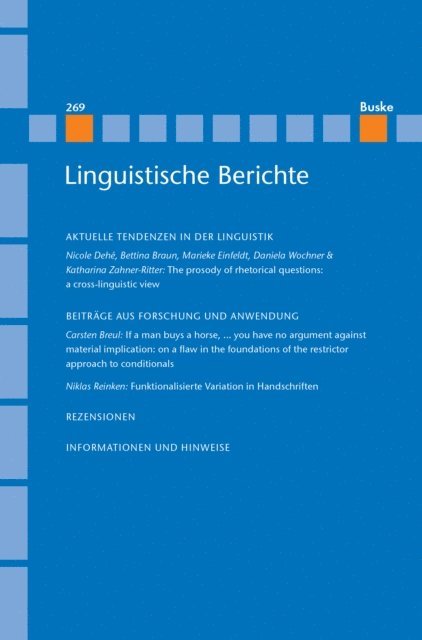
Linguistische Berichte Heft 269
Av Markus Steinbach, Arnim von Stechow m. fl.
E-bok, 2022
735 kr
Lägg i varukorg
AbstractsDehé, Nicole, Braun, Bettina, Einfeldt, Marieke, Wochner, Daniela, Zahner-Ritter, Katharina: The prosody of rhetorical questions: a cross-linguistic view.This paper provides a survey of our knowledge of the prosody of rhetorical questions, i.e. questions that do not require an answer and …
Linguistische Berichte Heft 270
Av Markus Steinbach, Arnim von Stechow m. fl.
E-bok, 2022
735 kr
Lägg i varukorg
Beiträge aus Forschung und Anwendung:– Dennis Wegner, Marcel Schlechtweg & Holden Härtl: Optionality and the recovery of temporal information in German verb clusters.Abstract: While the clause-final placement of finite elements is usually quite rigid in German embedded clauses, verbal clusters mark …
Linguistische Berichte Heft 271
Av Markus Steinbach, Arnim von Stechow m. fl.
E-bok, 2022
708 kr
Lägg i varukorg
Beiträge aus Forschung und Anwendung– Jürg Fleischer: "Qualität hat seinen Preis Preis": Genus-insensitives ''sein'' im Gegenwartsdeutschen.Abstract: The German possessive ''sein'' is usually classified as a pronoun of the 3rd person singular masculine and neuter. However, in the grammatical …
Linguistische Berichte Heft 272
Av Markus Steinbach, Arnim von Stechow m. fl.
E-bok, 2022
708 kr
Lägg i varukorg
Beiträge aus Forschung und Anwendung– Jörg Meibauer: Konzepte des unwahrhaftigen Implikatierens – Realistisches Lügenkonzept und die Verpflichtung auf die Wahrheit konversationeller Implikaturen.Abstract: A realistic concept of lying is one that comprises the levels of semantics and pragmatics, …
Linguistische Berichte Heft 273
Av Arnim von Stechow, Gunther Grewendorf m. fl.
E-bok, 2023
708 kr
Lägg i varukorg
Vorwort der RedaktionBeiträge aus Forschung und Anwendung– Ewa Trutkowski & Helmut Weiß: Zeugen gesucht! Zur Geschichte des generischen Maskulinums im Deutschen.Abstract: On the basis of synchronic and diachronic data, we argue that in the human domain German masculine nouns commonly display a …
Linguistische Berichte Heft 274
Av Arnim von Stechow, Gunther Grewendorf m. fl.
E-bok, 2023
735 kr
Lägg i varukorg
Beiträge aus Forschung und Anwendung– Emanuela Sanfelici: On the strength of D0: case resolution phenomena in free relative clausesAbstract: This paper proposes a novel account of free relative clauses (RCs), which associates case resolution patterns to the typology of D0 heads à la Longobardi …
Linguistische Berichte Heft 275
Av Arnim von Stechow, Gunther Grewendorf m. fl.
E-bok, 2023
735 kr
Lägg i varukorg
Aktuelle Tendenzen in der Linguistik– Fabian Bross: Zur Syntax der Negation im DeutschenAbstract: The goal of the present article is a syntactic description of different types of negation in German. To be more precise, this article deals with sentential negation, constituent negation, and two types …
Linguistische Berichte Heft 276
Av Arnim von Stechow, Gunther Grewendorf m. fl.
E-bok, 2023
708 kr
Lägg i varukorg
Beiträge aus Forschung und Anwendung– Nanna Fuhrhop, Niklas Reinken & Jonas Romstadt: Der ''modalisierende'' Gebrauch von Anführungszeichen in AbiturklausurenAbstract: Quotation marks are substantially used for direct speech and citations. For the ''modalizing'' use, the Official Rules state that a …
Linguistische Berichte Heft 277
Av Arnim von Stechow, Gunther Grewendorf m. fl.
E-bok, 2024
787 kr
Lägg i varukorg
Beiträge aus Forschung und Anwendung– Milena Belosevic: Die Semantik ereignisbasierter Personennamenkomposita im DeutschenAbstract: The paper aims to account for the semantic properties of eventive personal name compounds in German (e.g. Brezel-Bush/Pretzel-Bush). These are compounds where the …
Linguistische Berichte Heft 278
Av Arnim von Stechow, Gunther Grewendorf m. fl.
E-bok, 2024
787 kr
Lägg i varukorg
Beiträge aus Forschung und Anwendung– Daniel Gutzmann & Katharina Turgay: Expressive Interpunktion!?! Interpunktion zwischen Grammatik (?) und Pragmatik!Abstract: Whereas the use of most punctuation marks is thought to be governed by grammatical rules, some punctuation marks can be used in a more …
Linguistische Berichte Heft 279
Av Arnim von Stechow, Gunther Grewendorf m. fl.
E-bok, 2024
787 kr
Lägg i varukorg
Beiträge aus Forschung und Anwendung– Lena Stutz: ''Wo ein Sprichwort ist, ist auch ein Muster.'' Korpusbasierte Studien zur Produktivität und Schematizität deutscher Sprichwortmuster.Abstract: This article focuses a certain type of phraseological construction that has only been marginally …
Linguistische Berichte Heft 280
Av Arnim von Stechow, Gunther Grewendorf m. fl.
E-bok, 2024
744 kr
Lägg i varukorg
Beiträge aus Forschung und Anwendung- Zeming Xu: Asymmetric conjunction and the semantics-pragmatics interface- Susann Fischer, Jorge Vega Vilanova, Bistra Andreeva, Tania Avgustinova, Christoph Gabriel, Jonas Grünke, Diana Klüh & Mitko Sabev: Patterns and interfaces in language contact: the case …
Linguistische Berichte Heft 282
Av Arnim von Stechow, Gunther Grewendorf m. fl.
E-bok, 2025
787 kr
Lägg i varukorg
Beiträge aus Forschung und Anwendung – Miriam Brinkmann, Antonia Fünter, Laura d''Aurizio & Natascha Müller: Die Repräsentation von Genus im Französischen: Psycholinguistische Evidenz für ein dreigliedriges System Abstract: Previous studies generally considered grammatical gender in French as a …
Linguistische Berichte Heft 283
Av Arnim von Stechow, Gunther Grewendorf m. fl.
E-bok, 2025
787 kr
Lägg i varukorg
Vorwort – Felicitas Otte, Markus Steinbach & Nina-Kristin Meister: Auf dem Weg zur digitalen Barrierefreiheit in den Linguistischen Berichten: Errungenschaften und Ziele Aktuelle Tendenzen in der Linguistik – Silva H. Ladewig: Aktuelle Trends und Entwicklungen in der linguistischen Gesten- und …
Linguistische Berichte Heft 284
Av Arnim von Stechow, Gunther Grewendorf m. fl.
E-bok, 2025
787 kr
Lägg i varukorg
Beiträge aus Forschung und Anwendung – Patrizio Malloggi: Untypische Präpositionen des Deutschen: bis, von, ab, seit Abstract: This article examines the question of whether bis, ab, von and, seit should be regarded as atypical prepositions. The investigation is based on the nature of their …