E-bok, Tyska, 2024
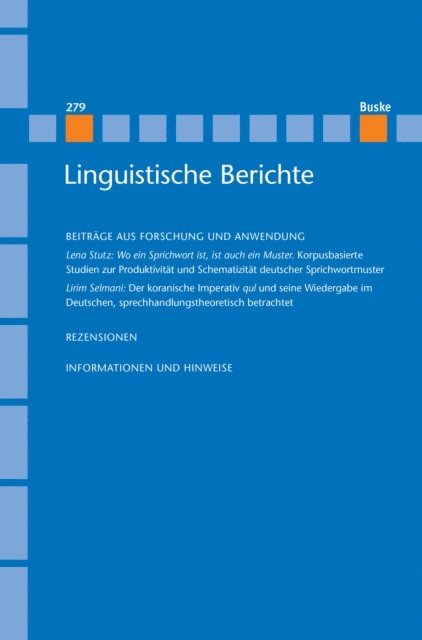
Linguistische Berichte Heft 279
Av Arnim von Stechow, Gunther Grewendorf, Nina-Kristin Meister, Markus Steinbach
787 kr
Läs direkt i Bokus Reader – eller ladda ned till din enhet (PDF kräver ofta zoom och scroll på små skärmar).
Beskrivning
Beiträge aus Forschung und Anwendung– Lena Stutz: ''Wo ein Sprichwort ist, ist auch ein Muster.'' Korpusbasierte Studien zur Produktivität und Schematizität deutscher Sprichwortmuster.Abstract: This article focuses a certain type of phraseological construction that has only been marginally investigated in phraseological research so far: productive, partially schematic units that go back to lexically fully specified phrasemes that, due to the popularity of the modification of certain positions, have developed over time into phrasemes with conceptual slot positions that require a separate cognitive anchoring, i. e. constitute an independent lexicon entry.On the basis of an exemplary selection of German proverbs like ''Ein Unglück kommt selten allein'' (lit. ''A misfortune never comes alone'') that are taken from the "Sprichwörterbuch" of the IDS-dictionary platform OWID (vgl. SWB), it will be shown that through serially and systematically operated modification processes, proverbs have even created a considerable amount of semi-schematic patterns that are used more or less productively. With recourse to Stumpf''s (2016) distinction between modification patterns ("Modifikationsmuster") and phraseological schemata ("Modellbildungen") it will be argued, on empirical grounds, that said patterns underly different degrees of productivity and schematicity in that some of them represent only ''modification series'' of the lexically specified proverb base (and thus are located as a phenomenon on the parole level) and others constitute ''true'' phraseological constructions with an intrinsic vacancy structure that expand the lexicon (and therefore have the status of a system-level phenomenon). The central method used here are ''slot analyses'', carried out by the corpus linguistic tool ''Lexpan'' (Steyer & Brunner 2014), which allows for the differentiation of modified and schematic phrasemes on the basis of certain frequency values. In addition, ''timeline graphs'' (Lüngen & Keibel 2014) are used, which can be particularly useful in classifying transition phenomena by visualizing the annual development of modifications over the last decades.– Lirim Selmani: Der koranische Imperativ ''qul'' und seine Wiedergabe im Deutschen, sprechhandlungstheoretisch betrachtet.Abstract: In the Qoran, commands are commonly used by the devine speaker to address Mohammed and further addressees. The imperative mode is used frequently, especially the imperative "say!" (''qul''). The imperative is a linguistic devise which is specific to discourses. Hence it will be argued that the Qoran is a discourse rather than a text in the proper sense. The ''qul''-speech is closely related to the unwillingness of the addressees who do not believe in the prophethood of Mohammed. In German there are three lexicalized verbs for Arabic ''qul'': ''sagen'', ''sprechen'', ''reden''. These verbs differ semantically form each other: ''sagen'' puts the focus on the addressee, ''sprechen'' puts the focus on the proposition, and ''reden'' indicates a bidirectional communication. It will be shown how the Qoranic imperative ''qul'' is translated into German.Rezensionen– Harro Stammerjohann: Raffaele Simone (2020): ''Il software del linguaggio'' & Raffaele Simone (2022): ''La grammatica presa sul serio. Come è nata, come funziona e come cambia''.– Cornelia Loos: Josep Quer, Annika Herrmann, Roland Pfau (2020): ''The Routledge handbook of theoretical and experimental sign language research''.– Vilma Symanczyk Joppe: Sonja Taigel (2021): ''Ikonizität''.Informationen und Hinweisevon Klaus Müllner und den Herausgeber*innen
Produktinformation
- Utgivningsdatum: 2024-08-28
- Språk: Tyska
- Filformat: PDF
- Kopieringsskydd: LCP
- ISBN: 9783967693997
- Förlag: Helmut Buske Verlag GmbH
Utforska kategorier
Betyg & recensioner
0 recensioner
Inga recensioner tillgängliga.