G.W.F. Hegel – författare
Visar alla böcker från författaren G.W.F. Hegel. Handla med fri frakt och snabb leverans.
19 produkter
Lectures on the Philosophy of Spirit 1827-8
Av G.W.F. Hegel, Robert R. Williams
Inbunden, 2007
2810 kr
Lägg i varukorg
The Hegel Lectures SeriesSeries Editor: Peter C. Hodgson Hegel's lectures have had as great a historical impact as the works he himself published. Important elements of his system are elaborated only in the lectures, especially those given in Berlin during the last decade of his life. The original …
Hegel's Philosophy of Nature
Volume III
Inbunden, 2002
4594 kr
Lägg i varukorg
This is Volume III of Hegel's philosophy of nature, which is part of a wider collection of seven volumes on Hegel. Originally published in 1970, this text looks at Organic Physics.
Hegel's Philosophy of Nature
Volume III
Häftad, 2010
750 kr
Lägg i varukorg
This is Volume III of Hegel's philosophy of nature, which is part of a wider collection of seven volumes on Hegel. Originally published in 1970, this text looks at Organic Physics.
Jena System, 1804-5
Logic and Metaphysics
Av George Di Giovanni, John W. Burbidge m. fl.
E-bok, 1986
1041 kr
Lägg i varukorg
As he worked on the Jena sytem, Hegel''s understanding of the nature of logic and its connection with metaphysics underwent changes crucial to his later system. As a result, logic acquired a new and expanded significance for him. This text is thus the key to an understanding of the works of …
Hegel: Faith and Knowledge
An English translation of G. W. F. Hegel's Glauben und Wissen
Av G.W.F. Hegel
Häftad, 1988
619 kr
Lägg i varukorg
As the title indicates, Faith and Knowledge deals with the relation between religious faith and cognitive beliefs, between the truth of religion and the truths of philosophy and science. Hegel is guided by his understanding of the historical situation: the individual alienated from God, nature, and …
Difference Between Fichte's and Schelling's System of Philosophy
An English Translation of G. W. F. Hegel's Differenz des Fichte'schen und Schelling'schen Systems der Philosophie
Av G.W.F. Hegel
Häftad, 1988
463 kr
Lägg i varukorg
In this essay, Hegel attempted to show how Fichte's Science of Knowledge was an advance from the position of Kant in the Critique of Pure Reason, and how Schelling (and incidentally Hegel himself) had made a further advance from the position of Fichte.In this essay, Hegel attempted to show how …
Hegel's Philosophy of Nature
Volume III
E-bok, 2014
864 kr
Lägg i varukorg
This is Volume III of Hegel''s philosophy of nature, which is part of a wider collection of seven volumes on Hegel. Originally published in 1970, this text looks at Organic Physics.
Hegel's Philosophy of Nature
Volume III
E-bok, 2014
883 kr
Lägg i varukorg
This is Volume III of Hegel''s philosophy of nature, which is part of a wider collection of seven volumes on Hegel. Originally published in 1970, this text looks at Organic Physics.
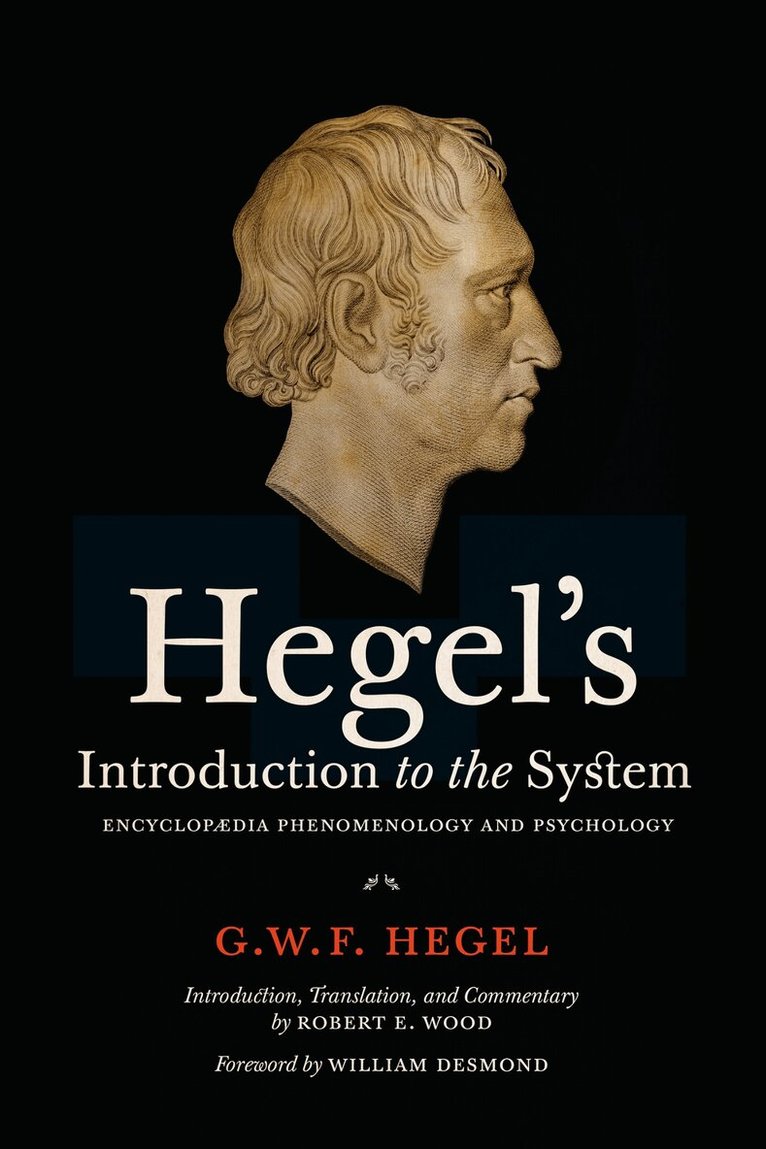
Hegel's Introduction to the System
Encyclopaedia Phenomenology and Psychology
Av G.W.F. Hegel
E-bok, 2014
415 kr
Lägg i varukorg
As an introduction to his own notoriously complex and challenging philosophy, Hegel recommended the sections on phenomenology and psychology from The Philosophy of Spirit, the third part of his Encyclopaedia of the Philosophic Sciences. These offered the best introduction to his philosophic system, …
Hegel's Introduction to the System
Encyclopaedia Phenomenology and Psychology
Av G.W.F. Hegel
E-bok, 2014
424 kr
Lägg i varukorg
As an introduction to his own notoriously complex and challenging philosophy, Hegel recommended the sections on phenomenology and psychology from The Philosophy of Spirit, the third part of his Encyclopaedia of the Philosophic Sciences. These offered the best introduction to his philosophic system, …
Hegel's Introduction to the System
Encyclopaedia Phenomenology and Psychology
Av G.W.F. Hegel
Häftad, 2014
343 kr
Lägg i varukorg
As an introduction to his own notoriously complex and challenging philosophy, Hegel recommended the sections on phenomenology and psychology from The Philosophy of Spirit, the third part of his Encyclopaedia of the Philosophic Sciences. These offered the best introduction to his philosophic system, …
Lectures on the Philosophy of Right, 1819-1820
Av G.W.F. Hegel
Inbunden, 2023
1102 kr
Lägg i varukorg
Published in 1821, Outlines of the Philosophy of Right is considered the definitive articulation of the legal, moral, social, and political philosophy of G.W.F. Hegel. However, shortly before its publication, Hegel delivered a series of lectures on the subject matter of the work at the University …
Lectures on the Philosophy of Right, 1819–1820
Av G.W.F. Hegel
E-bok, 2023
1005 kr
Lägg i varukorg
Published in 1821, Outlines of the Philosophy of Right is considered the definitive articulation of the legal, moral, social, and political philosophy of G.W.F. Hegel. However, shortly before its publication, Hegel delivered a series of lectures on the subject matter of the work at the University …
Lectures on the Philosophy of Right, 1819–1820
Av G.W.F. Hegel
E-bok, 2023
1027 kr
Lägg i varukorg
Published in 1821, Outlines of the Philosophy of Right is considered the definitive articulation of the legal, moral, social, and political philosophy of G.W.F. Hegel. However, shortly before its publication, Hegel delivered a series of lectures on the subject matter of the work at the University …
G. W. F. Hegel: Phänomenologie Des Geistes
Av G.W.F. Hegel, Otto Pöggeler m. fl.
Inbunden, 2006
336 kr
Lägg i varukorg
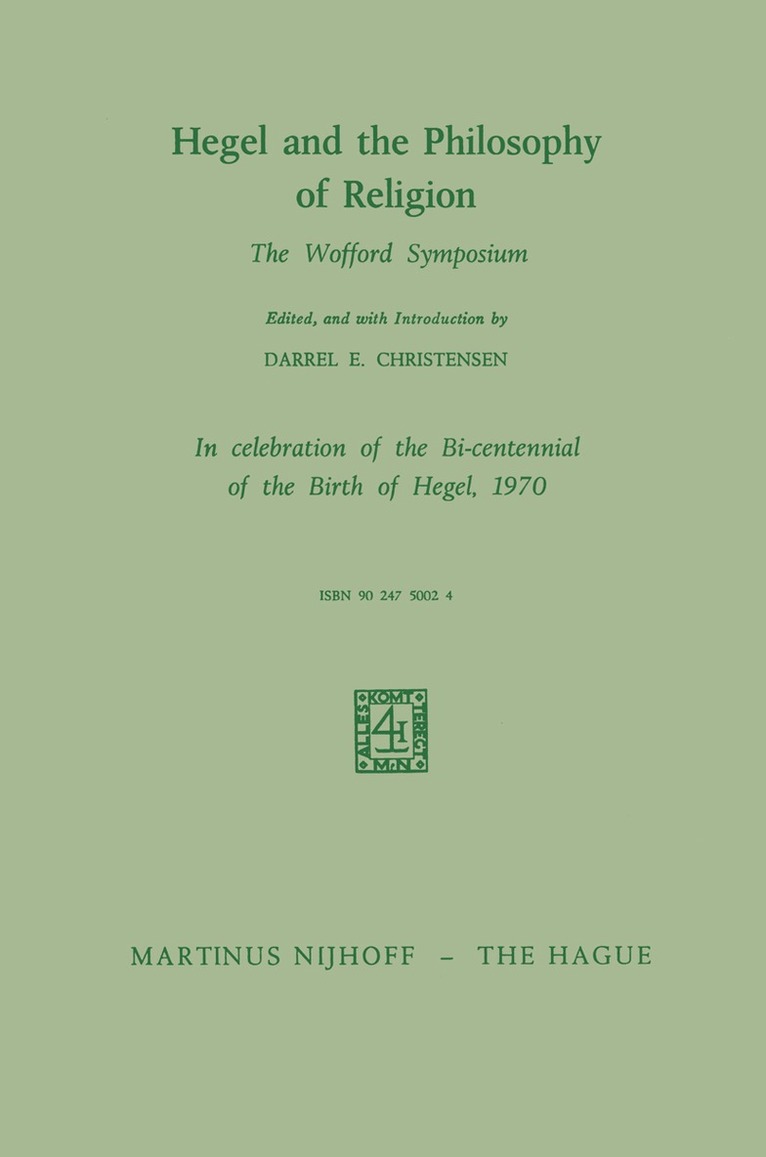
Hegel and the Philosophy of Religion
The Wofford Symposium
Av Darrel E. Christensen, Darrel E. Christensen m. fl.
Häftad, 1970
552 kr
Lägg i varukorg
THE WOFFORD SYMPOSIUM: ITs PURPOSE, GENESIS, AND THEME The purpose of The Wofford Symposium was to stimulate original scholarship on the theme of the meeting, to provide a forum in philosophy of high quality in the area which Wofford College principally serves, and to make available for publication …
Hegel and the Philosophy of Religion
The Wofford Symposium
Av Darrel E. Christensen, G.W.F. Hegel m. fl.
E-bok, 2012
734 kr
Lägg i varukorg
THE WOFFORD SYMPOSIUM: ITs PURPOSE, GENESIS, AND THEME The purpose of The Wofford Symposium was to stimulate original scholarship on the theme of the meeting, to provide a forum in philosophy of high quality in the area which Wofford College principally serves, and to make available for publication …