H. Hartmann - Böcker
Visar alla böcker från författaren H. Hartmann. Handla med fri frakt och snabb leverans.
3 produkter
3 produkter
534 kr
Skickas inom 10-15 vardagar
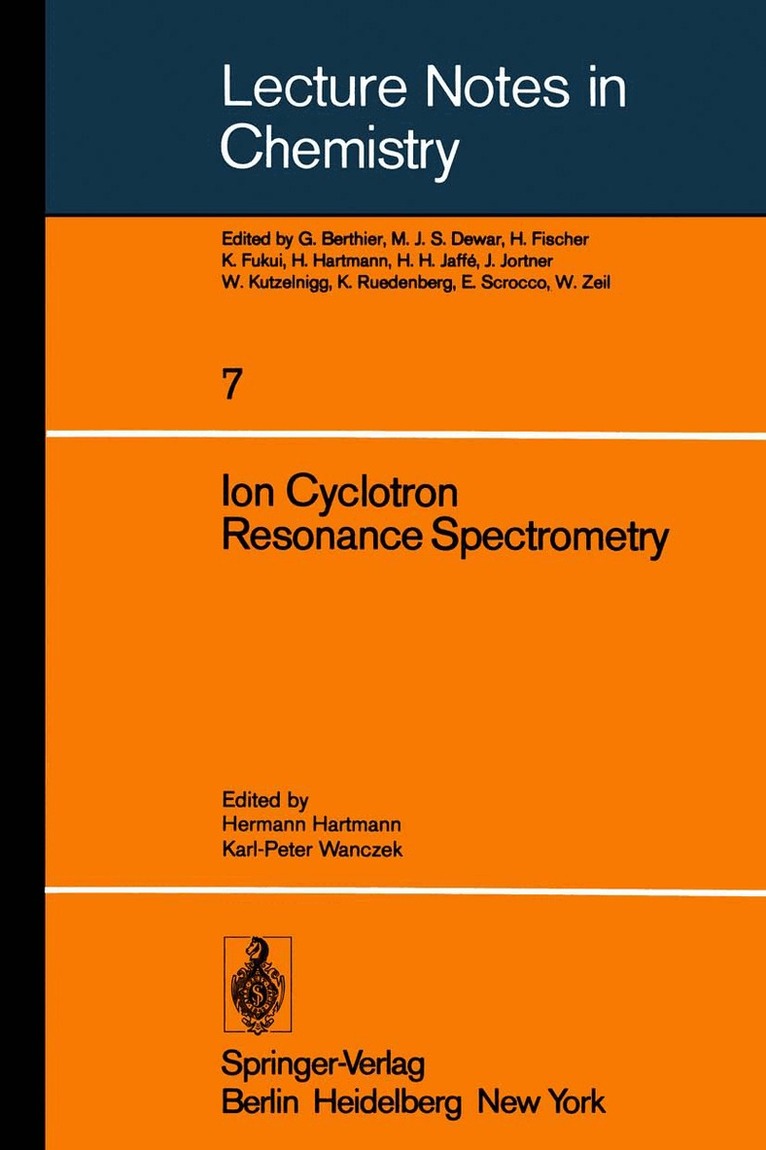
In this volume, for the first time, a dozen of papers is collected dealing with almost all important aspects of ion cyclotron resonance spectrometry. The ICR technique was developed very rapidly in the last two decades. It seems to the editors that the method is now established well enough to dedicate a progress report to it. This report is devided into three parts: The first articles pre- sent new developments in the theory of ICR spectrometry. They are fol~ lowed by papers on r.ecent developments of the experimental technique. About half of the volume is dedicated to applications of ICR spectrome- try to reactivity, reaction mechanism and structure in the chemistry of thermal ions. The editors are indebted to Mrs. A. Tin for typewrfting most of the manuscript and to Mrs. E. Jacke for reproduction of Figures appearing in the volume. Hermann Hartmann, Akademie der Wissenschaften und der Literatur Mainz Karl-Peter Wanczek Institut fur physikalische Chemie Universitat, Frankfurt/Main Contents Line Shapes in Ion Cyclotron Resonance Spectra A. H. Huizer and W. J. van der Hart 1 Quantum Mechanical Description of Collision- Dominated Ion Cyclotron Resonance H. Hartmann and K.-M.Chung 17 Improvement of the Electric Potential in the Ion Cyclotron Resonance Cell J. Urakawa, H. Shibata and M. Inoue 33 Thermodynamic Information from Ion-Molecule Equilibrium Constant Determinations S. G. Lias 59 Pulsed Ion Cyclotron Resonance Studies with a One-Region Trapped Ion Analyzer Cell R. T. McIver, Jr.
534 kr
Skickas inom 10-15 vardagar
In this volume 28 papers are presented. They cover all the fields studied with ion cyclotron resonance today, including reviews on important fields as well as short contributions on special topics. This report is devided into four parts: 1. Detailed studies on simple molecules, 2. Systematic studies of the ion chemistry, 3. Spectrometer development and 4. Theory. The plan to edit a progress report of the complete field was projected at the 2nd International Symposium on Ion Cyclotron Resonance Spectrometry, held at the Akademie der Wissenschaften und der Literatur, Mainz, March, 1981. Most of the contributions were written in late 1981 or in 1982. Hermann Hartmann Akademie der Wissenschaften und der Literatur Mainz Karl-Peter Wanczek Institut fUrphysikalische und theoretische Chemie Universitat, Frankfurt Acknowledgements The editors gratefully acknowledge support of the Symposium by the Stiftung Volkswagenwerk and the Fonds der Chemischen Industrie. The editors want to take the opportunity to thank H. Otten, President, Akademie der Wissenschaften und der Literatur, for the hospitality all the participants of the Symposium enjoyed.IV Delegates attending the 2nd International Symposium on Ion Cyclotron Reso- nance Spectrometry, Akademie der Wissenschaften und der Literatur, Mainz (numbers refer to the photograph) 26. D. Parent 1. M. B. Comisarow 2. 27. R. T. McIver, Jr.
Del 12 - Reactivity and Structure: Concepts in Organic Chemistry
Light Absorption of Organic Colorants
Theoretical Treatment and Empirical Rules
Häftad, Engelska, 2012
534 kr
Skickas inom 10-15 vardagar
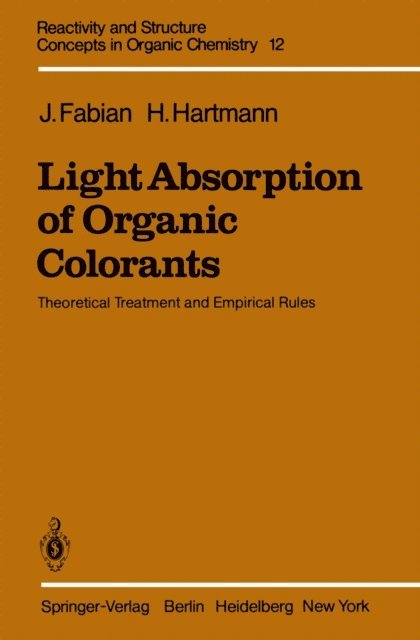
Although studies on synthetic dyes have been performed for more than 100 years, their detailed elucidation requires further extensive research. The discovery of novel high polymers, the necessity of supplying a whole range of shades and increasing require ments for dyestuffs of high fastness properties give rise to a permanent search for new dyes. Extensive investigations on dyes were also occasioned by various applications in the field of spectral sensitization and of staining of biological specimens. Another more recent development concerns the lasing properties of some organic dyes. Most of the progress, however, was only achieved by time-consuming, purely empirical approaches and theoretical understanding of the dye properties is only at its very beginnings. The color is the sine qua non of every dye. For this reason organic chemists and color chemists have looked for relations between the "color and constitution" of dye molecules for a long time. This knowlege as a whole is known as "theory of color". The classic theory of color was established abou t 100 years ago by Witt and was signi ficantly extended 50 years later by W. Konig.