H. Stuart Hughes - Böcker
Visar alla böcker från författaren H. Stuart Hughes. Handla med fri frakt och snabb leverans.
6 produkter
6 produkter
267 kr
Skickas inom 7-10 vardagar
"Professor Hughes offers an earnest warning: 'Unless there is some emotional tie, some elective affinity linking the student to his subject of study, the results will be pedantic and perfunctory.' In other words, it is only a step from the sublime to the meticulous. Those eager to guard against that sad descent will find History as Art and as Science a guide, a tonic, and an inspiration. Its short, electrifying essays are so magnificently sane and persuasive they should be required reading for every student who contemplates a major in history."—Geoffrey Bruun, Saturday Review
733 kr
Skickas inom 10-15 vardagar
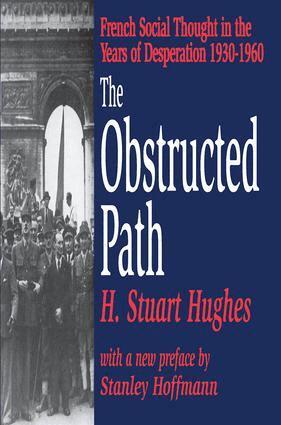
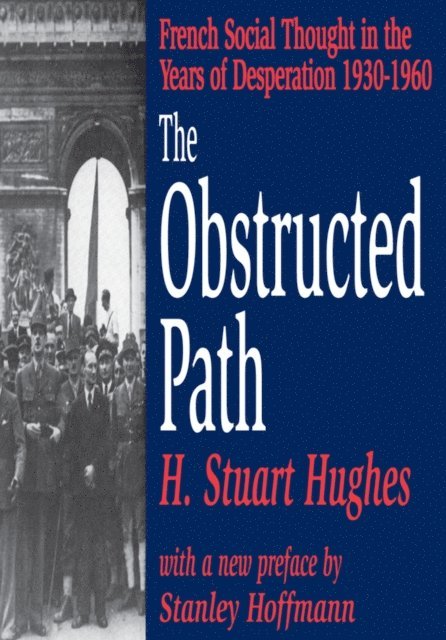
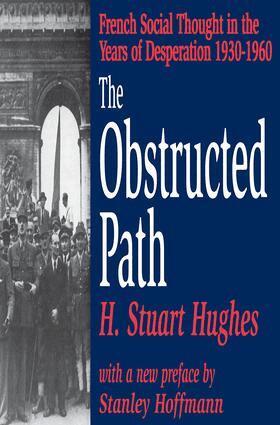
The years of political and social despair in France-from the great depression through the Nazi occupation, Resistance, and liberation, to the Algerian War-forced French intellectuals to rethink the values of their culture. Their faltering attempts to break out of a psychological impasse are the subject of this thoughtful and compassionate book by a distinguished American historian. In this first treatment of contemporary French thought to bridge philosophy, literature, and social science and to show its relation to comparable thinking in Germany, Britain, and the United States. Hughes also assesses the work of other writers in terms of their emotional biography and role in society.Hughes found those who struggled to find meaning and purpose amid chaos to be among the most brilliant minds of their century. They included the social historians Bloch and Febvre; the Catholic philosophers Maritain and Marcel; the proponents of heroism Martin du Gard, Bernanos, Saint-Exupery, Malraux, and DeGaulle; and the phenomenologists Sartre and Merleau-Ponty. They also included the strangely assorted trio of Camus, Teilhard de Chardin, and Levi-Strauss, who showed the way to a wider cultural community. Yet in nearly every case these scholars achieved something quite different from what they set out to do. For this self-questioning generation, the interchange between history and anthropology became most compelling and of greatest interest to the world outside.The Obstructed Path blends H. Stuart Hughes' concern for the many ways in which historians define and practice their craft, his lifelong interest in literature, his fascination with the influence of Marx and Freud, and his empathy with the varieties of Christian thought. It also demonstrates his delicate grasp of singular personalities such as Bernanos, Merleau-Ponty, Jean-Paul Sartre and Levi-Strauss. His profound insight into the flaws of many elaborate philosophical constructions, and into the core of deep emotions, bold images, and searing passions that were often hidden in them, bring us close to these thinkers and makes this an enduring work.
691 kr
Skickas inom 10-15 vardagar
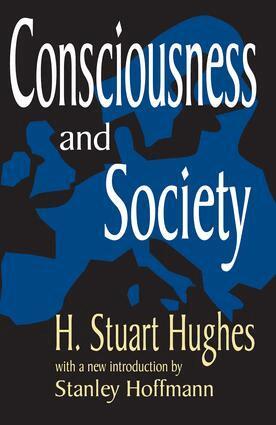
Hughes' ideas, and the way they are expressed in Consciousness and Society, have become paradigms of twentieth-century scholarship. In dealing with the changing social thought after 1890 in Europe, Hughes covers a wide array of thinkers and issues in a scholarly, yet graceful manner. His is a study of the "cluster of genius" of Europe at that time: Croce, Durkheim, Freud, Weber, and Nietzsche, as well as other great European minds. The book explores questions that are still relevant in today's society: Is the separation of facts and values tenable, or even desirable? Can rationality accommodate the ideas of a Bergson or a Freud? Is there, or should there be, a relationship between science and religion? And does history have any ultimate meaning for later generations?
2 712 kr
Skickas inom 3-6 vardagar
Hughes' ideas, and the way they are expressed in Consciousness and Society, have become paradigms of twentieth-century scholarship. In dealing with the changing social thought after 1890 in Europe, Hughes covers a wide array of thinkers and issues in a scholarly, yet graceful manner. His is a study of the "cluster of genius" of Europe at that time: Croce, Durkheim, Freud, Weber, and Nietzsche, as well as other great European minds. The book explores questions that are still relevant in today's society: Is the separation of facts and values tenable, or even desirable? Can rationality accommodate the ideas of a Bergson or a Freud? Is there, or should there be, a relationship between science and religion? And does history have any ultimate meaning for later generations?
2 150 kr
Skickas inom 10-15 vardagar
The years of political and social despair in France-from the great depression through the Nazi occupation, Resistance, and liberation, to the Algerian War-forced French intellectuals to rethink the values of their culture. Their faltering attempts to break out of a psychological impasse are the subject of this thoughtful and compassionate book by a distinguished American historian. In this first treatment of contemporary French thought to bridge philosophy, literature, and social science and to show its relation to comparable thinking in Germany, Britain, and the United States. Hughes also assesses the work of other writers in terms of their emotional biography and role in society.Hughes found those who struggled to find meaning and purpose amid chaos to be among the most brilliant minds of their century. They included the social historians Bloch and Febvre; the Catholic philosophers Maritain and Marcel; the proponents of heroism Martin du Gard, Bernanos, Saint-Exupery, Malraux, and DeGaulle; and the phenomenologists Sartre and Merleau-Ponty. They also included the strangely assorted trio of Camus, Teilhard de Chardin, and Levi-Strauss, who showed the way to a wider cultural community. Yet in nearly every case these scholars achieved something quite different from what they set out to do. For this self-questioning generation, the interchange between history and anthropology became most compelling and of greatest interest to the world outside.The Obstructed Path blends H. Stuart Hughes' concern for the many ways in which historians define and practice their craft, his lifelong interest in literature, his fascination with the influence of Marx and Freud, and his empathy with the varieties of Christian thought. It also demonstrates his delicate grasp of singular personalities such as Bernanos, Merleau-Ponty, Jean-Paul Sartre and Levi-Strauss. His profound insight into the flaws of many elaborate philosophical constructions, and into the core of deep emotions, bold images, and searing passions that were often hidden in them, bring us close to these thinkers and makes this an enduring work.
539 kr
Tillfälligt slut
Since its publication in 1918, Oswald Spengler's The Decline of the West has been the object of academic controversy and opprobrium. In their efforts to dispose of it, scholars have resorted to a variety of tactics: bitter invective, icy scorn, urbane mockery, or simply pretending that the book is not there. Yet generations of readers have refused to be warned off, finding in Spengler a prophetic voice and a source of profound intellectual excitement. H. Stuart Hughes's Oswald Spengler offers a judicious and objective reading of Spengler's works that admirably fills the gap between hypercritical invective and naïve enthusiasm. This pioneering volume makes clear why Spengler's pessimistic reading of the fate of European civilization continues to resonate with contemporary anxieties.Despite the author's self-imposed intellectual and social isolation, Spengler's work was as Hughes demonstrates, a part of the enormous effort of intellectual reevaluation that has characterized the early twentieth century. Viewing Spengler in the broadest possible perspective, the author places his thought in its cultural relationship to that of such predecessors as Giambattista Vico, Friedrich Nietzsche, and Nikolai Danilevsky and contemporaries including Benedetto Croce, Henri Bergson, and Vilfredo Pareto. A chapter of Hughes's book is devoted to Spengler's influence on later cyclical thinkers such as Arnold Toynbee and Pitirim Sorokin. Another chapter clarifies the essentially antagonistic relationship between his thought and Nazi ideology.Throughout, Hughes is carefully attuned to the complex and often bewildering shifts of Spengler's ideas and manner, providing a unified picture of the sober historian; the lofty seer; the cool, detached observer; and the impassioned participant. In his introduction to this new edition, Hughes comments on the timeliness of Spengler's message with respect to technology and environmental issues and draws some unexpected and fascinating parallels between Spengler's thought and that of Ludwig Wittgenstein. Oswald Spengler offers an illuminating view of the achievements and limitations of one of the most influential and representative figures of the twentieth century. It will be of concern to intellectual historians, philosophers, political scientists, and sociologists.