Habib Borjian - Böcker
Visar alla böcker från författaren Habib Borjian. Handla med fri frakt och snabb leverans.
4 produkter
4 produkter
Del 13 - American Oriental Series Essays
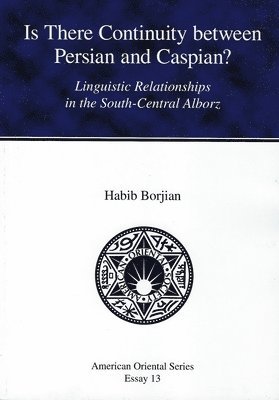
Is There Continuity between Persian and Caspian? AOSE 13
Linguistic Relationships in the South-Central Alborz
Häftad, Engelska, 2013
548 kr
Skickas inom 5-8 vardagar
Is There Continuity between Persian and Caspian? studies the south-central Alborz as a language transition zone. This mountainous area, also known as Qasran, consists of the upper valleys of the Jajrud and Karaj rivers, separated from both Tehran and Mazandaran by mountain chains, and of Shemiran, within Greater Tehran. There are dozens of villages in the area with vanishing dialects that show various degrees of affinity with the neighbouring languages. The following questions are addressed: Is there a sufficient amount of idiosyncrasy within Qasran to define it as a language group; how do the Qasran dialects relate to neighbouring Caspian, Persian, and Tati; and is there a language continuum or disruption? In addition to linguistic analysis, the study incorporates historical, socioeconomic, and emigrational data. The relationships among the dialects are categorized by making explicit the areal distribution of major linguistic differences in phonology, morphology, syntax, and lexicon. An analysis based on 48 isoglosses from 35 localities (amounting to more than 2000 linguistic items) is summarized in five bundle maps. These maps not only show some idiosyncrasy in the middle and southern part of Qasran but also reveal two distinct dialect groups, with thick isoglottic lines separating the dialects in the north and southeast—showing high degrees of affinity with Tabari (Mazandarani)—from the southern dialects, which are akin to Persian. This outcome dictated the coining of two dialect groups: Tabaroid and Perso-Tabaric.
Del 99 - American Oriental Series
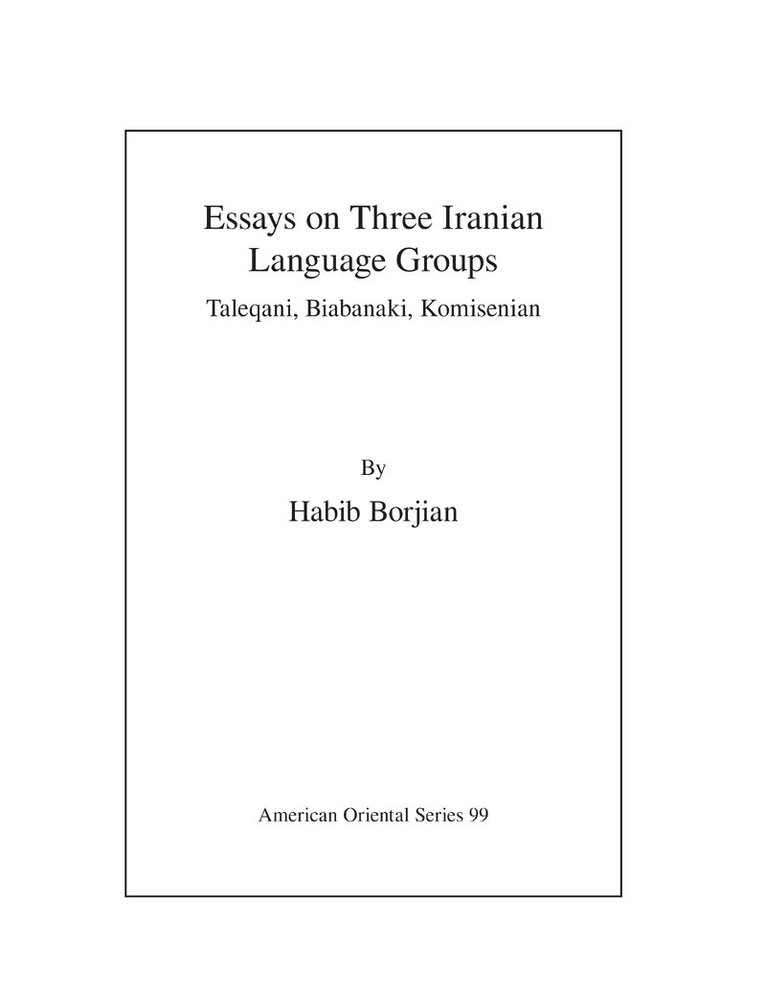
Essays on Three Iranian Language Groups
Taleqani, Biabanaki, Komisenian
Inbunden, Engelska, 2022
903 kr
Skickas inom 5-8 vardagar
This volume studies three West Iranian language groups that are either undefined or have been scantly analysed. The first chapter, "The Languages of Taleqan and Alamut," studies nineteen kindred language varieties spoken in the Sāhrud basin in central-western Alborz; the second, "Biābānaki Language Group," studies the vernaculars spoken in four villages in the historical district of Biābānak, located on the southern edge of the Great Desert in central Persia; while the third, "The Komisenian Sprachbund," treats seven languages spoken in and around Semnan, located halfway between Tehran and Khorasan. Each chapter addresses phonology, morphosyntax, and lexis, following the areal typological approach developed for West Iranian by Donald Stilo. This approach is complemented for the Biabanaki and Komisenian groups by the longstanding historical-comparative method. Special attention is given to ethnolinguistics and the language contact phenomenon, as well as the historical geography of each region. Published by American Oriental Society in association with Lockwood Press
1 659 kr
Kommande
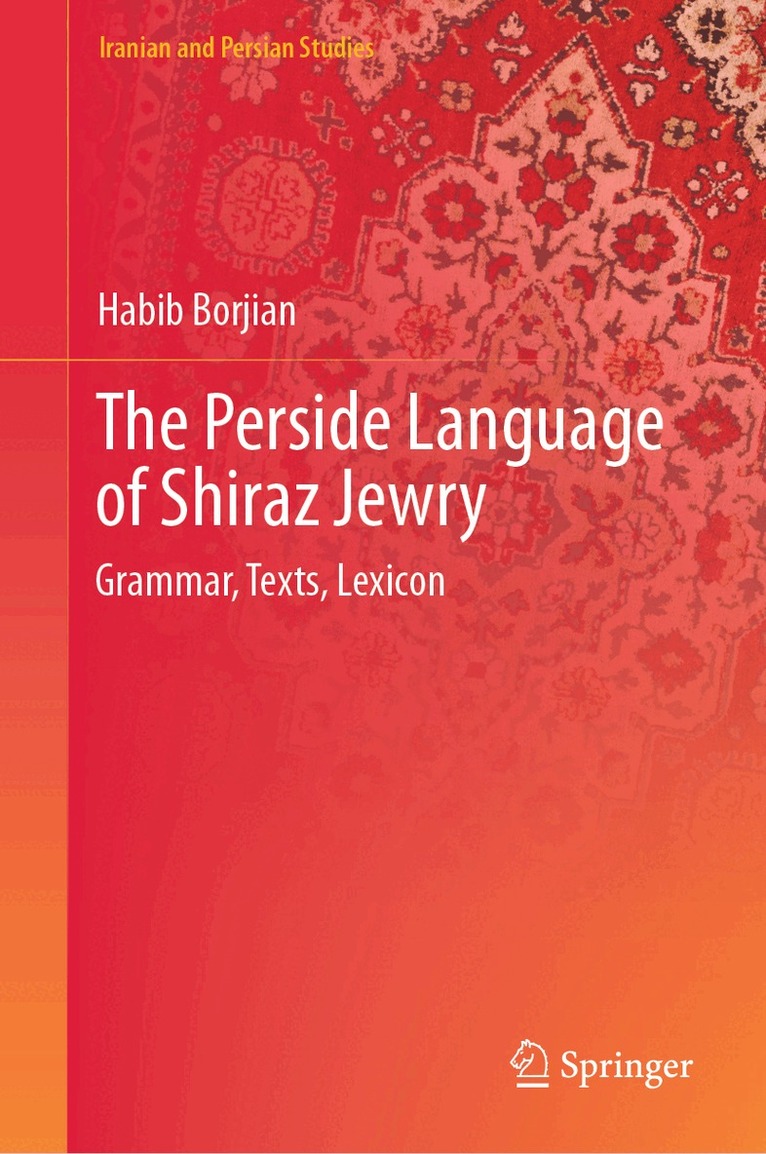
This book concerns the native language of the Jews of Shiraz, most of who live in diasporic communities outside of Iran. The language, Judeo-Shirazi, belongs to the Southwest Iranian group, as do most other native vernaculars spoken in southern Iran. None of these languages—unlike other languages of Iranic stock—has been studied in any detail. This is the first novel and detailed look into this language. The author shows Judeo-Shirazi as truly moribund. The result of a ten-year study, this book covers diachrony, phonology, morphosyntax, and lexis, drawn from more than a dozen texts collected from the Shirazi Jewish diaspora living in New York City and Los Angeles areas, as well as unpublished texts collected in Shiraz in 1969, when the speech community was still intact. Conservative as the Shirazi Jewish community is extremely difficult to find speakers who are often old and linguistically isolated. This work draws from immensely valuable videotapes, supported by the Endangered Language Alliance in New York and the Jewish Language Project in Los Angeles. As an ethnically bounded urban language, Judeo-Shirazi is distinct among the Iranic family. Its study is significant within not only Iranic and Indo-European linguistic scholarship but also in Jewish studies.
1 045 kr
Kommande