Hafez Ghanem – författare
Visar alla böcker från författaren Hafez Ghanem. Handla med fri frakt och snabb leverans.
9 produkter
After the Spring
Economic Transitions in the Arab World
Av Magdi Amin, Ragui Assaad m. fl.
Inbunden, 2012
871 kr
Lägg i varukorg
The Arab Spring constitutes perhaps the most far-reaching political and economic transition since the end of communism in Europe. For too long, the economic aspirations of the people in the region, especially young people, have been ignored by leaders in Arab countries and abroad. Competing views …
After the Spring
Economic Transitions in the Arab World
Av Daniel Kaufmann, Carol Graham m. fl.
E-bok, 2012
554 kr
Lägg i varukorg
This volume examines the economic problems of Arab countries following the Arab Spring. The authors argue that reforms need to accomplish four objectives: more opportunities for youth, modernization of the state, creation of a competitive private economy, and integration of Arab countries with the …
After the Spring
Economic Transitions in the Arab World
Av Daniel Kaufmann, Carol Graham m. fl.
E-bok, 2012
554 kr
Lägg i varukorg
This volume examines the economic problems of Arab countries following the Arab Spring. The authors argue that reforms need to accomplish four objectives: more opportunities for youth, modernization of the state, creation of a competitive private economy, and integration of Arab countries with the …
Arab Spring Five Years Later Vol. 1
Toward Great Inclusiveness
Av Hafez Ghanem
Häftad, 2016
472 kr
Lägg i varukorg
The dilemma felt by Arab youth was captured in Tunisia by the selfimmolation in 2010 of Mohamed Bouazizi, who was frustrated by restrictions on his small street-vending business. His death became the catalyst for revolts throughout the Middle East. The frustration had been building for some time: …
Arab Spring Five Years Later
Toward Great Inclusiveness
Av Hafez Ghanem
E-bok, 2015
429 kr
Lägg i varukorg
The dilemma felt by Arab youth was captured in Tunisia by the selfimmolation in 2010 of Mohamed Bouazizi, who was frustrated by restrictions on his small street-vending business. His death became the catalyst for revolts throughout the Middle East. The frustration had been building for some time: …
Arab Spring Five Years Later
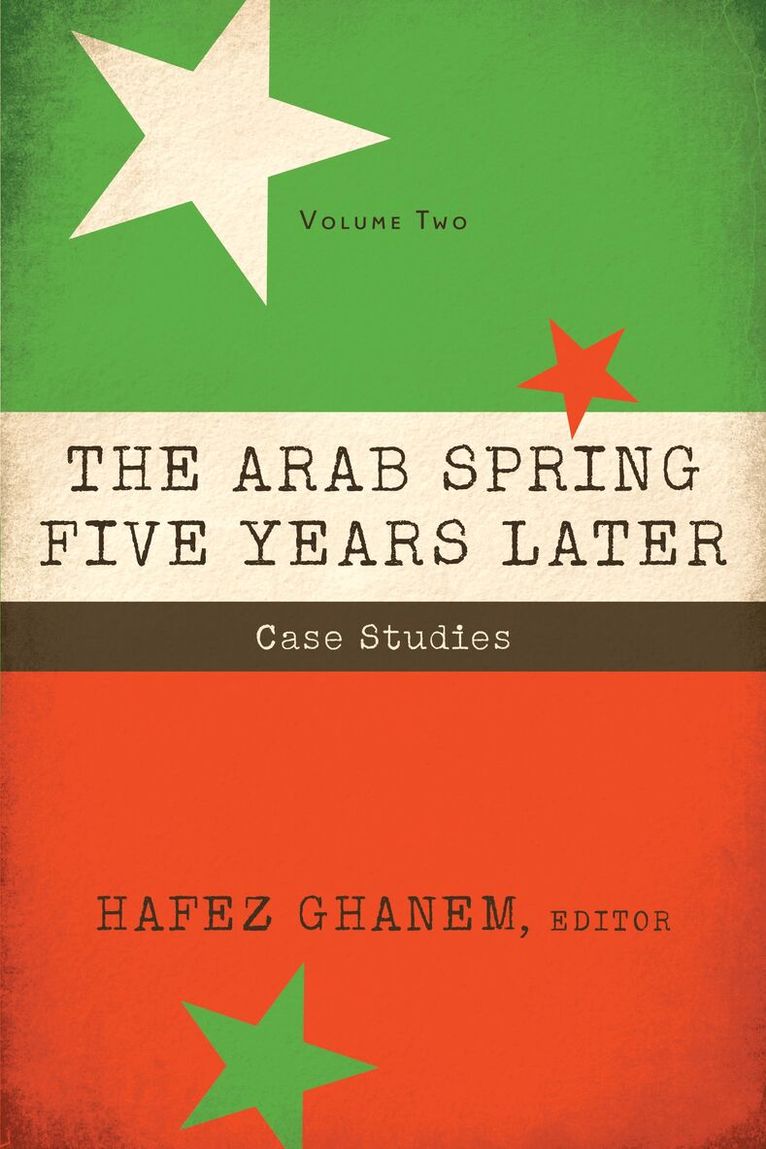
Vol 2: Case Studies
Av Hafez Ghanem
Häftad, 2016
472 kr
Lägg i varukorg
Volume 1 of The Arab Spring Five Years Later is based on extensive research conducted by scholars from a variety of backgrounds, including many associated with the Japan International Cooperation Agency (JICA). The original research papers are gathered in volume 2 and are available for readers who …
Arab Spring Five Years Later
Vol 2: Case Studies
Av Hafez Ghanem
E-bok, 2015
514 kr
Lägg i varukorg
Volume 1 of The Arab Spring Five Years Later is based on extensive research conducted by scholars from a variety of backgrounds, including many associated with the Japan International Cooperation Agency (JICA). The original research papers are gathered in volume 2 and are available for readers who …
Arab Spring Five Years Later
Av Hafez Ghanem
E-bok, 2016
750 kr
Lägg i varukorg
The dilemma felt by Arab youth was captured in Tunisia by the selfimmolation in 2010 of Mohamed Bouazizi, who was frustrated by restrictions on his small street-vending business. His death became the catalyst for revolts throughout the Middle East. The frustration had been building for some time: …
Arab Spring Five Years Later: Vol. 1 & Vol. 2
Av Hafez Ghanem
E-bok, 2016
651 kr
Lägg i varukorg
This two-volume set explores in-depth the economic origins and repercussions of the Arab Spring revolts. Volume 1 of The Arab Spring Five Years Later is based on extensive research conducted by scholars from a variety of backgrounds, including many associated with the Japan International …