Hamid Taieb - Böcker
Visar alla böcker från författaren Hamid Taieb. Handla med fri frakt och snabb leverans.
3 produkter
3 produkter
1 227 kr
Skickas inom 7-10 vardagar
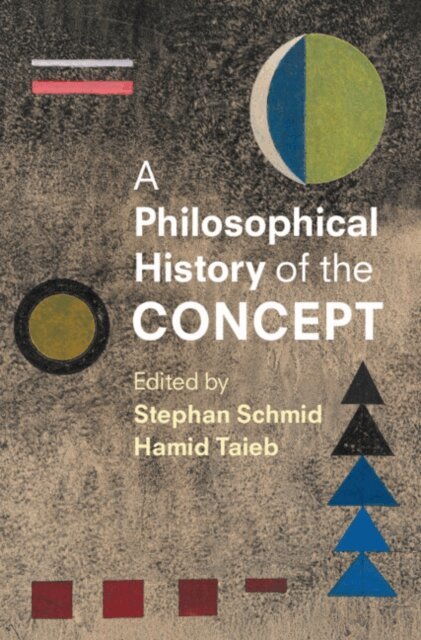
The concept of concept plays a central role in philosophy, serving both as a subject of study in disciplines such as logic, epistemology, and philosophy of mind, and as a methodologically central notion for those who think that philosophy is essentially concerned with analysing, deconstructing, developing, or ameliorating concepts. But what exactly are concepts, and why have they become so significant in philosophy? The chapters of this volume explore critical moments in the history of the concept of concept, investigating why and how philosophers across different eras and cultures have addressed concepts' nature, acquisition, and relationship to the entities to which they apply. Spanning classical Greek to modern Western philosophies, and incorporating Chinese, Indian, and Islamic traditions, the volume examines concepts as means for categorizing the world - tracing their evolution from elements of thought to foundational components of reality, and the transformation of the concept into the key notion of philosophy.
Del 19 - Phenomenology & Mind
Mind and Language – On the Philosophy of Anton Marty
Inbunden, Engelska, 2017
1 866 kr
Skickas inom 5-8 vardagar
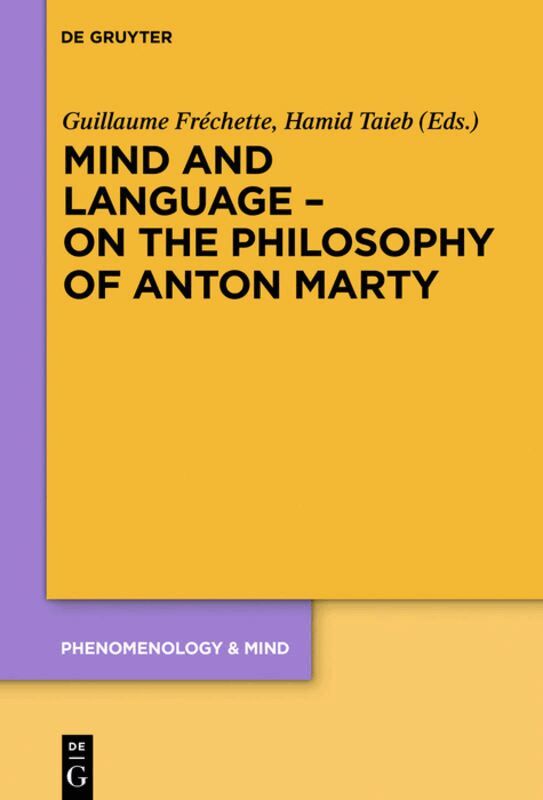
Anton Marty (Schwyz, 1847–Prague, 1914) contributed significantly to some of the central themes of Austrian philosophy. This collection contributes to assessing the specificity of his theses in relation with other Austrian philosophers. Although strongly inspired by his master, Franz Brentano, Marty developed his own theory of intentionality, understood as a sui generis relation of similarity. Moreover, he established a comprehensive philosophy of language, or "semasiology", based on descriptive psychology, and in which the utterer’s meaning plays a central role, anticipating Grice’s pragmatic semantics. The present volume, including sixteen articles by scholars in the field of the history of Austrian philosophy and in contemporary philosophy, aims at exposing some of Marty’s most important contributions in philosophy of mind and language, but also in other fields of research such as ontology and metaphysics. As archive material, the volume contains the edition of a correspondence between Marty and Hans Cornelius on similarity. This book will interest scholars in the fields of the history of philosophy in the 19th and 20th centuries, historians of phenomenology, and, more broadly, contemporary theoretical philosophers.
1 069 kr
Skickas inom 10-15 vardagar
This book sheds new light on the history of the philosophically crucial notion of intentionality, which accounts for one of the most distinctive aspects of our mental life: the fact that our thoughts are about objects. Intentionality is often described as a certain kind of relation. Focusing on Franz Brentano, who introduced the notion into contemporary philosophy, and on the Aristotelian tradition, which was Brentano’s main source of inspiration, the book reveals a rich history of debate on precisely the relational nature of intentionality. It shows that Brentano and the Aristotelian authors from which he drew not only addressed the question whether intentionality is a relation, but also devoted extensive discussions to what kind of relation it is, if any.The book aims to show that Brentano distinguishes the intentional relation from two other relations with which it might be confused, namely, causality and reference, which also hold between thoughts and their objects. Intentionality accounts for the aboutness of a thought; causality, by contrast, explains how the thought is generated, and reference, understood as a sort of similarity, occurs when the object towards which the thought is directed exists. Brentano claims to find some anticipation of his views in Aristotle. This book argues that, whether or not Brentano’s interpretation of Aristotle is correct, his claim is true of the Aristotelian tradition as a whole, since followers of Aristotle more or less explicitly made some or all of Brentano’s distinctions. This is demonstrated through examination of some major figures of the Aristotelian tradition (broadly understood), including Alexander of Aphrodisias, the Neoplatonic commentators, Thomas Aquinas, Duns Scotus, and Francisco Suárez.This book combines a longue durée approach – focusing on the long-term evolution of philosophical concepts rather than restricting itself to a specific author or period – with systematic analysis in thehistory of philosophy. By studying Brentano and the Aristotelian authors with theoretical sensitivity, it also aims to contribute to our understanding of intentionality and cognate features of the mind.