Harold Levine - Böcker
Visar alla böcker från författaren Harold Levine. Handla med fri frakt och snabb leverans.
3 produkter
3 produkter
2 100 kr
Skickas inom 10-15 vardagar
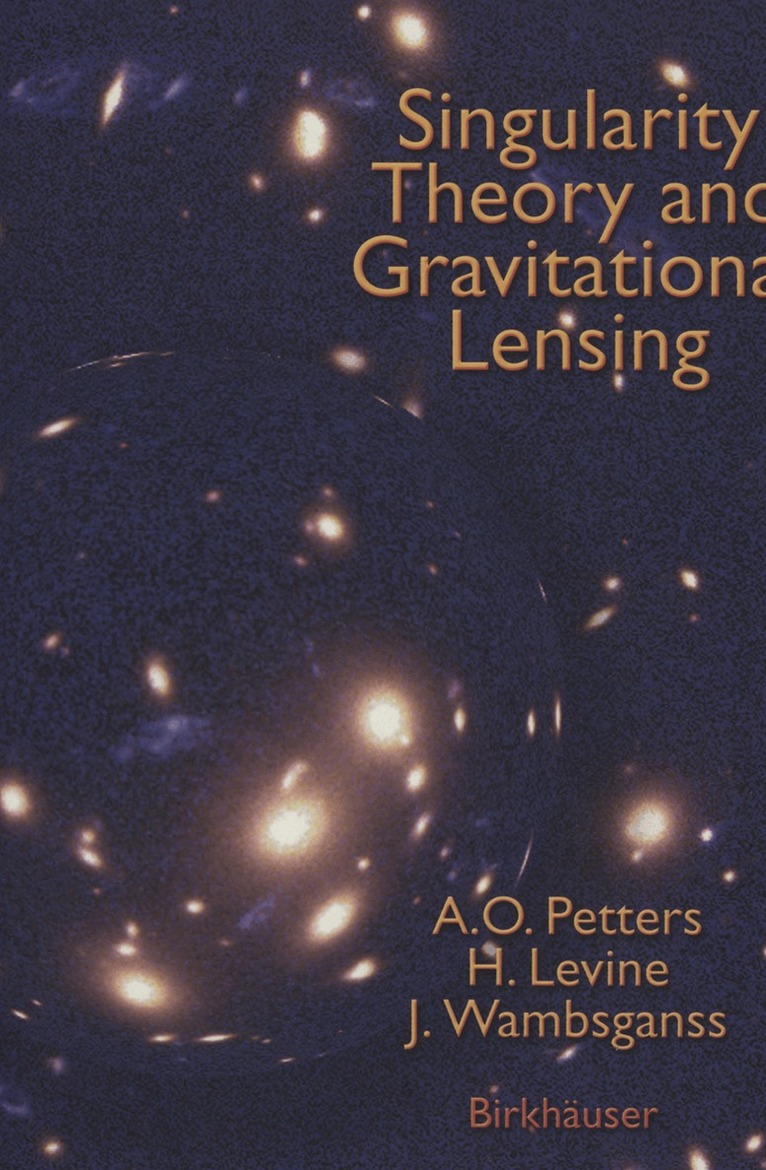
This monograph, unique in the literature, is the first to develop a mathematical theory of gravitational lensing. The theory applies to any finite number of deflector planes and highlights the distinctions between single and multiple plane lensing. Introductory material in Parts I and II present historical highlights and the astrophysical aspects of the subject. Among the lensing topics discussed are multiple quasars, giant luminous arcs, Einstein rings, the detection of dark matter and planets with lensing, time delays and the age of the universe (Hubble's constant), microlensing of stars and quasars. The main part of the book - Part III - employs the ideas and results of singularity theory to put gravitational lensing on a rigorous mathematical foundation and solve certain key lensing problems. Results are published here for the first time. Mathematical topics discussed: Morse theory, Whitney singularity theory, Thom catastrophe theory, Mather stability theory, Arnold singularity theory, and the Euler characteristic via projectivized rotation numbers.These tools are applied to the study of stable lens systems, local and global geometry of caustics, caustic metamorphoses, multiple lensed images, lensed image magnification, magnification cross sections, and lensing by singular and nonsingular deflectors. Examples, illustrations, bibliography and index make this a suitable text for an undergraduate/graduate course, seminar, or independent thesis project on gravitational lensing. The book is also an excellent reference text for professional mathematicians, mathematical physicists, astrophysicists, and physicists.
2 100 kr
Skickas inom 10-15 vardagar
Astronomers do not do experiments. They observe the universe primarily through detect ing light emitted by stars and other luminous objects. Since this light must travel through space to reach us, variations in the metric of space affects the appearance of astronomical objects. These variations lead to dramatic changes in the shape and brightness of astronom ical sources. Because these variations are sensitive to mass rather than to light, observations of gravitational lensing enable astronomers to probe the mass distribution of the universe. With gravitational lensing observations, astronomers are addressing many of the most important scientific questions in astronomy and physics: • What is the universe made of? Most of the energy and mass in the universe is not in the form of luminous objects. Stars account for less than 1 % of the energy density of the universe. Perhaps, as much as another 3% of the energy density of the universe is in the form of warm gas that fills the space between galaxies. The remaining 96% of the energy density is in some yet unidentified form. Roughly one third of this energy density of the universe is "dark matter," matter that clusters gravitationally but does not emit light. Most cosmologists suspect that this dark matter is composed of weakly interacting subatomic particles. However, most of the energy density of the universe appears to be in an even stranger form: energy associated with empty space.
Del 1157 - Lecture Notes in Mathematics
Classifying Immersions into R4 over Stable Maps of 3-Manifolds into R2
Häftad, Engelska, 1985
271 kr
Skickas inom 10-15 vardagar