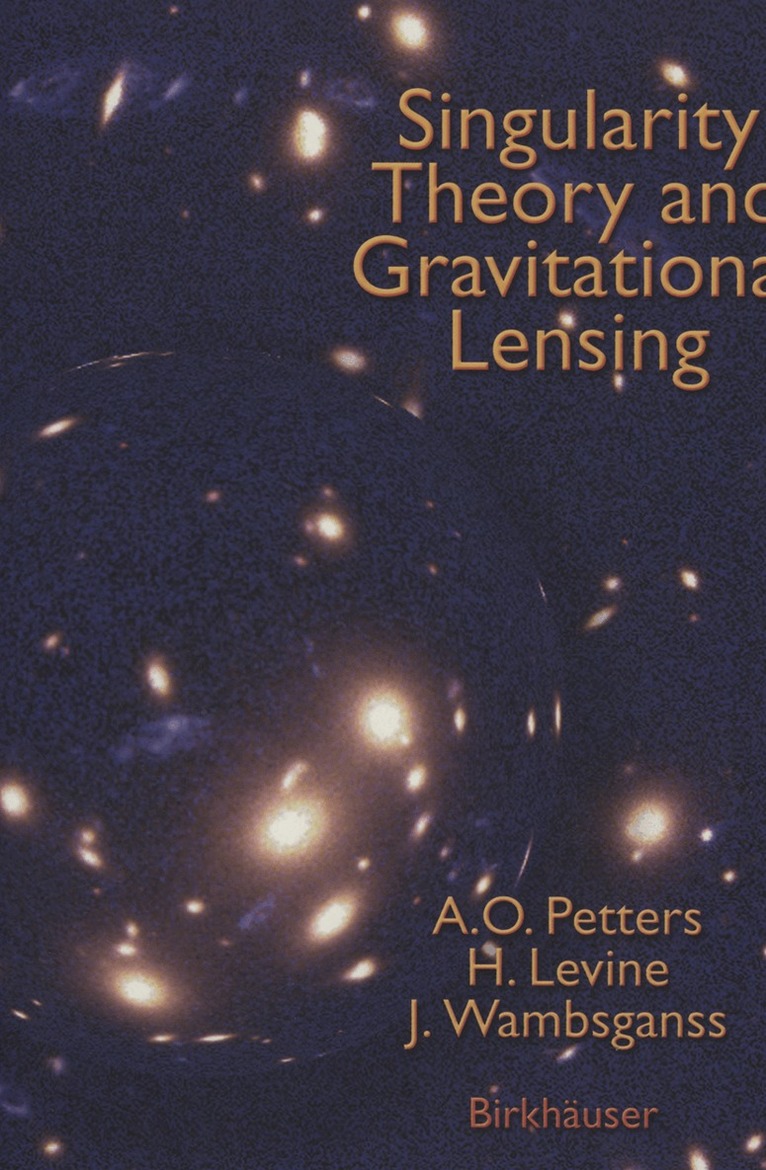
Häftad, Engelska, 2012
Singularity Theory and Gravitational Lensing
Av Arlie O. Petters, Harold Levine, Joachim Wambsganss
2183 kr
Beställningsvara. Skickas inom 10-15 vardagar. Fri frakt över 249 kr.
Beskrivning
Astronomers do not do experiments. They observe the universe primarily through detect ing light emitted by stars and other luminous objects. Since this light must travel through space to reach us, variations in the metric of space affects the appearance of astronomical objects. These variations lead to dramatic changes in the shape and brightness of astronom ical sources. Because these variations are sensitive to mass rather than to light, observations of gravitational lensing enable astronomers to probe the mass distribution of the universe. With gravitational lensing observations, astronomers are addressing many of the most important scientific questions in astronomy and physics: • What is the universe made of? Most of the energy and mass in the universe is not in the form of luminous objects. Stars account for less than 1 % of the energy density of the universe. Perhaps, as much as another 3% of the energy density of the universe is in the form of warm gas that fills the space between galaxies. The remaining 96% of the energy density is in some yet unidentified form. Roughly one third of this energy density of the universe is "dark matter," matter that clusters gravitationally but does not emit light. Most cosmologists suspect that this dark matter is composed of weakly interacting subatomic particles. However, most of the energy density of the universe appears to be in an even stranger form: energy associated with empty space.
Produktinformation
- Utgivningsdatum: 2012-10-21
- Mått: 178 x 254 x 34 mm
- Vikt: 1 170 g
- Format: Häftad
- Språk: Engelska
- Serie: Progress in Mathematical Physics
- Antal sidor: 603
- Förlag: Springer-Verlag New York Inc.
- ISBN: 9781461266334
Utforska kategorier
Betyg & recensioner
0 recensioner
Inga recensioner tillgängliga.