Joachim Wambsganss – författare
Visar alla böcker från författaren Joachim Wambsganss. Handla med fri frakt och snabb leverans.
7 produkter
7 produkter
2 115 kr
Skickas inom 10-15 vardagar
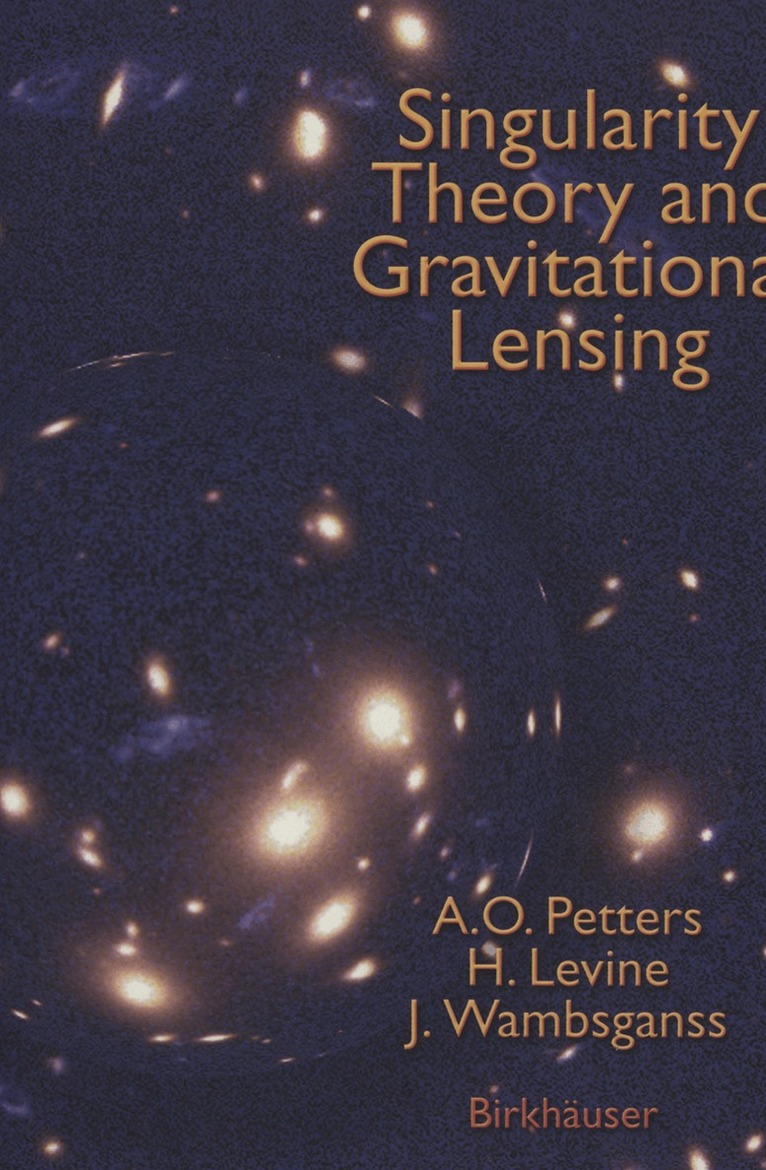
This monograph, unique in the literature, is the first to develop a mathematical theory of gravitational lensing. The theory applies to any finite number of deflector planes and highlights the distinctions between single and multiple plane lensing. Introductory material in Parts I and II present historical highlights and the astrophysical aspects of the subject. Among the lensing topics discussed are multiple quasars, giant luminous arcs, Einstein rings, the detection of dark matter and planets with lensing, time delays and the age of the universe (Hubble's constant), microlensing of stars and quasars. The main part of the book - Part III - employs the ideas and results of singularity theory to put gravitational lensing on a rigorous mathematical foundation and solve certain key lensing problems. Results are published here for the first time. Mathematical topics discussed: Morse theory, Whitney singularity theory, Thom catastrophe theory, Mather stability theory, Arnold singularity theory, and the Euler characteristic via projectivized rotation numbers.These tools are applied to the study of stable lens systems, local and global geometry of caustics, caustic metamorphoses, multiple lensed images, lensed image magnification, magnification cross sections, and lensing by singular and nonsingular deflectors. Examples, illustrations, bibliography and index make this a suitable text for an undergraduate/graduate course, seminar, or independent thesis project on gravitational lensing. The book is also an excellent reference text for professional mathematicians, mathematical physicists, astrophysicists, and physicists.
2 115 kr
Skickas inom 10-15 vardagar
Astronomers do not do experiments. They observe the universe primarily through detect ing light emitted by stars and other luminous objects. Since this light must travel through space to reach us, variations in the metric of space affects the appearance of astronomical objects. These variations lead to dramatic changes in the shape and brightness of astronom ical sources. Because these variations are sensitive to mass rather than to light, observations of gravitational lensing enable astronomers to probe the mass distribution of the universe. With gravitational lensing observations, astronomers are addressing many of the most important scientific questions in astronomy and physics: • What is the universe made of? Most of the energy and mass in the universe is not in the form of luminous objects. Stars account for less than 1 % of the energy density of the universe. Perhaps, as much as another 3% of the energy density of the universe is in the form of warm gas that fills the space between galaxies. The remaining 96% of the energy density is in some yet unidentified form. Roughly one third of this energy density of the universe is "dark matter," matter that clusters gravitationally but does not emit light. Most cosmologists suspect that this dark matter is composed of weakly interacting subatomic particles. However, most of the energy density of the universe appears to be in an even stranger form: energy associated with empty space.
Del 33 - Saas-Fee Advanced Course
Gravitational Lensing: Strong, Weak and Micro
Saas-Fee Advanced Course 33
Inbunden, Engelska, 2006
1 167 kr
Skickas inom 10-15 vardagar
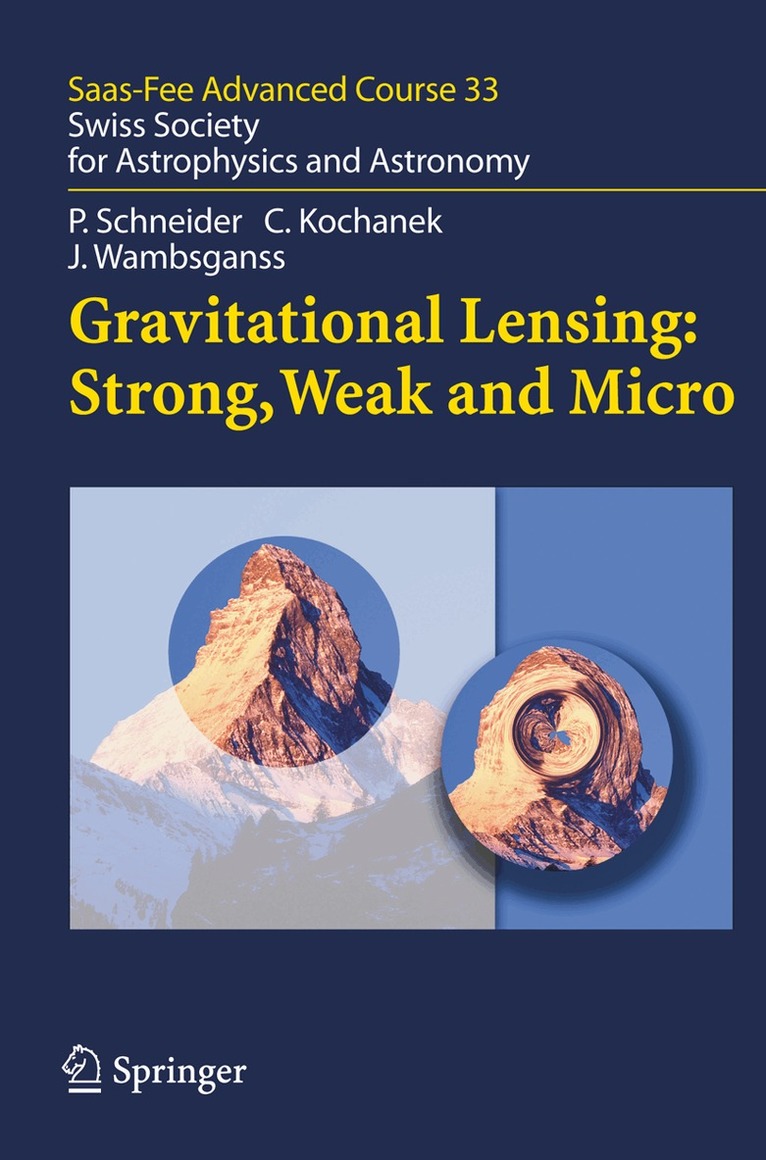
The observation, in 1919 by A.S. Eddington and collaborators, of the gra- tational de?ection of light by the Sun proved one of the many predictions of Einstein’s Theory of General Relativity: The Sun was the ?rst example of a gravitational lens. In 1936, Albert Einstein published an article in which he suggested - ing stars as gravitational lenses. A year later, Fritz Zwicky pointed out that galaxies would act as lenses much more likely than stars, and also gave a list of possible applications, as a means to determine the dark matter content of galaxies and clusters of galaxies. It was only in 1979 that the ?rst example of an extragalactic gravitational lens was provided by the observation of the distant quasar QSO 0957+0561, by D. Walsh, R.F. Carswell, and R.J. Weymann. A few years later, the ?rst lens showing images in the form of arcs was detected. The theory, observations, and applications of gravitational lensing cons- tute one of the most rapidly growing branches of astrophysics. The gravi- tional de?ection of light generated by mass concentrations along a light path producesmagni?cation,multiplicity,anddistortionofimages,anddelaysp- ton propagation from one line of sight relative to another. The huge amount of scienti?c work produced over the last decade on gravitational lensing has clearly revealed its already substantial and wide impact, and its potential for future astrophysical applications.
Del 33 - Saas-Fee Advanced Course
Gravitational Lensing: Strong, Weak and Micro
Saas-Fee Advanced Course 33
Häftad, Engelska, 2010
1 167 kr
Skickas inom 10-15 vardagar
The theory, observations, and applications of gravitational lensing constitute one of the most rapidly growing branches of astrophysics. The gravitational deflection of light generated by mass concentrations along a light path produces magnification, multiplicity, and distortion of images and delays photon propagation from one line of sight relative to another. The huge amount of scientific work produced over the last decade on gravitational lensing has clearly revealed its already substantial and wide impact and its potential for future astrophysical applications. The up-to-date contributions in this book are based on the lecture notes of the 33rd Saas--Fee Advanced Course of the Swiss Society of Astronomy and Astrophysics, entitled Gravitational Lensing: Strong, Weak, and Micro. The book comprises four complementary parts, written by leading experts in the field, constituting a genuine textbook about gravitational lensing. Students and researchers alike will benefit from this comprehensive presentation of the astrophysical and astronomical aspects of gravitational lensing.
303 kr
Skickas inom 10-15 vardagar
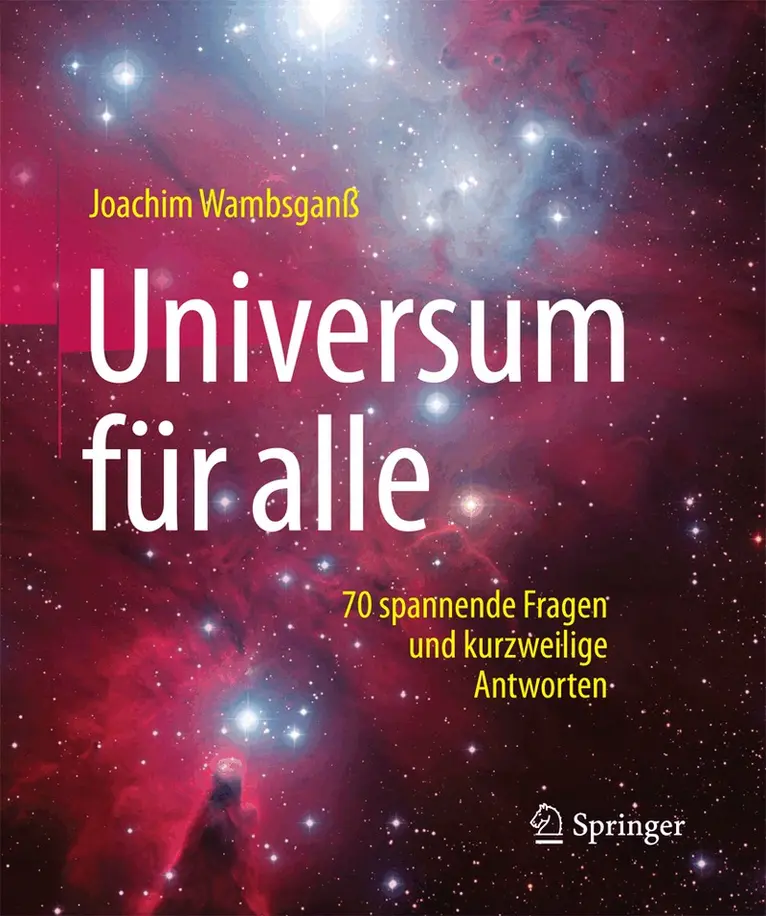
Das Universum für alle beantwortet Ihnen zahlreiche Fragen zu Sonne und Mond, zu Sternen und Galaxien und lädt Sie ein zu einer Reise durchs Weltall! Sie werden erfahren, warum die Sterne funkeln, wieso es den 29. Februar so selten gibt, was es mit Einstein-Ringen auf sich hat und wie die Astronomen das Weltall vermessen. In jedem der 70 Kapitel wird in leicht verständlicher Sprache eine astronomische Fragestellung erläutert. Reich bebildert und unterhaltsam erklärt bieten Ihnen erstklassige Experten kurze und kurzweilige Geschichten aus dem Universum: Von der Sternschnuppe bis zum Urknall, von der Sternengeburt bis zur Supernova-Explosion, vom Saturn bis zu Schwarzen Löchern. Diese Buch beruht auf der preisgekrönten Vortragsreihe „Uni(versum) für alle! – Halbe Heidelberger Sternstunden“, bei der von April bis Juli 2011 Heidelberger Astronominnen und Astronomen der interessierten Öffentlichkeit in 70 Kurzvorträgen faszinierende Themen der Astronomie näher gebracht haben. Am Ende jedes Kapitels werden Sie zu den Videos dieser Vorträge geleitet, die Sie über YouTube anschauen können.Tauchen Sie also ein in die Welt der Galaxien und Schwarzen Löcher, genießen Sie die großartigen astronomischen Fotografien und erfreuen Sie sich an den anregenden Texten. Viel Spaß beim Blättern, Lesen und Staunen!
532 kr
Skickas inom 5-8 vardagar
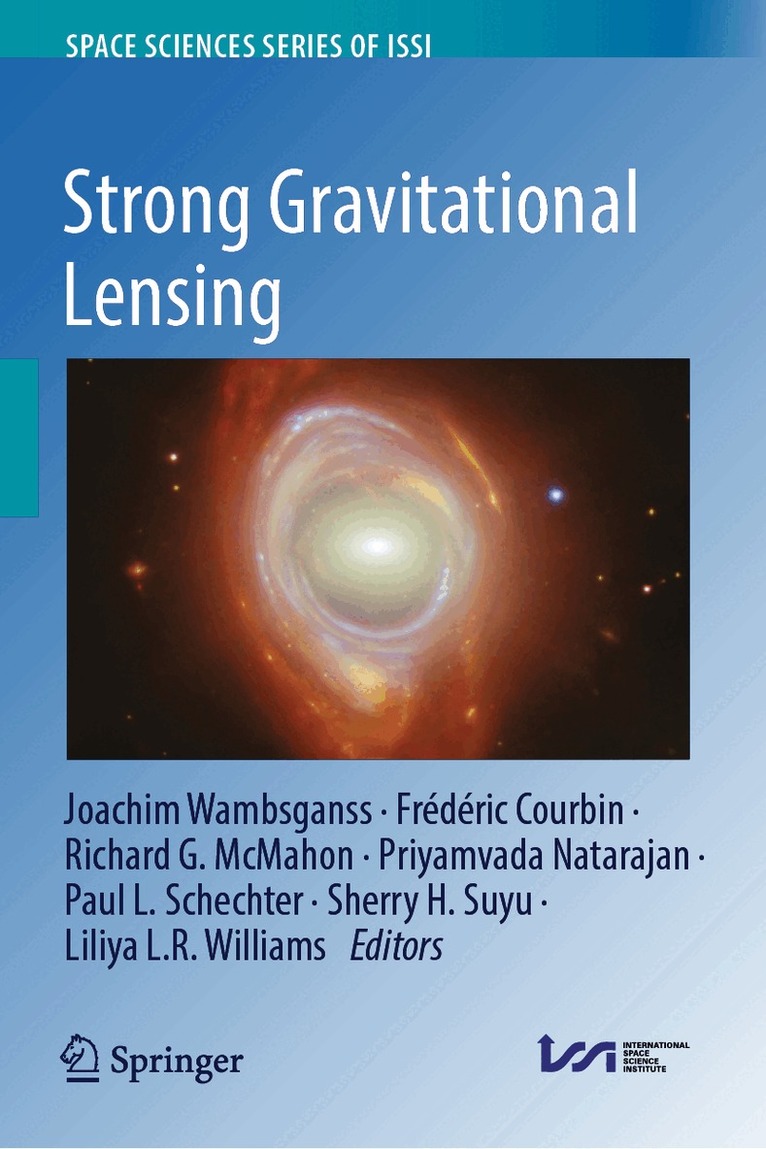
This book contains up-to-date review articles on all important aspects of strong gravitational lensing, written by the top experts in the field. The chapters cover themes like the search for strong lenses, lensing as a probe for dark matter, lensing and microlensing of supernovae, to name just a few. The topical reviews are framed by two complementary introductory articles on “Essentials” and “Basic Elements”, respectively, of strong gravitational lensing.This book is aimed both at front-line researchers and at newcomers and students, offering a comprehensive treatment that bridges fundamental concepts with the latest advances in gravitational lensingReprinted from the journal Space Science Reviews, Topical Collection: Strong Gravitational Lensing, 2025
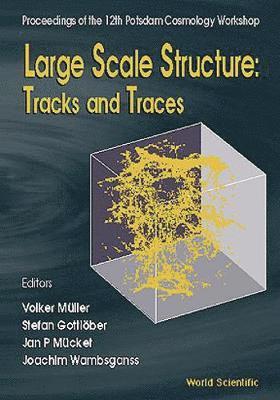
Large Scale Structure: Tracks And Traces - Proceedings Of 12th Potsdam Cosmology Workshop
Inbunden, Engelska, 1998
2 255 kr
Tillfälligt slut
Understanding the largest physical structures in the universe is essential for the comprehension of the cosmos as a whole. We want to know how our world is formed, what it is made of and how it evolves.Galaxies, as the most visible constituents of the universe, are interesting probes for the cosmic time sequence. Their formation and development provides us with unique clues to the cosmic evolution. This is tightly connected with the hierarchical cosmic structure: groups and clusters of galaxies and their embedding into the large scale structure offer the opportunity to study the dependencies.Galaxy redshift surveys delineate most impressively a large cosmic web, which is composed of sheets and filaments. Grand simulations of the cosmic evolution complement these observations from the theoretical side and allow one quantify and compare various model universes.Quasar absorption line studies, gravitational lensing and even the X-ray background radiation provide important quantitative measures of the history of matter clustering. Finally, the microwave radiation traces very early structures, which are supposed to originate in the phase of inflationary expansion shortly after the big bang.This volume constituting the proceedings of the 12th Potsdam Cosmology Workshop, deals with the basic aspects of cosmological structure formation on the largest physical scales.