• Fri frakt över 249 kr
  • •
  • Snabba leveranser
  • •
  • Billiga böcker
Kundservice

Du är på sajten för privatpersoner.

Företag, bibliotek eller offentlig verksamhet?

Du handlar på classic.bokus.com, där alla dina funktioner finns intakta.
Till classic.bokus.com
Bokus logotyp. Gå till startsidan.
  • Erbjudanden
  • Nyheter
  • Student
  • Topplistor
  • Barn & ungdom
  • Bokus Play
  • E-böcker
  • Pocketböcker
  • Spel & pussel

10% rabatt på allt med kod NYSTART10 →

Sidfot

Mina sidor

    Hjälp

    • Kundservice
    • Vanliga frågor och svar
    • Frakt och leverans
    • Retur vid ångerrätt
    • Reklamera vara
    • Betalning
    • Köpvillkor
    • Allmänna villkor
    • Information om webbplatsens tillgänglighet

    Om Bokus

    • Om oss
    • Pressrum
    • För studenter
    • För företag
    • För bibliotek och offentlig verksamhet
    • För leverantörer
    • Hållbarhet

    Populärt

    • Aktuella erbjudanden
    • Presentkort
    • Studentlitteratur
    • Nya böcker
    • Topplistor
    • Signerade böcker
    • Engelska böcker

    Inspiration

    • Boktips
    • BookTok
    • Populära bokserier
    • Barnbokskaraktärer
    • Populära författare
    Logotyp för Bokus
    Följ oss på Facebook (extern länk)Följ oss på Instagram (extern länk)Följ oss på YouTube (extern länk)Följ oss på TikTok (extern länk)
    bokus @ CookiesAnpassa cookiesIntegritetspolicyKöpvillkor
    Till Citymail hemsida (extern länk)Till Budbee hemsida (extern länk)Till Postnord hemsida (extern länk)Till Schenker hemsida (extern länk)Till Early Bird hemsida (extern länk)Till Walleys hemsida (extern länk)
    1. Naturvetenskap och teknik
    2. Matematik och naturvetenskap
    3. Matematik

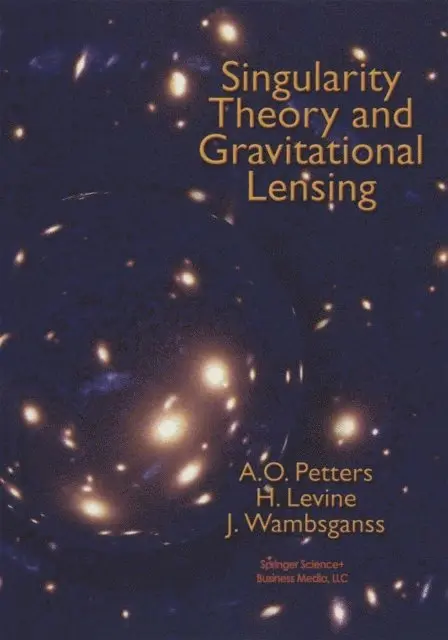
    Singularity Theory and Gravitational Lensing

    AvJoachim Wambsganss,Harold Levine

    E-bok
    PDF, Engelska, 2012

    2 833 kr

    Läs direkt i Bokus Reader – eller ladda ned till din enhet (PDF kräver ofta zoom och scroll på små skärmar).

    Beskrivning

    Astronomers do not do experiments. They observe the universe primarily through detect­ ing light emitted by stars and other luminous objects. Since this light must travel through space to reach us, variations in the metric of space affects the appearance of astronomical objects. These variations lead to dramatic changes in the shape and brightness of astronom­ ical sources. Because these variations are sensitive to mass rather than to light, observations of gravitational lensing enable astronomers to probe the mass distribution of the universe. With gravitational lensing observations, astronomers are addressing many of the most important scientific questions in astronomy and physics: • What is the universe made of? Most of the energy and mass in the universe is not in the form of luminous objects. Stars account for less than 1 % of the energy density of the universe. Perhaps, as much as another 3% of the energy density of the universe is in the form of warm gas that fills the space between galaxies. The remaining 96% of the energy density is in some yet unidentified form. Roughly one third of this energy density of the universe is "dark matter," matter that clusters gravitationally but does not emit light. Most cosmologists suspect that this dark matter is composed of weakly interacting subatomic particles. However, most of the energy density of the universe appears to be in an even stranger form: energy associated with empty space.

    Produktinformation

    • Utgivningsdatum:2012-12-06
    • Språk:Engelska
    • Filformat:PDF
    • Kopieringsskydd:LCP
    • ISBN:9781461201458
    • Förlag:Birkhauser Boston

    Utforska kategorier

    • Matematik inom Naturvetenskap och teknik
    • Tillämpad matematik inom Naturvetenskap och teknik
    • Matematisk fysik inom Naturvetenskap och teknik