Helmut Müller-Enbergs - Böcker
Visar alla böcker från författaren Helmut Müller-Enbergs. Handla med fri frakt och snabb leverans.
4 produkter
4 produkter
2 088 kr
Skickas inom 10-15 vardagar
This edited book examines the East German foreign intelligence service (Hauptverwaltung Aufklärung, or HVA) as a historical problem, covering politics, scientific-technical and military intelligence and counterintelligence. The contributors broaden the conventional view of East German foreign intelligence as driven by the inter-German conflict to include its targeting of the United States, northern European and Scandinavian countries, highlighting areas that have previously received scant attention, like scientific-technical and military intelligence. The CIA’s underestimation of the HVA was a major intelligence failure. As a result, East German intelligence served as a stealth weapon against the US, West German and NATO targets, acquiring the lion’s share of critical Warsaw Pact intelligence gathered during the Cold War. This book explores how though all of the CIA’s East German sources were double agents controlled by the Ministry of State Security, the CIA was still able to declare victory in the Cold War. Themes and topics that run through the volume include the espionage wars; the HVA's relationship with the Russian KGB; successes and failures of the BND (West German Federal Intelligence Service) in East Germany; the CIA and the HVA; the HVA in countries outside of West Germany; disinformation and the role and importance of intelligence gathering in East Germany.This book will be of much interest to students of East Germany, Intelligence Studies, Cold War History and German politics in general.Kristie Macrakis is Professor at the Georgia Institute of Technology, Atlanta. Thomas Wegener Friis is an Assistant Professor at the University of Southern Denmark’s Centre for Cold War Studies. Helmut Müller-Enbergs is currently a Visiting Professor at the University of Southern Denmark and holds a tenured senior staff position at the German Federal Commission for the STASI Archives in Berlin.
677 kr
Skickas inom 10-15 vardagar
This edited book examines the East German foreign intelligence service (Hauptverwaltung Aufklärung, or HVA) as a historical problem, covering politics, scientific-technical and military intelligence and counterintelligence. The contributors broaden the conventional view of East German foreign intelligence as driven by the inter-German conflict to include its targeting of the United States, northern European and Scandinavian countries, highlighting areas that have previously received scant attention, like scientific-technical and military intelligence. The CIA’s underestimation of the HVA was a major intelligence failure. As a result, East German intelligence served as a stealth weapon against the US, West German and NATO targets, acquiring the lion’s share of critical Warsaw Pact intelligence gathered during the Cold War. This book explores how though all of the CIA’s East German sources were double agents controlled by the Ministry of State Security, the CIA was still able to declare victory in the Cold War. Themes and topics that run through the volume include the espionage wars; the HVA's relationship with the Russian KGB; successes and failures of the BND (West German Federal Intelligence Service) in East Germany; the CIA and the HVA; the HVA in countries outside of West Germany; disinformation and the role and importance of intelligence gathering in East Germany.This book will be of much interest to students of East Germany, Intelligence Studies, Cold War History and German politics in general.Kristie Macrakis is Professor at the Georgia Institute of Technology, Atlanta. Thomas Wegener Friis is an Assistant Professor at the University of Southern Denmark’s Centre for Cold War Studies. Helmut Müller-Enbergs is currently a Visiting Professor at the University of Southern Denmark and holds a tenured senior staff position at the German Federal Commission for the STASI Archives in Berlin.
986 kr
Skickas inom 3-6 vardagar
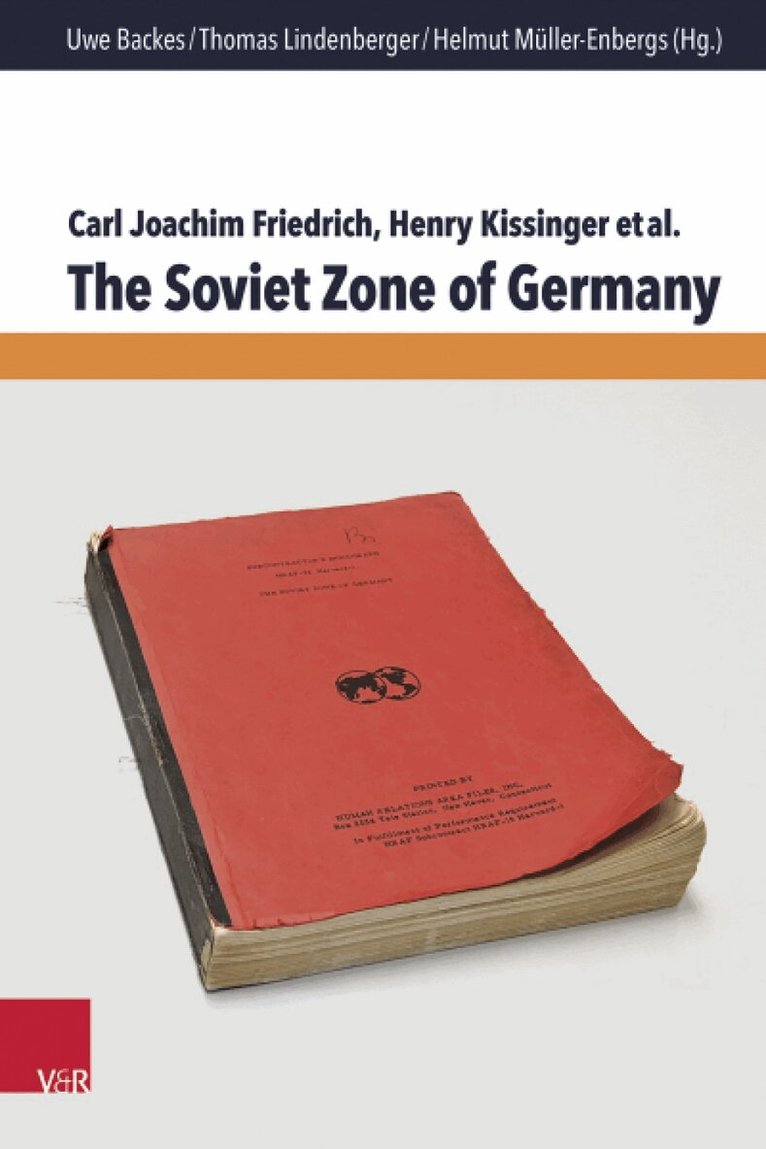
Wer erfahren will, wie die DDR ein halbes Jahrzehnt nach ihrer Gründung von einem deutsch-amerikanischen Team ausgezeichneter Kenner auf mehr als 600 Seiten analysiert und eingeordnet wurde, wird dafür kaum eine bessere Quelle finden als dieses nur als gebundener Manuskriptdruck erschienene (1956), weitgehend vergessene und kaum rezipierte Werk. Es erscheint in der Reihe „Wege der Totalitarismusforschung“ des Hannah-Arendt-Instituts, weil es in unmittelbarem Zusammenhang zur Ausarbeitung der meistdiskutierten Totalitarismuskonzeption unter der Ägide des Politikwissenschaftlers Carl J. Friedrich an der Harvard University entstand. Einer seiner engsten Mitarbeiter und Koautoren war der spätere US-Außenminister Henry Kissinger. Die Liste der Autoren und Berater (u.a. Gerhard Abeken, Fritz Baade, Erich Matthias, Carl Mayer, Heinrich Rittershausen, Otto Stammer, Carola Stern, Karl C. Thalheim, Siegfried Unseld) liest sich wie ein Who’s Who der frühen DDR-Forschung.
442 kr
Skickas inom 3-6 vardagar