Henrik Madsen – författare
803 kr
Skickas inom 10-15 vardagar
992 kr
Läs direkt efter köp
Do you have data on occupant behaviour, indoor environment or energy use in buildings? Are you interested in statistical analysis and modelling? Do you have a specific (research) question and dataset and would like to know how to answer the question with the data available?
Statistical Modelling of Occupant Behaviour covers a range of statistical methods and models used for modelling energy- and comfort-related occupant behaviour in buildings. It is a classical textbook on statistics, including many practical examples related to occupant behaviour that are either taken from real research problems or adapted from such.
The main focus is traditional statistical techniques based on the likelihood principle that can be applied to occupant behaviour modelling, including:
General, generalised linear and survival models Mixed effect and hierarchical models Linear time series and Markov models Linear state space and hidden Markov models Illustration of all methods using occupant behaviour examples implemented in RThe built environment affects occupants who live and work in it, and occupants affect the built environment by adapting it to their needs – for example, by adapting their indoor environments by interacting with building components and systems. These adaptive behaviours account for great uncertainty in the prediction of building energy use and indoor environmental conditions. Occupant behaviour is complex and multi-disciplinary but can be successfully modelled using statistical approaches.
Statistical Modelling of Occupant Behaviour is written for researchers and advanced practitioners who work with real-world applications and modelling of occupant data. It describes the kinds of statistical models that may be used in various occupant behaviour modelling research. It gives a theoretical overview of these methods and then applies them to the study of occupant behaviour using readily replaceable examples in the R environment that are based on actual and experimental data.
992 kr
Läs direkt efter köp
Do you have data on occupant behaviour, indoor environment or energy use in buildings? Are you interested in statistical analysis and modelling? Do you have a specific (research) question and dataset and would like to know how to answer the question with the data available?
Statistical Modelling of Occupant Behaviour covers a range of statistical methods and models used for modelling energy- and comfort-related occupant behaviour in buildings. It is a classical textbook on statistics, including many practical examples related to occupant behaviour that are either taken from real research problems or adapted from such.
The main focus is traditional statistical techniques based on the likelihood principle that can be applied to occupant behaviour modelling, including:
General, generalised linear and survival models Mixed effect and hierarchical models Linear time series and Markov models Linear state space and hidden Markov models Illustration of all methods using occupant behaviour examples implemented in RThe built environment affects occupants who live and work in it, and occupants affect the built environment by adapting it to their needs – for example, by adapting their indoor environments by interacting with building components and systems. These adaptive behaviours account for great uncertainty in the prediction of building energy use and indoor environmental conditions. Occupant behaviour is complex and multi-disciplinary but can be successfully modelled using statistical approaches.
Statistical Modelling of Occupant Behaviour is written for researchers and advanced practitioners who work with real-world applications and modelling of occupant data. It describes the kinds of statistical models that may be used in various occupant behaviour modelling research. It gives a theoretical overview of these methods and then applies them to the study of occupant behaviour using readily replaceable examples in the R environment that are based on actual and experimental data.
2 060 kr
Skickas inom 10-15 vardagar
696 kr
Skickas inom 10-15 vardagar
790 kr
Läs direkt efter köp
2 102 kr
Läs direkt efter köp
925 kr
Läs direkt efter köp
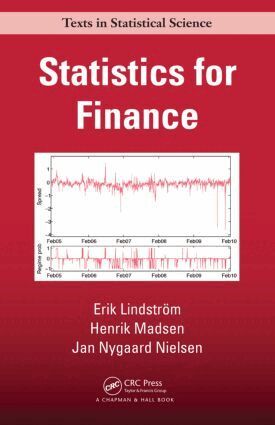
Statistics for Finance develops students’ professional skills in statistics with applications in finance. Developed from the authors’ courses at the Technical University of Denmark and Lund University, the text bridges the gap between classical, rigorous treatments of financial mathematics that rarely connect concepts to data and books on econometrics and time series analysis that do not cover specific problems related to option valuation.
The book discusses applications of financial derivatives pertaining to risk assessment and elimination. The authors cover various statistical and mathematical techniques, including linear and nonlinear time series analysis, stochastic calculus models, stochastic differential equations, Itō’s formula, the Black–Scholes model, the generalized method-of-moments, and the Kalman filter. They explain how these tools are used to price financial derivatives, identify interest rate models, value bonds, estimate parameters, and much more.
This textbook will help students understand and manage empirical research in financial engineering. It includes examples of how the statistical tools can be used to improve value-at-risk calculations and other issues. In addition, end-of-chapter exercises develop students’ financial reasoning skills.
925 kr
Läs direkt efter köp
Statistics for Finance develops students’ professional skills in statistics with applications in finance. Developed from the authors’ courses at the Technical University of Denmark and Lund University, the text bridges the gap between classical, rigorous treatments of financial mathematics that rarely connect concepts to data and books on econometrics and time series analysis that do not cover specific problems related to option valuation.
The book discusses applications of financial derivatives pertaining to risk assessment and elimination. The authors cover various statistical and mathematical techniques, including linear and nonlinear time series analysis, stochastic calculus models, stochastic differential equations, Itō’s formula, the Black–Scholes model, the generalized method-of-moments, and the Kalman filter. They explain how these tools are used to price financial derivatives, identify interest rate models, value bonds, estimate parameters, and much more.
This textbook will help students understand and manage empirical research in financial engineering. It includes examples of how the statistical tools can be used to improve value-at-risk calculations and other issues. In addition, end-of-chapter exercises develop students’ financial reasoning skills.
2 060 kr
Skickas inom 10-15 vardagar
2 028 kr
Läs direkt efter köp
1 188 kr
Skickas inom 10-15 vardagar
790 kr
Läs direkt efter köp
Integrating Renewables in Electricity Markets
Operational Problems
917 kr
Skickas inom 5-8 vardagar
1 598 kr
Läs direkt efter köp
This addition to the ISOR series addresses the analytics of the operations of electric energy systems with increasing penetration of stochastic renewable production facilities, such as wind- and solar-based generation units.
As stochastic renewable production units become ubiquitous throughout electric energy systems, an increasing level of flexible backup provided by non-stochastic units and other system agents is needed if supply security and quality are to be maintained.
Within the context above, this book provides up-to-date analytical tools to address challenging operational problems such as:
• The modeling and forecasting of stochastic renewable power production.• The characterization of the impact of renewable production on market outcomes.• The clearing of electricity markets with high penetration of stochastic renewable units.• The development of mechanisms to counteract the variability and unpredictability of stochastic renewable units so that supply security is not at risk.• The trading of the electric energy produced by stochastic renewable producers.• The association of a number of electricity production facilities, stochastic and others, to increase their competitive edge in the electricity market.• The development of procedures to enable demand response and to facilitate the integration of stochastic renewable units.
This book is written in a modular and tutorial manner and includes many illustrative examples to facilitate its comprehension. It is intended for advanced undergraduate and graduate students in the fields of electric energy systems, applied mathematics and economics. Practitioners in the electric energy sector will benefit as well from the concepts and techniques explained in this book.
1 764 kr
Skickas inom 10-15 vardagar
Integrating Renewables in Electricity Markets
Operational Problems
648 kr
Skickas inom 5-8 vardagar
422 kr
Skickas inom 5-8 vardagar
411 kr
Skickas inom 5-8 vardagar