Henry Chang - Böcker
Visar alla böcker från författaren Henry Chang. Handla med fri frakt och snabb leverans.
9 produkter
9 produkter
1 073 kr
Skickas inom 10-15 vardagar
The aim of Surviving the SOC Revolution: A Guide to Platform-Based Design is to provide the engineering community with a thorough understanding of the challenges involved when moving to system-on-a-chip and deliver a step-by-step methodology to get them there. Design reuse is most effective in reducing the cost and development time when the components to be shared are close to the final implementation. On the other hand, it is not always possible or desirable to share designs at this level, since minimal variations in specification can result in different, albeit similar, implementations. However, moving higher in abstraction can eliminate the differences among designs, so that the higher level of abstraction can be shared and only a minimal amount of work needs to be carried out to achieve final implementation. The ultimate goal is to create a library of functions and of hardware and software implementations that can be used for all new designs. It is important to have a multilevel library, since it is often the case that the lower levels that are closer to the physical implementation change because of the advances in technology, while the higher levels tend to be stable across product versions. It is most likely that the preferred approaches to the implementation of complex embedded systems will include the following aspects: Design costs and time are likely to dominate the decision-making process for systems designers. Therefore, design reuse in all its shapes and forms will be of paramount importance. Designs have to be captured at the highest level of abstraction to be able to exploit all the degrees of freedom that are available. Next-generation systems will use a few highly complex (Moore's Law Limited) part-types, but many more energy-power-cost-efficient, medium-complexity (10M-100M) gates in 50nm technology chips, working concurrently to implement solutions to complex sensing, computing, and signaling/actuating problems. Such chips will most likely be developed as an instance of a particular platform. That is, rather than being assembled from a collection of independently developed blocks of silicon functionality, they will be derived from a specific `family' of rnicro-architectures, possibly oriented toward a particular class of problems, that can be modified (extended or reduced) by the system developer. These platforms will be highly programmable. Both system and software reuse impose a design methodology that has to leverage existing implementations available at all levels of abstraction. £/LIST£ This book deals with the basic principles of a design methodology that addresses the concerns expressed above. The platform concept is carried throughout the book as a unifying theme to reuse. This is the first book that deals with the platform-based approach to the design of embedded systems and is a stepping stone for anyone who is interested in the real issues facing the design of complex systems-on-chip. From the Preface by Alberto Sangiovanni-Vincentelli
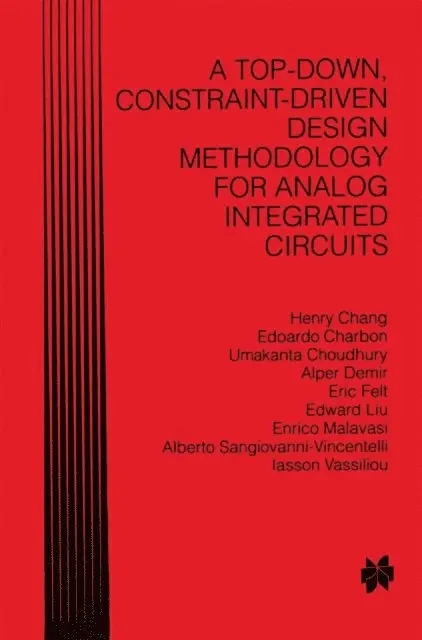
Top-Down, Constraint-Driven Design Methodology for Analog Integrated Circuits
Inbunden, Engelska, 1996
1 590 kr
Skickas inom 10-15 vardagar
Analog circuit design is often the bottleneck when designing mixed analog-digital systems. This text presents a methodology based on a top-down, constraint-driven design paradigm that provides a solution to this problem.Analog circuit design is often the bottleneck when designing mixed analog-digital systems. This text presents a methodology based on a top-down, constraint-driven design paradigm that provides a solution to this problem. This methodology has two principal advantages: it provides a high probability for the first silicon which meets all specifications, and it shortens the design cycle. It is part of an ongoing research effort at the University of California at Berkeley in the Electrical Engineering and Computer Sciences Department. This work is divided into three parts. Chapter 2 presents the design methodology along with foundation material. Chapters 3-8 describe supporting concepts for the methodology, from behavioural simulation and modelling to circuit module generators. Finally, chapters 9-11 illustrate the methodology in detail by presenting the entire design cycle through three large-scale examples.These include the design of a current source D/A converter, a S- A/D converter, and a video driver system. Chapter 12 presents conclusions and current research topics.
1 590 kr
Skickas inom 10-15 vardagar
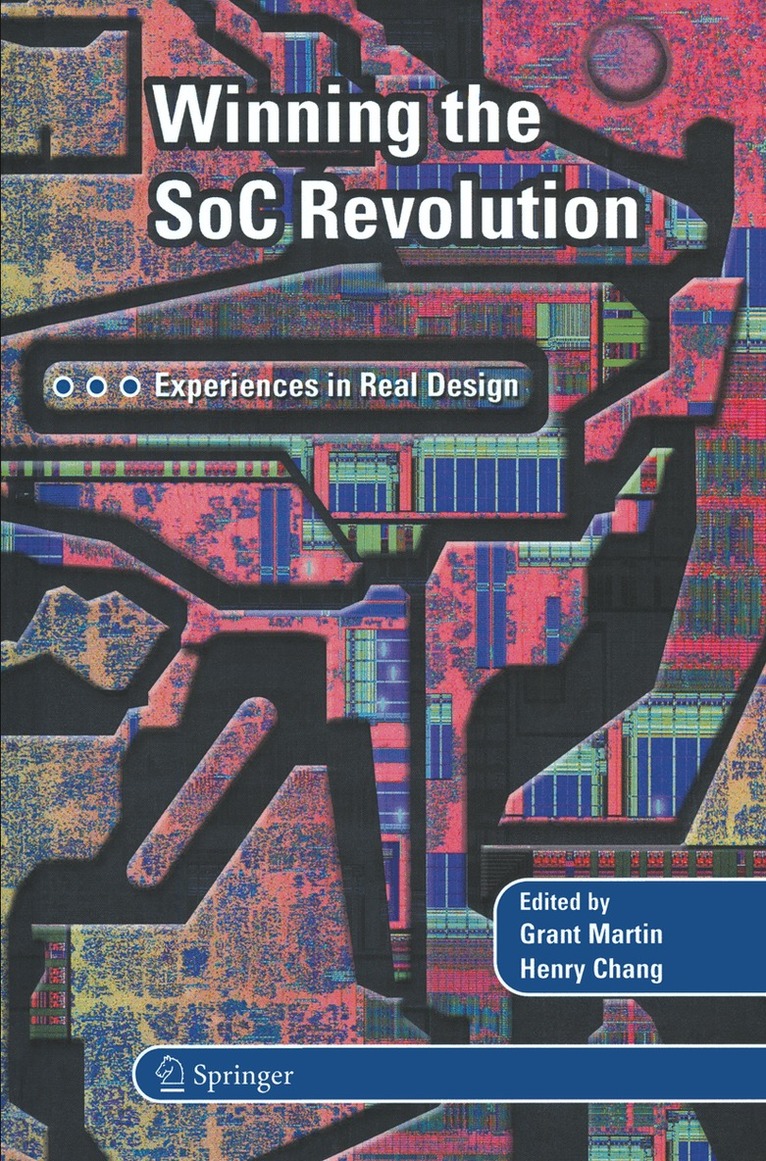
This volume gathers together some of the best practical experiences in how to design SoCs from the most advanced design groups, while setting the issues and techniques in the context of SoC design methodologies. As an edited volume, the book has contributions from the leading design houses who are winning in SoCs - Altera, ARM, IBM, Philips, TI, UC Berkeley, and Xilinx. The chapters present the many facets of SoC design - the platform based approach, how to best utilize IP, Verification, FPGA fabrics as an alternative to ASICs, and next generation process technology issues. Observations from Ron Wilson of CMP Media on best practices for SoC design team collaboration are also included.
1 590 kr
Skickas inom 10-15 vardagar
Analog circuit design is often the bottleneck when designing mixed analog-digital systems. A Top-Down, Constraint-Driven Design Methodology for Analog Integrated Circuits presents a new methodology based on a top-down, constraint-driven design paradigm that provides a solution to this problem. This methodology has two principal advantages: (1) it provides a high probability for the first silicon which meets all specifications, and (2) it shortens the design cycle. A Top-Down, Constraint-Driven Design Methodology for Analog Integrated Circuits is part of an ongoing research effort at the University of California at Berkeley in the Electrical Engineering and Computer Sciences Department. Many faculty and students, past and present, are working on this design methodology and its supporting tools. The principal goals are: (1) developing the design methodology, (2) developing and applying new tools, and (3) `proving' the methodology by undertaking `industrial strength' design examples. The work presented here is neither a beginning nor an end in the development of a complete top-down, constraint-driven design methodology, but rather a step in its development. This work is divided into three parts. Chapter 2 presents the design methodology along with foundation material. Chapters 3-8 describe supporting concepts for the methodology, from behavioral simulation and modeling to circuit module generators. Finally, Chapters 9-11 illustrate the methodology in detail by presenting the entire design cycle through three large-scale examples. These include the design of a current source D/A converter, a Sigma-Delta A/D converter, and a video driver system. Chapter 12 presents conclusions and current research topics. A Top-Down, Constraint-Driven Design Methodology for Analog Integrated Circuits will be of interest to analog and mixed-signal designers as well as CAD tool developers.
1 590 kr
Skickas inom 10-15 vardagar
In 1998-99, at the dawn of the SoC Revolution, we wrote Surviving the SOC Revolution: A Guide to Platform Based Design. In that book, we focused on presenting guidelines and best practices to aid engineers beginning to design complex System-on-Chip devices (SoCs). Now, in 2003, facing the mid-point of that revolution, we believe that it is time to focus on winning.In this book, Winning the SoC Revolution: Experiences in Real Design, we gather the best practical experiences in how to design SoCs from the most advanced design groups, while setting the issues and techniques in the context of SoC design methodologies. As an edited volume, this book has contributions from the leading design houses who are winning in SoCs - Altera, ARM, IBM, Philips, TI, UC Berkeley, and Xilinx. These chapters present the many facets of SoC design - the platform based approach, how to best utilize IP, Verification, FPGA fabrics as an alternative to ASICs, and next generation process technology issues. We also include observations from Ron Wilson of CMP Media on best practices for SoC design team collaboration. We hope that by utilizing this book, you too, will win the SoC Revolution.
1 073 kr
Skickas inom 10-15 vardagar
The aim of Surviving the SOC Revolution: A Guide to Platform-Based Design is to provide the engineering community with a thorough understanding of the challenges involved when moving to system-on-a-chip and deliver a step-by-step methodology to get them there. Design reuse is most effective in reducing the cost and development time when the components to be shared are close to the final implementation. On the other hand, it is not always possible or desirable to share designs at this level, since minimal variations in specification can result in different, albeit similar, implementations. However, moving higher in abstraction can eliminate the differences among designs, so that the higher level of abstraction can be shared and only a minimal amount of work needs to be carried out to achieve final implementation. The ultimate goal is to create a library of functions and of hardware and software implementations that can be used for all new designs. It is important to have a multilevel library, since it is often the case that the lower levels that are closer to the physical implementation change because of the advances in technology, while the higher levels tend to be stable across product versions. It is most likely that the preferred approaches to the implementation of complex embedded systems will include the following aspects: Design costs and time are likely to dominate the decision-making process for systems designers. Therefore, design reuse in all its shapes and forms will be of paramount importance. Designs have to be captured at the highest level of abstraction to be able to exploit all the degrees of freedom that are available. Next-generation systems will use a few highly complex (Moore's Law Limited) part-types, but many more energy-power-cost-efficient, medium-complexity (10M-100M) gates in 50nm technology chips, working concurrently to implement solutions to complex sensing, computing, and signaling/actuating problems. Such chips will most likely be developed as an instance of a particular platform. That is, rather than being assembled from a collection of independently developed blocks of silicon functionality, they will be derived from a specific `family' of rnicro-architectures, possibly oriented toward a particular class of problems, that can be modified (extended or reduced) by the system developer. These platforms will be highly programmable. Both system and software reuse impose a design methodology that has to leverage existing implementations available at all levels of abstraction. £/LIST£ This book deals with the basic principles of a design methodology that addresses the concerns expressed above. The platform concept is carried throughout the book as a unifying theme to reuse. This is the first book that deals with the platform-based approach to the design of embedded systems and is a stepping stone for anyone who is interested in the real issues facing the design of complex systems-on-chip. From the Preface by Alberto Sangiovanni-Vincentelli
120 kr
Skickas inom 7-10 vardagar
109 kr
Tillfälligt slut
109 kr
Skickas inom 7-10 vardagar