Henry E. Kyburg, Jr - Böcker
Visar alla böcker från författaren Henry E. Kyburg, Jr. Handla med fri frakt och snabb leverans.
7 produkter
7 produkter
712 kr
Skickas inom 7-10 vardagar
Coping with uncertainty is a necessary part of ordinary life and is crucial to an understanding of how the mind works. For example, it is a vital element in developing artificial intelligence that will not be undermined by its own rigidities. There have been many approaches to the problem of uncertain inference, ranging from probability to inductive logic to nonmonotonic logic. Thisbook seeks to provide a clear exposition of these approaches within a unified framework. The principal market for the book will be students and professionals in philosophy, computer science, and AI. Among the special features of the book are a chapter on evidential probability, which has not received a basic exposition before; chapters on nonmonotonic reasoning and theory replacement, matters rarely addressed in standard philosophical texts; and chapters on Mill's methods and statistical inference that cover material sorely lacking in the usual treatments of AI and computer science.
428 kr
Skickas inom 7-10 vardagar
Measurement is fundamental to all the sciences, the behavioural and social as well as the physical and in the latter its results provide our paradigms of 'objective fact'. But the basis and justification of measurement is not well understood and is often simply taken for granted. Henry Kyburg Jr proposes here an original, carefully worked out theory of the foundations of measurement, to show how quantities can be defined, why certain mathematical structures are appropriate to them and what meaning attaches to the results generated. Crucial to his approach is the notion of error - it can not be eliminated entirely from its introduction and control, her argues, arises the very possibility of measurement. Professor Kyburg's approach emphasises the empirical process of making measurements. In developing it he discusses vital questions concerning the general connection between a scientific theory and the results which support it (or fail to).
995 kr
Skickas inom 7-10 vardagar
Coping with uncertainty is a necessary part of ordinary life and is crucial to an understanding of how the mind works. For example, it is a vital element in developing artificial intelligence that will not be undermined by its own rigidities. There have been many approaches to the problem of uncertain inference, ranging from probability to inductive logic to nonmonotonic logic. Thisbook seeks to provide a clear exposition of these approaches within a unified framework. The principal market for the book will be students and professionals in philosophy, computer science, and AI. Among the special features of the book are a chapter on evidential probability, which has not received a basic exposition before; chapters on nonmonotonic reasoning and theory replacement, matters rarely addressed in standard philosophical texts; and chapters on Mill's methods and statistical inference that cover material sorely lacking in the usual treatments of AI and computer science.
302 kr
Tillfälligt slut
The theory of probability grew up in gaming rooms, and then in insurance companies, but was eventually applied by philosophers to all kinds of ordinary choices. That application, however, bristles with knotty problems and disagreements among the experts. This collection of philosophical essays by leading specialists in the subject looks at various technical problems in the use of probability theory for guidance in practical decisions. For those who already have a basic grounding in philosophy, logic, and probability theory, this book provides an informative sampling of the best recent work on developing an adequate conception of the use of probability theory in practical decision-making. The three standard views of probability are those of Richard von Mises, which identifies probability with limiting frequency; Carnap and his followers, which sees probability as a kind of partial entailment according to "state descriptions"; and Ramsey and Finetti (the Bayesian or subjective interpretation), which sees probabilities as tied to choices.As guides to life, each of these approaches has its shortcomings: the frequency interpretation allows many values of probability, the Carnapian or logical view fails to provide any specific values, and the subjective view can accommodate any value. Attempts to combine these approaches have also been disappointing. The contributors to this book represent a cross-section of contemporary views. They include attempts to tackle general issues, such as McGrew's discussion of Hume's assault on induction and Henderson's examination of recent attempts to reconcile Bayesian and Frequentist approaches, and the application of probability theory to specific kinds of decision, like Malinas's treatment of Simpson's Paradox or the article by Colyvan, Regan, and Ferson, which looks at the pitfalls of depending on statistical evidence to establish criminal guilt.
617 kr
Skickas inom 10-15 vardagar
Epistemology and Inference was first published in 1983. Minnesota Archive Editions uses digital technology to make long-unavailable books once again accessible, and are published unaltered from the original University of Minnesota Press editions.Henry Kyburg has developed an original and important perspective on probabilistic and statistical inference. Unlike much contemporary writing by philosophers on these topics, Kyburg's work is informed by issues that have arisen in statistical theory and practice as well as issues familiar to professional philosophers. In two major books and many articles, Kyberg has elaborated his technical proposals and explained their ramifications for epistemology, decision-making, and scientific inquiry. In this collection of published and unpublished essays, Kyburg presents his novel ideas and their applications in a manner that makes them accessible to philosophers and provides specialists in probability and induction with a concise exposition of his system.
1 585 kr
Skickas inom 10-15 vardagar
Everyone knows it is easy to lie with statistics. It is important then to be able to tell a statistical lie from a valid statistical inference. It is a relatively widely accepted commonplace that our scientific knowledge is not certain and incorrigible, but merely probable, subject to refinement, modifi cation, and even overthrow. The rankest beginner at a gambling table understands that his decisions must be based on mathematical ex pectations - that is, on utilities weighted by probabilities. It is widely held that the same principles apply almost all the time in the game of life. If we turn to philosophers, or to mathematical statisticians, or to probability theorists for criteria of validity in statistical inference, for the general principles that distinguish well grounded from ill grounded generalizations and laws, or for the interpretation of that probability we must, like the gambler, take as our guide in life, we find disagreement, confusion, and frustration. We might be prepared to find disagreements on a philosophical and theoretical level (although we do not find them in the case of deductive logic) but we do not expect, and we may be surprised to find, that these theoretical disagreements lead to differences in the conclusions that are regarded as 'acceptable' in the practice of science and public affairs, and in the conduct of business.
Del 5 - Studies in Cognitive Systems
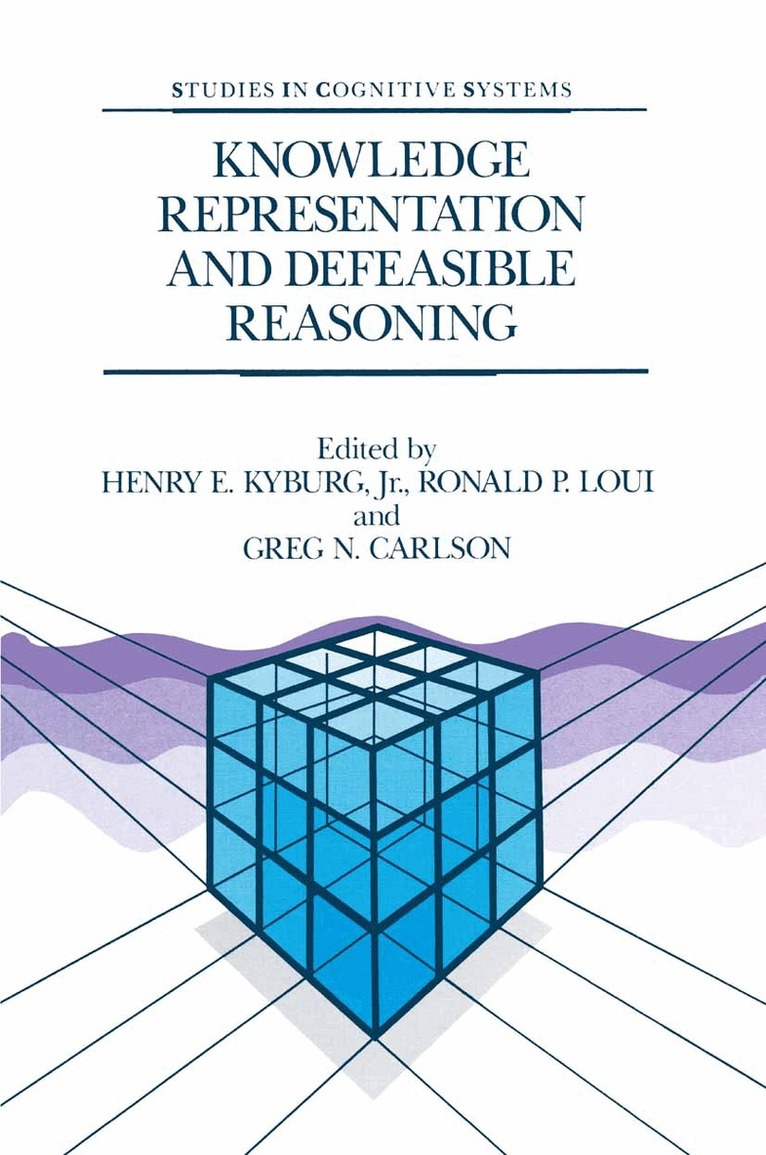
Knowledge Representation and Defeasible Reasoning
Häftad, Engelska, 2011
533 kr
Skickas inom 10-15 vardagar
This series will include monographs and collections of studies devoted to the investigation and exploration of knowledge, information, and data processing systems of all kinds, no matter whether human, (other) ani mal, or machine. Its scope is intended to span the full range of interests from classical problems in the philosophy of mind and philosophical psy chology through issues in cognitive psychology and sociobiology (concerning the mental capabilities of other species) to ideas related to artificial intelli gence and computer science. While primary emphasis will be placed upon theoretical, conceptual, and epistemological aspects of these problems and domains, empirical, experimental, and methodological studies will also ap pear from time to time. The present volume provides a collection of studies that focus on some of the central problems within the domain of artificial intelligence. These difficulties fall into four principal areas: defeasible reasoning (including the frame problem as apart), ordinary language (and the representation prob lems that it generates), the revision of beliefs (and its rules of inference), and knowledge representation (and the logical problems that are encountered there). These papers make original contributions to each of these areas of inquiry and should be of special interest to those who understand the crucial role that is played by questions of logical form. They vividly illustrate the benefits that can emerge from collaborative efforts involving scholars from linguistics, philosophy, computer science, and AI. J. H. F.