Henry Jacolin - Böcker
Visar alla böcker från författaren Henry Jacolin. Handla med fri frakt och snabb leverans.
4 produkter
4 produkter
2 160 kr
Skickas inom 10-15 vardagar
This book, the first in a two-volume work resulting from a 2018 conference organised by the International Railway History Association (IRHA), examines the relationship between the railways and the First World War from a global theoretical, methodological and geographical perspective.Although World War I (1914–1918) has been studied extensively from virtually every angle, the question of the railways has not been the subject of robust historical interest, despite their crucial role in every respect and at every stage. The war forced the railways to adopt more efficient techniques more quickly than they would have done in peacetime, to the extent where military operations would not have been possible without their massive and multifaceted help. This collection of essays brings together specialists in the field from a broad range of disciplines and backgrounds to demonstrate how this topic is integral to understanding the developments of European and world history throughout the 1910s and 1920s.Railways in the First World War will be a useful tool for students, scholars and non-specialist readers interested in the history of transport, the history of the First World War and World history.
2 160 kr
Skickas inom 10-15 vardagar
This book, the second in a two- volume work resulting from a 2018 conference organized by the International Railway History Association (IRHA), examines the relationship between the railways and the First World War from a global theoretical, methodological and geographical perspective.Although the First World War (1914– 1918) has been studied extensively from virtually every angle, the question of the railways has not been the subject of robust historical interest, despite their crucial role in every respect and at every stage. The war forced the railways to adopt more efficient techniques more quickly than they would have done in peacetime, to the extent where military operations would not have been possible without their massive and multifaceted help. This collection of essays brings together specialists in the field from a broad range of disciplines and backgrounds to demonstrate how this topic is integral to understanding the developments of European and world history throughout the 1910s and 1920s.Railways in the First World War will be a useful tool for students, scholars and nonspecialist readers interested in the history of transport, the history of the First World War and world history.
789 kr
Skickas inom 10-15 vardagar
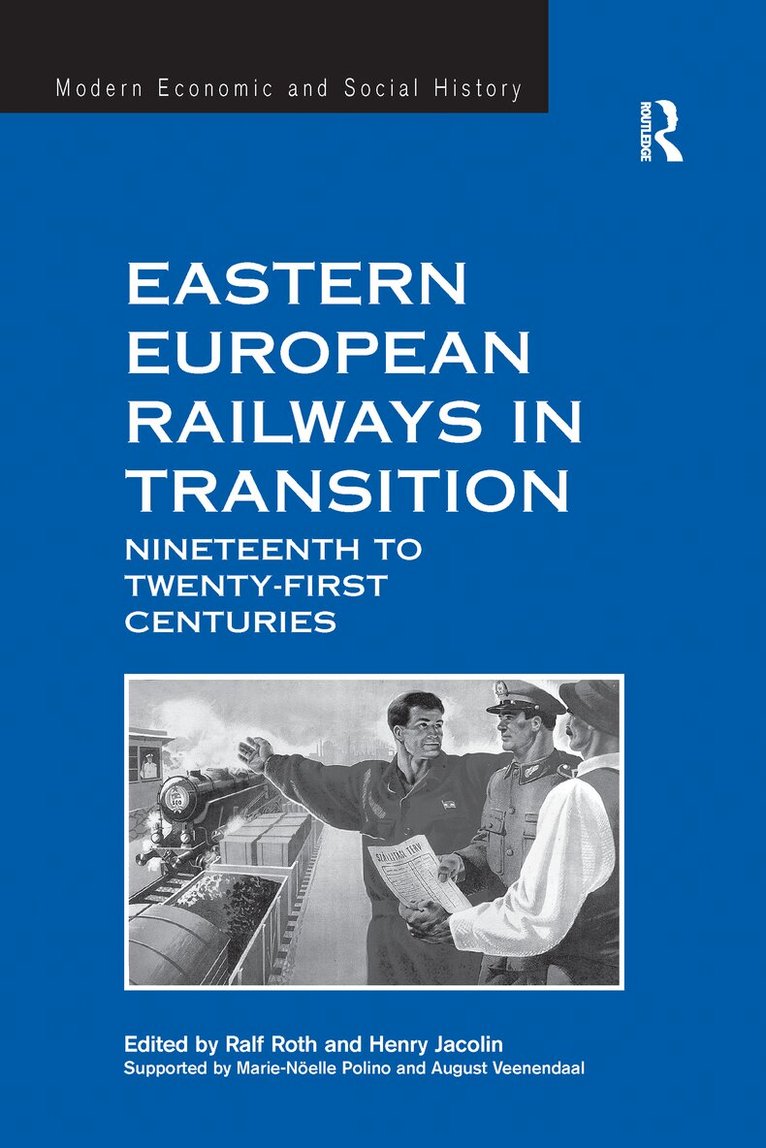
During the nineteenth century, railway lines spread rapidly across Europe, linking the continent in ways unimaginable to previous generations. By the beginning of the twentieth century the great cities of the continent were linked by a complex and extensive rail network. Yet this high-point of interconnectivity, was abruptly cut-off after 1945, as the Cold War built barriers - both physical and ideological - between east and west. In this volume, leading transport history scholars take a fresh look at this situation, and the ramifications it had for Europe. As well as addressing the parallel development of railways either side of the Iron Curtain, the book looks at how transport links have been reconnected and reconfigured in the twenty years since the reunification of Europe. In particular, it focuses upon the former communist countries and how they have responded to the challenges and opportunities railways offer both nationally and internationally. Including contributions from historians, researchers, policy makers, representatives of railway companies and railway museum staff, the essays in this collection touch upon a rich range of subjects. Divided into four sections: 'The Historical Overview', 'Under Russian Protection', After the Fall of the Iron Curtain, and 'The Heritage of Railways in Eastern Europe' the volume offers a broadly chronological introduction to the issue, that provides both a snap-shot of current debates and a starting point for further research. It concludes that in an era of increased globalisation and interconnectivity - and despite the rise of air and road transport and virtual methods of communication - railways still have a crucial role to play in the development of a prosperous and connected Europe.
2 230 kr
Skickas inom 10-15 vardagar
During the nineteenth century, railway lines spread rapidly across Europe, linking the continent in ways unimaginable to previous generations. By the beginning of the twentieth century the great cities of the continent were linked by a complex and extensive rail network. Yet this high-point of interconnectivity, was abruptly cut-off after 1945, as the Cold War built barriers - both physical and ideological - between east and west. In this volume, leading transport history scholars take a fresh look at this situation, and the ramifications it had for Europe. As well as addressing the parallel development of railways either side of the Iron Curtain, the book looks at how transport links have been reconnected and reconfigured in the twenty years since the reunification of Europe. In particular, it focuses upon the former communist countries and how they have responded to the challenges and opportunities railways offer both nationally and internationally. Including contributions from historians, researchers, policy makers, representatives of railway companies and railway museum staff, the essays in this collection touch upon a rich range of subjects. Divided into four sections: 'The Historical Overview', 'Under Russian Protection', After the Fall of the Iron Curtain, and 'The Heritage of Railways in Eastern Europe' the volume offers a broadly chronological introduction to the issue, that provides both a snap-shot of current debates and a starting point for further research. It concludes that in an era of increased globalisation and interconnectivity - and despite the rise of air and road transport and virtual methods of communication - railways still have a crucial role to play in the development of a prosperous and connected Europe.