Henry Phelps Brown – författare
Visar alla böcker från författaren Henry Phelps Brown. Handla med fri frakt och snabb leverans.
7 produkter
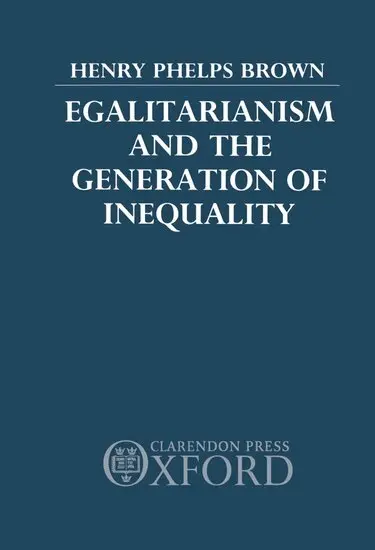
Egalitarianism and the Generation of Inequality
Inbunden, 1988
3406 kr
Lägg i varukorg
The belief that existing distributions of income and wealth are unjust has come to be widely held, and has prompted the inclusion of egalitarian measures in many political programmes. This work uses the methods of reasoned history and comparative statistics to arrive at an assessment of …
Perspective of Wages and Prices (Routledge Revivals)
Av Henry Phelps Brown, Sheila V. Hopkins
Inbunden, 2012
3154 kr
Lägg i varukorg
First published in book form in 1981, this collection of essays originally written between 1955 and 1966 contains ground-breaking research and analysis on the study of wages and prices across seven centuries, with particular reference to builder’s wage rates and the price of a bundle of the …
Perspective of Wages and Prices (Routledge Revivals)
Av Henry Phelps Brown, Sheila V. Hopkins
Häftad, 2013
667 kr
Lägg i varukorg
First published in book form in 1981, this collection of essays originally written between 1955 and 1966 contains ground-breaking research and analysis on the study of wages and prices across seven centuries, with particular reference to builder’s wage rates and the price of a bundle of the …
Perspective of Wages and Prices (Routledge Revivals)
Av Sheila V. Hopkins, Henry Phelps Brown
E-bok, 2013
785 kr
Lägg i varukorg
First published in book form in 1981, this collection of essays originally written between 1955 and 1966 contains ground-breaking research and analysis on the study of wages and prices across seven centuries, with particular reference to builder’s wage rates and the price of a bundle of the …
Perspective of Wages and Prices (Routledge Revivals)
Av Sheila V. Hopkins, Henry Phelps Brown
E-bok, 2013
785 kr
Lägg i varukorg
First published in book form in 1981, this collection of essays originally written between 1955 and 1966 contains ground-breaking research and analysis on the study of wages and prices across seven centuries, with particular reference to builder’s wage rates and the price of a bundle of the …