H.H. Van Laar – författare
Visar alla böcker från författaren H.H. Van Laar. Handla med fri frakt och snabb leverans.
11 produkter
11 produkter
Inbunden, Engelska, 1994
1 623 kr
Skickas inom 10-15 vardagar
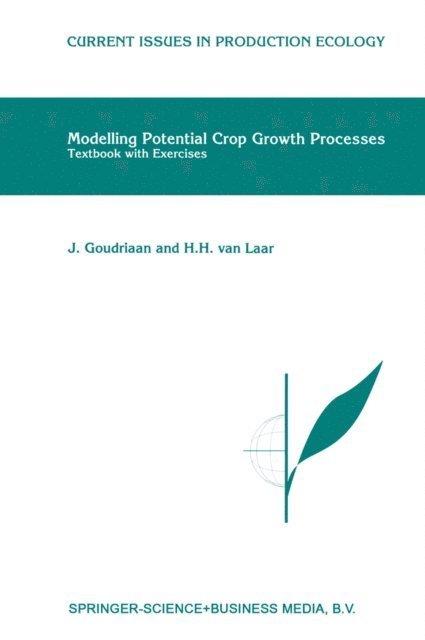
We dedicate this book to professor C. T. de Wit (1924 - 1993) who initiated Production Ecology as a school of thought at the Wageningen Agricultural Univer sity (see Rabbinge et at. , 1990). To acknowledge the leading role of C. T. de Wit, a recently formed graduate school at this university in Production Ecology was named after him. Production Ecology is the study of ecological processes, with special attention to flows of energy and matter as factors that determine the productivity of ecological systems. Agro-ecosystems are a special case of ecosystems which are much better suited for the productivity approach than natural ecosystems are. This is the reason for the strong role of agricultural research in production ecology. On the other hand, it must be recognized that the spatial heterogeneity of natural ecosys tems and their species richness may alter some ecophysiological relationships. However, the basic physical, chemical and physiological processes will be the same. De Wit introduced the state variable approach as the basis for simulation mod elling. In this approach the floating character of nature is schematized into a series of snapshots over time in which the states are frozen at each separate moment. The current state determines how the rates of change will lead to the next snapshot. This way of thinking enables a clear and workable representation of interacting simul taneous processes, without compromising on the mathematics.
Häftad, Engelska, 1994
1 623 kr
Skickas inom 10-15 vardagar
We dedicate this book to professor C. T. de Wit (1924 - 1993) who initiated Production Ecology as a school of thought at the Wageningen Agricultural Univer sity (see Rabbinge et at. , 1990). To acknowledge the leading role of C. T. de Wit, a recently formed graduate school at this university in Production Ecology was named after him. Production Ecology is the study of ecological processes, with special attention to flows of energy and matter as factors that determine the productivity of ecological systems. Agro-ecosystems are a special case of ecosystems which are much better suited for the productivity approach than natural ecosystems are. This is the reason for the strong role of agricultural research in production ecology. On the other hand, it must be recognized that the spatial heterogeneity of natural ecosys tems and their species richness may alter some ecophysiological relationships. However, the basic physical, chemical and physiological processes will be the same. De Wit introduced the state variable approach as the basis for simulation mod elling. In this approach the floating character of nature is schematized into a series of snapshots over time in which the states are frozen at each separate moment. The current state determines how the rates of change will lead to the next snapshot. This way of thinking enables a clear and workable representation of interacting simul taneous processes, without compromising on the mathematics.
2 161 kr
Skickas inom 10-15 vardagar
Systems approaches for agricultural development are needed to determine rational strategies for the role of agriculture in national development. Mathematical models and computer simulation provide objective tools for applying science to determine and evaluate options for resource management at field, farm and regional scales. However, these tools would not be fully utilizable without incorporating social and economic dimensions into their application. The second international symposium, Systems Approaches for Agricultural Development, held in Los Banos, 6-8 December 1995, fostered this link between the bio-physical sciences and the social sciences in the choice of keynote papers and oral presentations, a selection of which is included in this book. The book's contents reflect how systems approaches have moved beyond the research mode into the application mode. The number and quality of interdisciplinary research projects reported from different parts of the globe, to determine land use options that will meet multiple goals and yet sustain natural resource bases, is a key indicator of this "coming of age".
2 161 kr
Skickas inom 10-15 vardagar
Systems approaches for agricultural development are needed to determine rational strategies for the role of agriculture in national development. Mathematical models and computer simulation provide objective tools for applying science to determine and evaluate options for resource management at field, farm and regional scales. However, these tools would not be fully utilizable without incorporating social and economic dimensions into their application. The second international symposium, Systems Approaches for Agricultural Development (SAAD), held in Los Baños, 6-8 December 1995, fostered this link between the biophysical sciences and the social sciences in the selection of keynote papers and oral presentations, a selection of which are included in these books. The contents further reflect how systems approaches have definitely moved beyond the research mode into the application mode. The large number and high quality of interdisciplinary research projects reported from different parts of the globe, to determine land use options that will meet multiple goals and yet sustain natural resource bases, is a key indicator of this `coming of age'. At the farm level, where trade-off decisions between processes and products (commodities) feature strongly, much progress is also evident in the development of systems-based tools for decision making. At the field level optimization of resource use and minimizing environmental effects has become of major concern for which systems approaches are indispensable. The books, of which Volume I deals with regional and farm studies level and Volume II with field level studies, will be of particular interest to all agricultural scientists and planners, as well as students interested in multidisciplinary and holistic approaches to agricultural development.
Inbunden, Engelska, 2007
2 160 kr
Skickas inom 10-15 vardagar
The growing demand for food and increasing scarcity of fertile land and other resources (water, energy, etc. ) present multiple challenges to plant and crop scientists to meet the demands of future generations while protecting the environment and conserve biological diversity. Novel directions in linking basic plant sciences to crop and systems research are needed to meet the growing demand for food in a sustainable way. Crop performance can be changed by modifying genetic traits of the plant through plant breeding or changing the crop environment through agronomic management practices. To achieve that, systems analysis and modelling play an important role by integrating and evaluating new findings at the gene and plant level at higher scales of aggregation. Robust crop-physiological modelling can become an essential tool to use insights from functional genomics in explaining crop behaviour. Current crop models can predict crop performance over a range of environmental conditions. Recently QTL information has been incorporated into crop models, and this has proved the potential of narrowing genotype– phenotype gaps and of applying QTL-based models for the analysis of genotype-- environment interactions. To make further progress, model structure must be upgraded to allow for more physiological feedback features. Model input parameters should be designed to be potentially grounded in gene-level understanding. Integration of crop modelling into genetic and genomic researches can enhance the future position of crop physiology in ‘plant breeding by design’ (Yin, X.
Häftad, Engelska, 2007
2 375 kr
Skickas inom 10-15 vardagar
The growing demand for food and increasing scarcity of fertile land and other resources (water, energy, etc. ) present multiple challenges to plant and crop scientists to meet the demands of future generations while protecting the environment and conserve biological diversity. Novel directions in linking basic plant sciences to crop and systems research are needed to meet the growing demand for food in a sustainable way. Crop performance can be changed by modifying genetic traits of the plant through plant breeding or changing the crop environment through agronomic management practices. To achieve that, systems analysis and modelling play an important role by integrating and evaluating new findings at the gene and plant level at higher scales of aggregation. Robust crop-physiological modelling can become an essential tool to use insights from functional genomics in explaining crop behaviour. Current crop models can predict crop performance over a range of environmental conditions. Recently QTL information has been incorporated into crop models, and this has proved the potential of narrowing genotype– phenotype gaps and of applying QTL-based models for the analysis of genotype-- environment interactions. To make further progress, model structure must be upgraded to allow for more physiological feedback features. Model input parameters should be designed to be potentially grounded in gene-level understanding. Integration of crop modelling into genetic and genomic researches can enhance the future position of crop physiology in ‘plant breeding by design’ (Yin, X.
2 160 kr
Skickas inom 10-15 vardagar
Systems approaches for agricultural development are needed to determine rational strategies for the role of agriculture in national development. Mathematical models and computer simulation provide objective tools for applying science to determine and evaluate options for resource management at field, farm and regional scales. However, these tools would not be fully utilizable without incorporating social and economic dimensions into their application. The second international symposium, Systems Approaches for Agricultural Development (SAAD), held in Los Baños, 6-8 December 1995, fostered this link between the biophysical sciences and the social sciences in the selection of keynote papers and oral presentations, a selection of which are included in these books. The contents further reflect how systems approaches have definitely moved beyond the research mode into the application mode. The large number and high quality of interdisciplinary research projects reported from different parts of the globe, to determine land use options that will meet multiple goals and yet sustain natural resource bases, is a key indicator of this `coming of age'. At the farm level, where trade-off decisions between processes and products (commodities) feature strongly, much progress is also evident in the development of systems-based tools for decision making. At the field level optimization of resource use and minimizing environmental effects has become of major concern for which systems approaches are indispensable. The books, of which Volume I deals with regional and farm studies level and Volume II with field level studies, will be of particular interest to all agricultural scientists and planners, as well as students interested in multidisciplinary and holistic approaches to agricultural development.
2 160 kr
Skickas inom 10-15 vardagar
Systems approaches for agricultural development are needed to determine rational strategies for the role of agriculture in national development. Mathematical models and computer simulation provide objective tools for applying science to determine and evaluate options for resource management at field, farm and regional scales. However, these tools would not be fully utilizable without incorporating social and economic dimensions into their application. The second international symposium, Systems Approaches for Agricultural Development, held in Los Baños, 6-8 December 1995, fostered this link between the bio-physical sciences and the social sciences in the choice of keynote papers and oral presentations, a selection of which is included in this book. The book's contents further reflect how systems approaches have definitely moved beyond the research mode into the application mode. The large number and high quality of interdisciplinary research projects reported from different parts of the globe, to determine land use options that will meet multiple goals and yet sustain natural resource bases, is a key indicator of this `coming of age'. At the farm level, where trade-off decisions between processes and products (commodities) feature strongly, much progress is also evident in the development of systems-based tools for decision making. This book will be of particular interest to all agricultural scientists and planners, as well as students interested in multidisciplinary and holistic approaches for agricultural development.
E-bok
PDF, Engelska, 20122 049 kr
Läs direkt efter köp
We dedicate this book to professor C. T. de Wit (1924 - 1993) who initiated Production Ecology as a school of thought at the Wageningen Agricultural Univer sity (see Rabbinge et at. , 1990). To acknowledge the leading role of C. T. de Wit, a recently formed graduate school at this university in Production Ecology was named after him. Production Ecology is the study of ecological processes, with special attention to flows of energy and matter as factors that determine the productivity of ecological systems. Agro-ecosystems are a special case of ecosystems which are much better suited for the productivity approach than natural ecosystems are. This is the reason for the strong role of agricultural research in production ecology. On the other hand, it must be recognized that the spatial heterogeneity of natural ecosys tems and their species richness may alter some ecophysiological relationships. However, the basic physical, chemical and physiological processes will be the same. De Wit introduced the state variable approach as the basis for simulation mod elling. In this approach the floating character of nature is schematized into a series of snapshots over time in which the states are frozen at each separate moment. The current state determines how the rates of change will lead to the next snapshot. This way of thinking enables a clear and workable representation of interacting simul taneous processes, without compromising on the mathematics.
2 840 kr
Läs direkt efter köp
Systems approaches for agricultural development are needed to determine rational strategies for the role of agriculture in national development. Mathematical models and computer simulation provide objective tools for applying science to determine and evaluate options for resource management at field, farm and regional scales. However, these tools would not be fully utilizable without incorporating social and economic dimensions into their application. The second international symposium, Systems Approaches for Agricultural Development, held in Los Baños, 6-8 December 1995, fostered this link between the bio-physical sciences and the social sciences in the choice of keynote papers and oral presentations, a selection of which is included in this book. The book''s contents further reflect how systems approaches have definitely moved beyond the research mode into the application mode. The large number and high quality of interdisciplinary research projects reported from different parts of the globe, to determine land use options that will meet multiple goals and yet sustain natural resource bases, is a key indicator of this `coming of age''. At the farm level, where trade-off decisions between processes and products (commodities) feature strongly, much progress is also evident in the development of systems-based tools for decision making. This book will be of particular interest to all agricultural scientists and planners, as well as students interested in multidisciplinary and holistic approaches for agricultural development.
2 840 kr
Läs direkt efter köp
Systems approaches for agricultural development are needed to determine rational strategies for the role of agriculture in national development. Mathematical models and computer simulation provide objective tools for applying science to determine and evaluate options for resource management at field, farm and regional scales. However, these tools would not be fully utilizable without incorporating social and economic dimensions into their application. The second international symposium, Systems Approaches for Agricultural Development (SAAD), held in Los Baños, 6-8 December 1995, fostered this link between the biophysical sciences and the social sciences in the selection of keynote papers and oral presentations, a selection of which are included in these books. The contents further reflect how systems approaches have definitely moved beyond the research mode into the application mode. The large number and high quality of interdisciplinary research projects reported from different parts of the globe, to determine land use options that will meet multiple goals and yet sustain natural resource bases, is a key indicator of this `coming of age''. At the farm level, where trade-off decisions between processes and products (commodities) feature strongly, much progress is also evident in the development of systems-based tools for decision making. At the field level optimization of resource use and minimizing environmental effects has become of major concern for which systems approaches are indispensable. The books, of which Volume I deals with regional and farm studies level and Volume II with field level studies, will be of particular interest to all agricultural scientists and planners, as well as students interested in multidisciplinary and holistic approaches to agricultural development.