• Fri frakt över 249 kr
  • •
  • Snabba leveranser
  • •
  • Billiga böcker
Kundservice

Du är på sajten för privatpersoner.

Företag, bibliotek eller offentlig verksamhet?

Du handlar på classic.bokus.com, där alla dina funktioner finns intakta.
Till classic.bokus.com
Bokus logotyp. Gå till startsidan.
  • Erbjudanden
  • Nyheter
  • Student
  • Topplistor
  • Barn & ungdom
  • Bokus Play
  • E-böcker
  • Pocketböcker
  • Spel & pussel

10% rabatt på allt med kod NYSTART10 →

Sidfot

Mina sidor

    Hjälp

    • Kundservice
    • Vanliga frågor och svar
    • Frakt och leverans
    • Retur vid ångerrätt
    • Reklamera vara
    • Betalning
    • Köpvillkor
    • Allmänna villkor
    • Information om webbplatsens tillgänglighet

    Om Bokus

    • Om oss
    • Pressrum
    • För studenter
    • För företag
    • För bibliotek och offentlig verksamhet
    • För leverantörer
    • Hållbarhet

    Populärt

    • Aktuella erbjudanden
    • Presentkort
    • Studentlitteratur
    • Nya böcker
    • Topplistor
    • Signerade böcker
    • Engelska böcker

    Inspiration

    • Boktips
    • BookTok
    • Populära bokserier
    • Barnbokskaraktärer
    • Populära författare
    Logotyp för Bokus
    Följ oss på Facebook (extern länk)Följ oss på Instagram (extern länk)Följ oss på YouTube (extern länk)Följ oss på TikTok (extern länk)
    bokus @ CookiesAnpassa cookiesIntegritetspolicyKöpvillkor
    Till Citymail hemsida (extern länk)Till Budbee hemsida (extern länk)Till Postnord hemsida (extern länk)Till Schenker hemsida (extern länk)Till Early Bird hemsida (extern länk)Till Walleys hemsida (extern länk)
    1. Djur och Natur
    2. Naturböcker
    3. Växtböcker

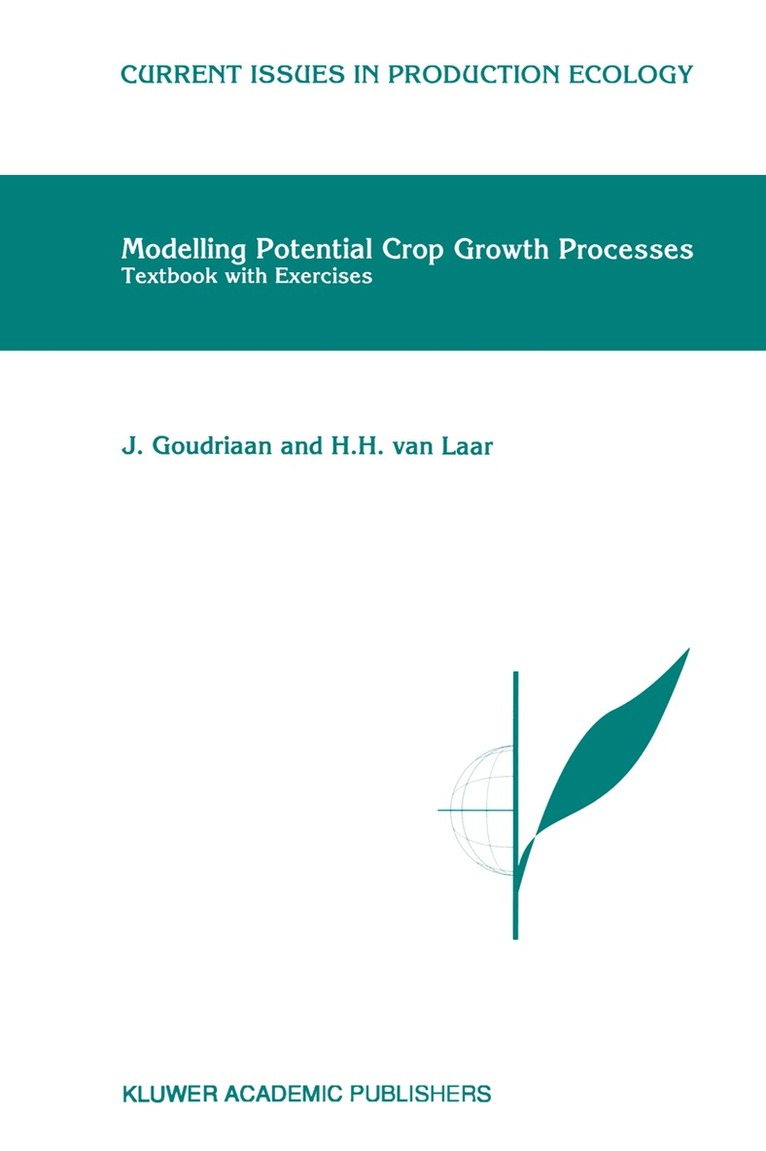
    Modelling Potential Crop Growth Processes

    Textbook with Exercises

    AvJ. Goudriaan,H.H. Van Laar

    Inbunden, Engelska, 1994

    Del i serien Current Issues in Production Ecology

    1 623 kr

    Beställningsvara. Skickas inom 10-15 vardagar. Fri frakt över 249 kr.

    Fler format och utgåvor

    Häftad

    1 623 kr

    Beskrivning

    We dedicate this book to professor C. T. de Wit (1924 - 1993) who initiated Production Ecology as a school of thought at the Wageningen Agricultural Univer­ sity (see Rabbinge et at. , 1990). To acknowledge the leading role of C. T. de Wit, a recently formed graduate school at this university in Production Ecology was named after him. Production Ecology is the study of ecological processes, with special attention to flows of energy and matter as factors that determine the productivity of ecological systems. Agro-ecosystems are a special case of ecosystems which are much better suited for the productivity approach than natural ecosystems are. This is the reason for the strong role of agricultural research in production ecology. On the other hand, it must be recognized that the spatial heterogeneity of natural ecosys­ tems and their species richness may alter some ecophysiological relationships. However, the basic physical, chemical and physiological processes will be the same. De Wit introduced the state variable approach as the basis for simulation mod­ elling. In this approach the floating character of nature is schematized into a series of snapshots over time in which the states are frozen at each separate moment. The current state determines how the rates of change will lead to the next snapshot. This way of thinking enables a clear and workable representation of interacting simul­ taneous processes, without compromising on the mathematics.

    Produktinformation

    • Utgivningsdatum:1994-10-31
    • Mått:170 x 244 x 19 mm
    • Vikt:553 g
    • Format:Inbunden
    • Språk:Engelska
    • Serie:Current Issues in Production Ecology
    • Antal sidor:239
    • Upplaga:1994
    • Förlag:Kluwer Academic Publishers
    • ISBN:9780792332190

    Utforska kategorier

    • Växtböcker inom Djur och Natur
    • Botanik inom Naturvetenskap och teknik

    Recensioner i media

    '... the textbook is highly recommended for all who want to learn more about modelling plant growth and want to have a basis from where one can start and add modules within the specific area of interest.' Scientia Horticulturae, 67 (1996)

    Innehållsförteckning

    • 1 Introduction.- 1.1 Levels of understanding of crop growth.- 1.2 Growth factors and production situations.- 1.3 CO2 assimilation as a basis.- 1.4 Some general modelling considerations.- 1.5 Outline of the book.- 2 The main seasonal growth pattern.- 2.1 Introduction.- 2.2 The growth phases.- 2.3 Exponential-linear growth: one equation.- 2.4 A special case: rm, cm,p1 and s are constant.- 2.5 Application for variable weather conditions.- 2.6 Generalization on approaching the senescence phase.- 2.7 A term for losses due to maintenance respiration.- 2.8 Additional exercises.- 2.9 Solutions to the exercises.- 2.10 Symbols and acronyms used in Chapter 2.- 3 Climatic factors.- 3.1 Importance of the diurnal course.- 3.2 The daily progress of the incident global radiation.- 3.3 Temperature.- 3.4 Humidity.- 3.5 Wind speed.- 3.6 Annual temperature course.- 3.7 Additional exercises.- 3.8 Solutions to the exercises.- 3.9 Symbols and acronyms used in Chapter 3.- 4 Assimilate flow and respiration.- 4.1 Introduction.- 4.2 Growth and respiration.- 4.3 Short-circuiting the assimilate pool on the long-term.- 4.4 Growth respiration and chemical composition.- 4.5 Maintenance respiration.- 4.6 Additional exercises.- 4.7 Solutions to the exercises.- 4.8 Symbols and acronyms used in Chapter 4.- 5 Development and growth.- 5.1 Introduction.- 5.2 Development stages.- 5.3 Development rate and environmental factors.- 5.4 Distribution of dry matter and development stage.- 5.5 Leaf area growth.- 5.6 Solutions to the exercises.- 5.7 Symbols and acronyms used in Chapter 5.- 6 Radiation in crops.- 6.1 Introduction.- 6.2 A model crop with black horizontal leaves.- 6.3 Black leaves that are not horizontal.- 6.4 Horizontal leaves that are not black.- 6.5 Scattering leaves, non-horizontal.- 6.6 Scattering by leaves and soil.- 6.7 Distribution of absorption of light over the leaf canopy.- 6.8 Clustering.- 6.9 Additional exercise.- 6.10 Solutions to the exercises.- 6.11 Symbols and acronyms used in Chapter 6.- 7 Leaf energy balance and transpiration.- 7.1 Introduction.- 7.2 Energy balance of a non-transpiring leaf.- 7.3 Thermal (‘long-wave’) radiation: 3 – 20 ?m.- 7.4 Evaporation from a wet surface.- 7.5 Leaf transpiration.- 7.6 Units of conductance: m s?1 or ?mol m?2 s?1.- 7.7 Notation with the coupling factor Omega.- 7.8 Additional exercises.- 7.9 Solutions to the exercises.- 7.10 Symbols and acronyms used in Chapter 7.- 8 Analysis of leaf CO2 assimilation.- 8.1 Introduction.- 8.2 The photosynthesis-light response curve.- 8.3 The light and dark processes in CO2 assimilation.- 8.4 Limitation by low CO2.- 8.5 Maximal photosynthetic capacity (at both high light and high CO2).- 8.6 Limitation by low light.- 8.7 The C3 cycle, photorespiration and the CO2 compensation point.- 8.8 Temperature.- 8.9 Additional exercises.- 8.10 Solutions to the exercises.- 8.11 Symbols and acronyms used in Chapter 8.- References.- Appendix 1 Richards and Gompertz functions.- A1.1 Richards function.- A1.2 Gompertz function.- Appendix 2 Gaussian integration in simulation modelling.- A2.1 Introduction.- A2.2 Canopy photosynthesis.- A2.3 Solution to the exercise.- Appendix 3 SUCROS1 — A crop growth model for potential production.- A3.1 Introduction.- A3.2 Initial conditions.- A3.3 Crop development (Chapter 5).- A3.6 Carbohydrate production (Chapter 4).- A3.7 Maintenance (Chapter 4).- A3.8 Dry matter partitioning (Chapter 5).- A3.9 Growth of plant organs and translocation (Chapts 4 and 5).- A3.10 Leaf and ear development (Chapter 5).- A3.11 Dry matter production.- A3.12 Weather data(Chapter 3).- A3.13 Carbon balance check (Chapter 4).- A3.14 Run control.- A3.15 Structure and listing of the model.- A3.16 Definition of the abbreviations used in SUCROS1.- Appendix 4 SUCROS1 — adapted for soil reflection.- Appendix 5 The FORTRAN Simulation Translator (FST), a simulation language.- A5.1 Introduction.- A5.2 The structure of the model.- A5.3 FST example program simulating logistic growth.- A5.4 Comment lines and FST statements.- A5.5 Rules for FST keywords, variable names and values.- A5.6 Definition of input values of the model (PARAMETER, INCON, CONSTANT, FUNCTION).- A5.7 Hierarchy of operations in expressions, and the use of FST functions and FORTRAN functions.- A5.8 FST keywords for output (TITLE, PRINT, OUTPUT).- A5.9 FST run control keywords (TRANSLATION_GENERAL, TRANSLATION_FSE, TIMER, FINISH).- A5.10 Weather data in FST programs (WEATHER).- A5.11 Rerun facility, the END keyword.- A5.12 FORTRAN subroutines with FST, the STOP keyword.- Appendix 6 Derivation of the equations for exponential extinction of horizontal, non-black leaves (after Goudriaan (1977), pg 13–14).