Hillel Gamoran - Böcker
Visar alla böcker från författaren Hillel Gamoran. Handla med fri frakt och snabb leverans.
4 produkter
4 produkter
362 kr
Skickas inom 7-10 vardagar
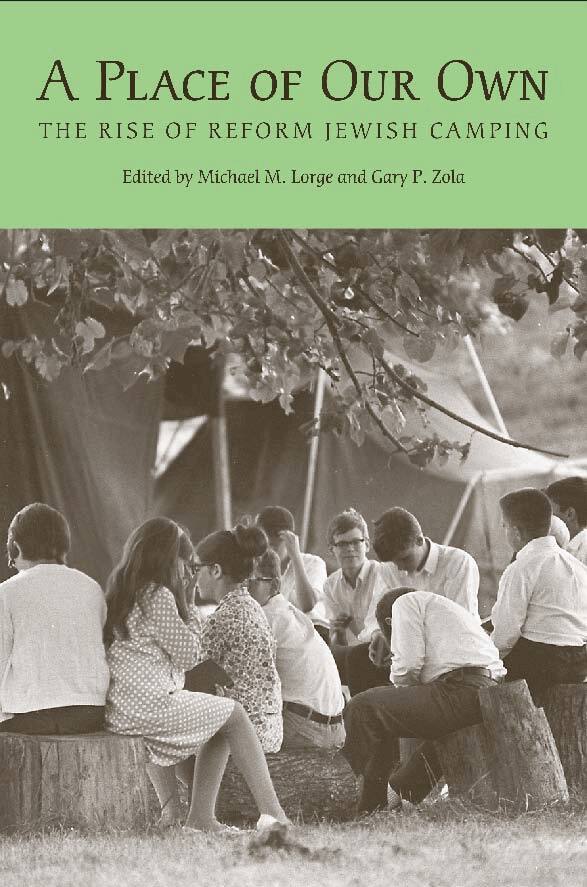
Reform Judaism is not the only religious group in America to make the summer camp experience a vital part of a faith community's effort to impart its values and beliefs to its adolescents, but perhaps no group relied more on summer camp as an adjunct to home and community for this purpose. Summer camp became an important part of Reform group identity, a bulwark against the attraction of assimilation into the greater society and mere nominal Judaism. These seven essays, which commemorate the fiftieth anniversary of the founding of the first Reform Jewish educational camp in the United States (Olin-Sang-Ruby Union Institute [OSRUI], in Oconomowoc, Wisconsin) cover a wide range of topics related to both the Reform Judaism movement and the development of the Reform Jewish camping system in the United States. Donald M. Splansky's chapter on 'Prayer at Reform Jewish Camps' documents changes in prayer services that took place both at OSRUI and in the Reform movement in general; Michael Zeldin's 'Making the Magic in Reform Jewish Summer Camps' describes the educational philosophies employed at many camps and analyzes their effectiveness; and Jonathan D. Sarna's 'The Crucial Decade in Jewish Camping' explains how social, political, and cultural conditions paved the way for the Reform camping movement.
Jewish Law in Transition
How Economic Forces Overcame the Prohibition Against Lending on Interest
Häftad, Engelska, 2015
489 kr
Tillfälligt slut
Jewish Law in Transition
How Economic Forces Overcame the Prohibition Against Lending on Interest
Inbunden, Engelska, 2008
523 kr
Tillfälligt slut
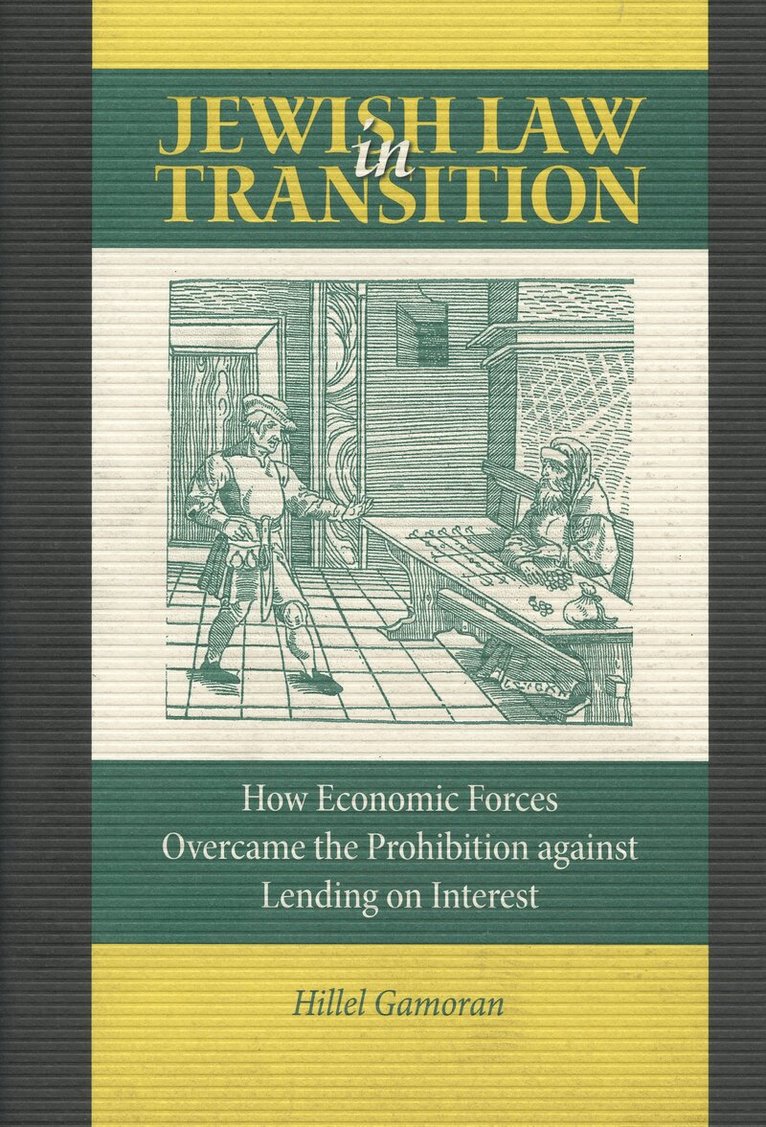
The prohibition against lending on interest (Exodus 22:24) is a well-known biblical law: "If you lend to any one of my people with you who is poor, you shall not be to him as a creditor, and you shall not exact interest from him." This prohibition was intended to prevent the wealthy from exploiting the unfortunate. In the course of time, it was seen to have consequences that militated against the economic welfare of Jewish society as a whole. As a result, Jewish law (halakhah) has over the centuries relaxed the biblical injunction, allowing interest charges despite the biblical prohibition. Hillel Gamoran seeks to explain how and when this law of high moral standing collapsed and fell over the course of the centuries. Talmudic rabbis believed that business agreements violated the biblical prohibition against lending in five areas: loans of produce, advance payment for the purchase of goods, buying on credit, mortgages, and investments. The Bible does not consider any of these activities, but all arise in postbiblical literature. How was the biblical law to be applied to situations that had not occurred in biblical times? And how could the rabbis allow these activities when they were hampered from doing so by the laws against lending on interest? To answer these questions, Gamoran examines the biblical prohibition against lending and postulates when it was written, why it was written, and to whom it applied. He then considers the early and later teachers of the Oral Law, the Tannaim and Amoraim, who expanded discussion of the ban in light of various business activities from 70 C.E. to 500 C.E. Finally, he explores how the original tannaitic proscriptions for each of the five activities were upheld or relaxed over the centuries. Each activity is considered in the period of the Geonim (ca. 650-1050), the Rishonim (ca. 1000-1500), and the Aharonim (ca. 1500-2000). For each period, Gamoran shows how the rabbis struggled with the law and with one another and used inventive interpretation to create the legal fictions necessary for business life to flourish.
Del 2 - Jewish Law Review
Jewish Law Review Vol. II: The Mishnah's Laws of Lost and Found
Häftad, Engelska, 2020
216 kr
Skickas inom 3-6 vardagar