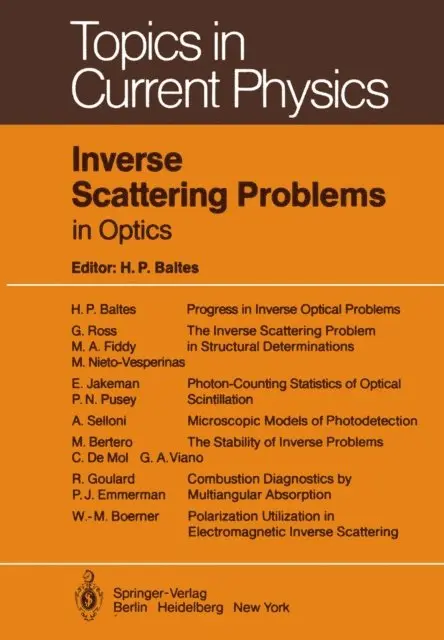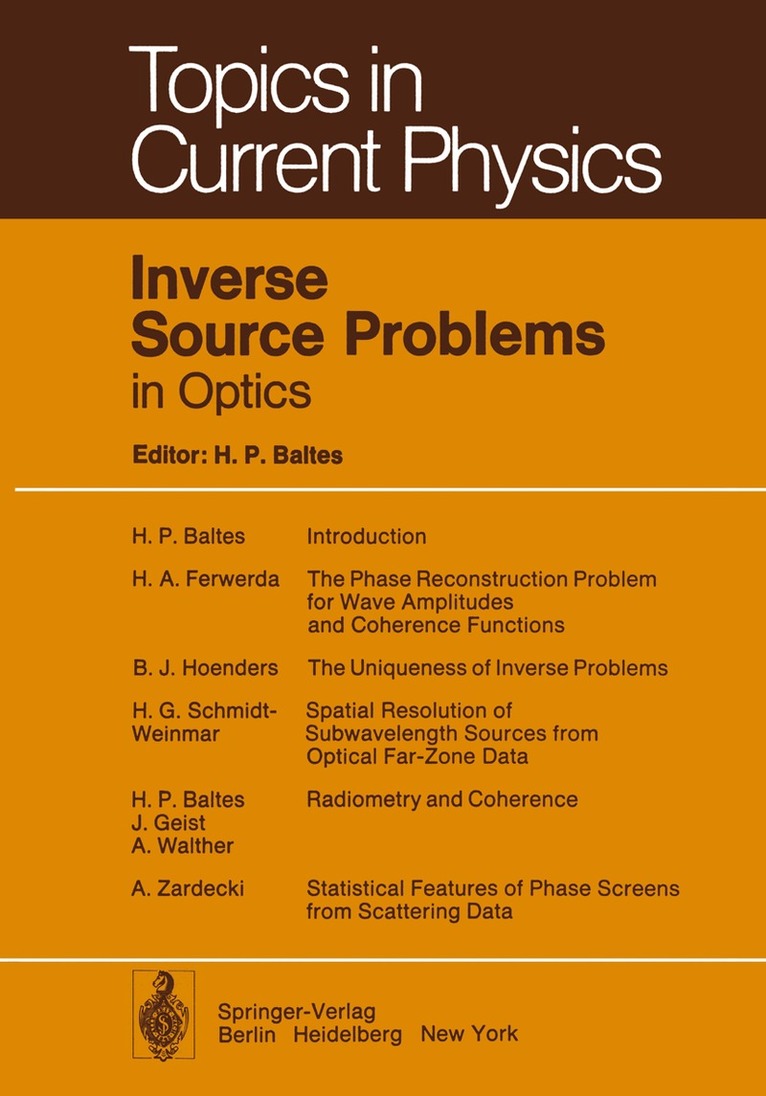
Häftad, Engelska, 2011
1 104 kr
Skickas inom 10-15 vardagar
H. P. Baltes We begin the introductory chapter with a general definition of the inverse optical problem. Next, we discuss the role of prior knowledge and the questions of uniqueness and stability. We then review the various specific inverse problems in optics as well as the contents of Chapters 2 to 6. Finally, we summarize the notation in co herence theory. 1. 1 Direct and Inverse Problems in Optical Physics The "direct" or "normal" problem in optical physics is to :Jredict the emission or propagation of radiation on the basis of a known constitution of sources or scat terers. The "inverse" or "indirect" problem is to deduce features of sources or scatterers from the detection of radiation. An intuitive solution of the optical inverse problem is commonplace: we infer the size, shape, surface texture, and ma terial of objects from their scattering and absorption of light as detected by our eyes. Intuition has to give way to mathematical reconstruction as soon as we wish to analyze optical data beyond their visual appearance. Examples are the extrapola tion and deblurring of optical images, the reconstruction from intuitively inacces sible data such as defocused images and interferograms, or the search for information that is "lost" in the detection process such as the phase. Following CHADAN and SABATIER [1. 1], a general definition of inverse optical problems can be attempted as follows. We describe the sources and scatterers by the set (1.