• Fri frakt över 249 kr
  • •
  • Snabba leveranser
  • •
  • Billiga böcker
Kundservice

Du är på sajten för privatpersoner.

Företag, bibliotek eller offentlig verksamhet?

Du handlar på classic.bokus.com, där alla dina funktioner finns intakta.
Till classic.bokus.com
Bokus logotyp. Gå till startsidan.
  • Erbjudanden
  • Nyheter
  • Student
  • Topplistor
  • Barn & ungdom
  • Bokus Play
  • E-böcker
  • Pocketböcker
  • Spel & pussel

10% rabatt på allt med kod NYSTART10 →

Sidfot

Mina sidor

    Hjälp

    • Kundservice
    • Vanliga frågor och svar
    • Frakt och leverans
    • Retur vid ångerrätt
    • Reklamera vara
    • Betalning
    • Köpvillkor
    • Allmänna villkor
    • Information om webbplatsens tillgänglighet

    Om Bokus

    • Om oss
    • Pressrum
    • För studenter
    • För företag
    • För bibliotek och offentlig verksamhet
    • För leverantörer
    • Hållbarhet

    Populärt

    • Aktuella erbjudanden
    • Presentkort
    • Studentlitteratur
    • Nya böcker
    • Topplistor
    • Signerade böcker
    • Engelska böcker

    Inspiration

    • Boktips
    • BookTok
    • Populära bokserier
    • Barnbokskaraktärer
    • Populära författare
    Logotyp för Bokus
    Följ oss på Facebook (extern länk)Följ oss på Instagram (extern länk)Följ oss på YouTube (extern länk)Följ oss på TikTok (extern länk)
    bokus @ CookiesAnpassa cookiesIntegritetspolicyKöpvillkor
    Till Citymail hemsida (extern länk)Till Budbee hemsida (extern länk)Till Postnord hemsida (extern länk)Till Schenker hemsida (extern länk)Till Early Bird hemsida (extern länk)Till Walleys hemsida (extern länk)
    1. Naturvetenskap och teknik
    2. Matematik och naturvetenskap
    3. Fysik
    4. Elektricitet och magnetism

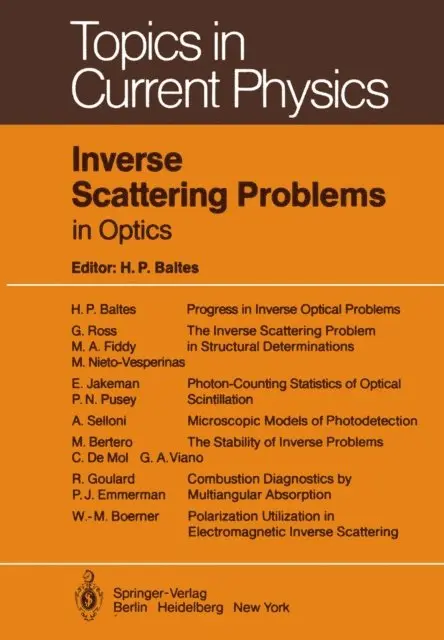
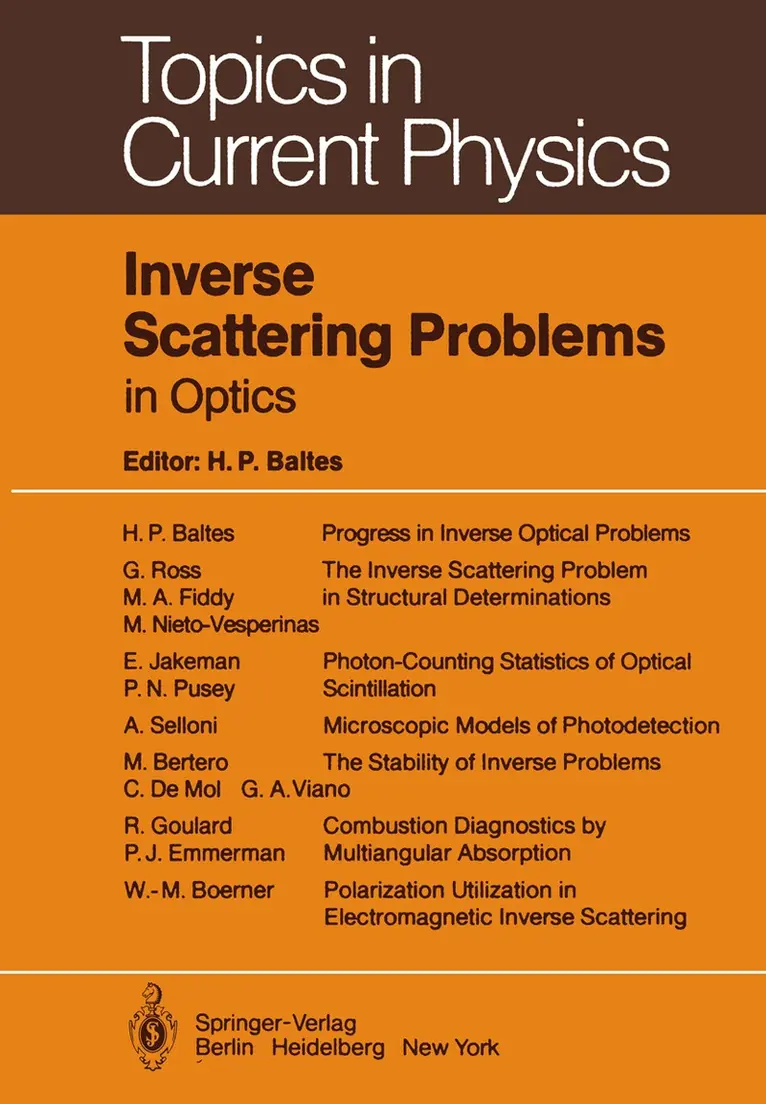
    Inverse Source Problems in Optics

    AvH.P. Baltes

    Häftad, Engelska, 2011

    Del i serien Topics in Current Physics

    1 085 kr

    Beställningsvara. Skickas inom 10-15 vardagar. Fri frakt över 249 kr.

    Beskrivning

    H. P. Baltes We begin the introductory chapter with a general definition of the inverse optical problem. Next, we discuss the role of prior knowledge and the questions of uniqueness and stability. We then review the various specific inverse problems in optics as well as the contents of Chapters 2 to 6. Finally, we summarize the notation in co­ herence theory. 1. 1 Direct and Inverse Problems in Optical Physics The "direct" or "normal" problem in optical physics is to :Jredict the emission or propagation of radiation on the basis of a known constitution of sources or scat­ terers. The "inverse" or "indirect" problem is to deduce features of sources or scatterers from the detection of radiation. An intuitive solution of the optical inverse problem is commonplace: we infer the size, shape, surface texture, and ma­ terial of objects from their scattering and absorption of light as detected by our eyes. Intuition has to give way to mathematical reconstruction as soon as we wish to analyze optical data beyond their visual appearance. Examples are the extrapola­ tion and deblurring of optical images, the reconstruction from intuitively inacces­ sible data such as defocused images and interferograms, or the search for information that is "lost" in the detection process such as the phase. Following CHADAN and SABATIER [1. 1], a general definition of inverse optical problems can be attempted as follows. We describe the sources and scatterers by the set (1.

    Produktinformation

    • Utgivningsdatum:2011-12-08
    • Mått:170 x 244 x 13 mm
    • Vikt:389 g
    • Format:Häftad
    • Språk:Engelska
    • Serie:Topics in Current Physics
    • Antal sidor:204
    • Förlag:Springer-Verlag Berlin and Heidelberg GmbH & Co. KG
    • Medarbetare:J.-F Moser
    • ISBN:9783642812743

    Utforska kategorier

    • Elektricitet och magnetism inom Naturvetenskap och teknik
    • Fysik inom Naturvetenskap och teknik

    Innehållsförteckning

    • 1. Introduction.- 1.1 Direct and Inverse Problems in Optical Physics.- 1.2 Role of Prior Knowledge.- 1.3 Survey of Specific Inverse Problems.- 1.4 Notati on i n Coherence Theory.- References.- 2. The Phase Reconstruction Problem for Wave Amplitudes and Coherence Functions.- 2.1 Phase Reconstruction for Wave Ampl i tudes.- 2.2 Phase Reconstruction for Coherence Functions.- References.- 3. The Uniqueness of Inverse Problems.- 3.1 Summary of Inverse Problems.- 3.2 Inverse Diffraction.- 3.3 Non-Radiating Sources.- 3.4 The Determination of an Object from Scattering Data.- References.- 4. Spatial Resolution of Subwavelength Sources from Optical Far-Zone Data.- 4.1 Approaches to Superresolution.- 4.2 Partial Waves Associated with Complex Spatial Frequencies.- 4.3 Representations and Expansions of the EM Field.- 4.4 Band-Limiting at Variance with X-Localized Sources.- 4.5 High-Frequency Information in the Far Zone Given a X-Localized Source.- 4.6 X-Localized Sources Reconstructed from Far-Zone Data.- 4.7 Measurement of Phase and Magnitude of the Optical Radiation Pattern.- 4.8 Discussion.- References.- 5. Radiometry and Coherence.- 5.1 The Development of Radiometry.- 5.2 Coherence of Blackbody Radiation.- 5.3 First-Order Radiometry.- 5.4 Radiant Intensity and Angular Coherence.- 5.5 Radiation Efficiency.- 5.6 Second-Order Radiometry.- References.- 6. Statistical Features of Phase Screens from Scattering Data.- 6.1 Basic Formulation of the Statistical Problem.- 6.2 More General Detection and Coherence Conditions.- 6.3 Amplitude and Intensity Correlations.- 6.4 Number-Dependent Effects.- 6.5 Concluding Remarks.- References.- Additional References with Titles.