• Fri frakt över 249 kr
  • •
  • Snabba leveranser
  • •
  • Billiga böcker
Kundservice

Du är på sajten för privatpersoner.

Företag, bibliotek eller offentlig verksamhet?

Du handlar på classic.bokus.com, där alla dina funktioner finns intakta.
Till classic.bokus.com
Bokus logotyp. Gå till startsidan.
  • Erbjudanden
  • Nyheter
  • Student
  • Topplistor
  • Barn & ungdom
  • Bokus Play
  • E-böcker
  • Pocketböcker
  • Spel & pussel

10% rabatt på allt med kod NYSTART10 →

Sidfot

Mina sidor

    Hjälp

    • Kundservice
    • Vanliga frågor och svar
    • Frakt och leverans
    • Retur vid ångerrätt
    • Reklamera vara
    • Betalning
    • Köpvillkor
    • Allmänna villkor
    • Information om webbplatsens tillgänglighet

    Om Bokus

    • Om oss
    • Pressrum
    • För studenter
    • För företag
    • För bibliotek och offentlig verksamhet
    • För leverantörer
    • Hållbarhet

    Populärt

    • Aktuella erbjudanden
    • Presentkort
    • Studentlitteratur
    • Nya böcker
    • Topplistor
    • Signerade böcker
    • Engelska böcker

    Inspiration

    • Boktips
    • BookTok
    • Populära bokserier
    • Barnbokskaraktärer
    • Populära författare
    Logotyp för Bokus
    Följ oss på Facebook (extern länk)Följ oss på Instagram (extern länk)Följ oss på YouTube (extern länk)Följ oss på TikTok (extern länk)
    bokus @ CookiesAnpassa cookiesIntegritetspolicyKöpvillkor
    Till Citymail hemsida (extern länk)Till Budbee hemsida (extern länk)Till Postnord hemsida (extern länk)Till Schenker hemsida (extern länk)Till Early Bird hemsida (extern länk)Till Walleys hemsida (extern länk)
    1. Naturvetenskap och teknik
    2. Matematik och naturvetenskap
    3. Fysik

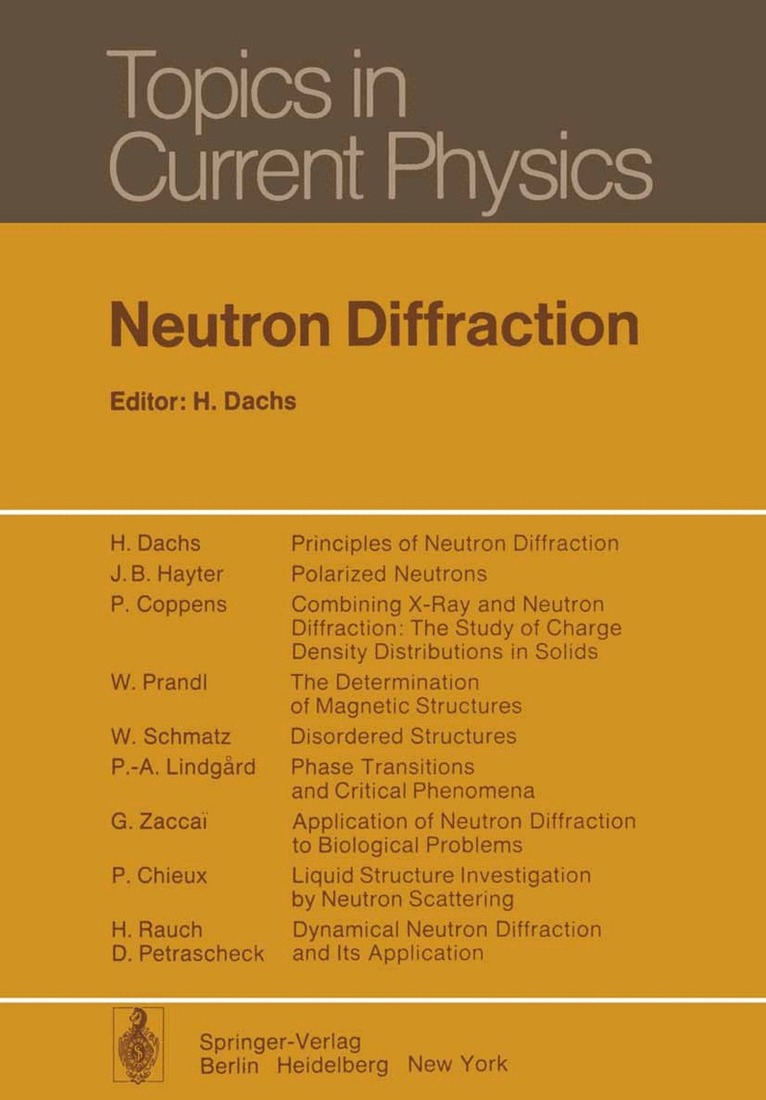
    Neutron Diffraction

    AvH. Dachs

    Häftad, Engelska, 2011

    Del i serien Topics in Current Physics

    1 085 kr

    Beställningsvara. Skickas inom 10-15 vardagar. Fri frakt över 249 kr.

    Beskrivning

    Since the great discovery made by Laue, x-ray diffraction has become the most im­ portant method for the investigation of atomic structure in condensed matter. Cer­ tain investigations, however, are difficult or totally impossible to conduct using x-rays, for example, the localization of atomic nuclei or atoms having only a few core electrons, and the observation of magnetic moments. The investigation of these important areas is made possible by neutron diffraction. Thus this method has devel­ oped into an important supplement to x-ray investigations. An ever-increasing de­ mand is put on the method by research areas, old and new. Neutron diffraction has completely reformed the subject of solid-state magnetism; especially the area of chemical binding has received a new impetus by the union of x-ray and neutron dif­ fraction. An exchange of different isotopes of the same element gives rise, as a rule, to a change in the strength of the neutron diffraction. Due to this effect itls possible, by means of deuteration, to make visible a single chain in a solid high polymer. Thus neutron small-angle scattering is important in protein research and for the biology of macromolecules. Of equal importance is the application of neu:ron diffraction in metallurgy. There already exist several excellent books which discuss the results obtained by neans of neutron diffraction.

    Produktinformation

    • Utgivningsdatum:2011-12-15
    • Mått:170 x 244 x 21 mm
    • Vikt:648 g
    • Format:Häftad
    • Språk:Engelska
    • Serie:Topics in Current Physics
    • Antal sidor:360
    • Förlag:Springer-Verlag Berlin and Heidelberg GmbH & Co. KG
    • ISBN:9783642812385

    Utforska kategorier

    • Fysik inom Naturvetenskap och teknik

    Innehållsförteckning

    • 1. Principles of Neutron Diffraction..- 1.1 Introduction.- 1.2 Background.- 1.3 VAN HOVE Theory in the Classical Approximation.- 1.4 Interaction of Neutrons with Matter.- 1.5 Optimization of Scattering Experiments.- 1.6 Theory of the Neutron Spectrometer.- References.- 2. Polarized Neutrons..- 2.1 Overview.- 2.2 Theoretical Background.- 2.3 Production and Handling of Polarized Beams.- 2.4 Some Applications of Polarized Neutron Scattering.- 2.5 Summary.- References.- 3. Combining X-Ray and Neutron Diffraction: The Study of Charge Density Distributions in Solids..- 3.1 Background.- 3.2 The Electron Distribution in Crystals and the Pertinence of Neutron Diffraction.- 3.3 Experimental Aspects.- 3.4 Statistical Analysis of the Errors in X-N Maps.- 3.5 Survey of Selected Results.- 3.6 Results Based Exclusively on X-Ray Data; Can They Replace the X-N Technique?.- References.- 4. The Determination of Magnetic Structures..- 4.1 Magnetic Neutron Scattering: Elementary Treatment.- 4.2 Magnetic Structures: Phenomenology.- 4.3 Generating Models.- 4.4 The Application of Magnetic Groups.- 4.5 Irreducible Representation of Space Groups.- 4.6 Magnetic Neutron Scattering: The General Case.- 4.7 Instruments/Measurements/Data Analysis.- 4.8 Nomenclature and Publications.- References.- 5. Disordered Structures..- 5.1 Summary.- 5.2 Scattering Laws.- 5.3 Experimental Techniques.- 5.4 Small-Angle Neutron Scattering (SANS).- 5.5 Diffuse Elastic Scattering by Nonmagnetic Crystals.- 5.6 Scattering by Disordered Magnetic Systems.- References.- 6. Phase Transitions and Critical Phenomena..- 6.1 Overview.- 6.2 Theory of Phase Transitions.- 6.3 Theories of Critical Phenomena.- 6.4 The Neutron Scattering Cross Section.- 6.5 Critical Phenomena at a Second-Order Phase Transition.- 6.6 Phase Diagrams: Multicritical Points and First- and Second-Order Transitions.- 6.7 Discussion and Outlook.- References.- 7. Application of Neutron Diffraction to Biological Problems..- 7.1 Background.- 7.2 Theory.- 7.3 Single-Crystal Analysis.- 7.4 Oriented Systems.- 7.5 Particles in Solution.- 7.6 Conclusions.- References.- 8. Liquid Structure Investigation by Neutron Scattering..- 8.1 Overview.- 8.2 The Basic Equations.- 8.3 Neutron Scattering Experiment.- 8.4 Monatomic Liquids.- 8.5 Binary Systems.- 8.6 Molecular Liquids.- 8.7 Solutions.- References.- 9. Dynamical Neutron Diffraction and Its Application..- 9.1 Basic Equations.- 9.2 Solution for a Plane Slab.- 9.3 Spatial Intensity Profiles and the Spherical Wave Theory.- 9.4 Influence of Absorption.- 9.5 Magnetic Crystals.- 9.6 Applications.- References.