H.W. Roesky - Böcker
Visar alla böcker från författaren H.W. Roesky. Handla med fri frakt och snabb leverans.
6 produkter
6 produkter
2 101 kr
Skickas inom 10-15 vardagar
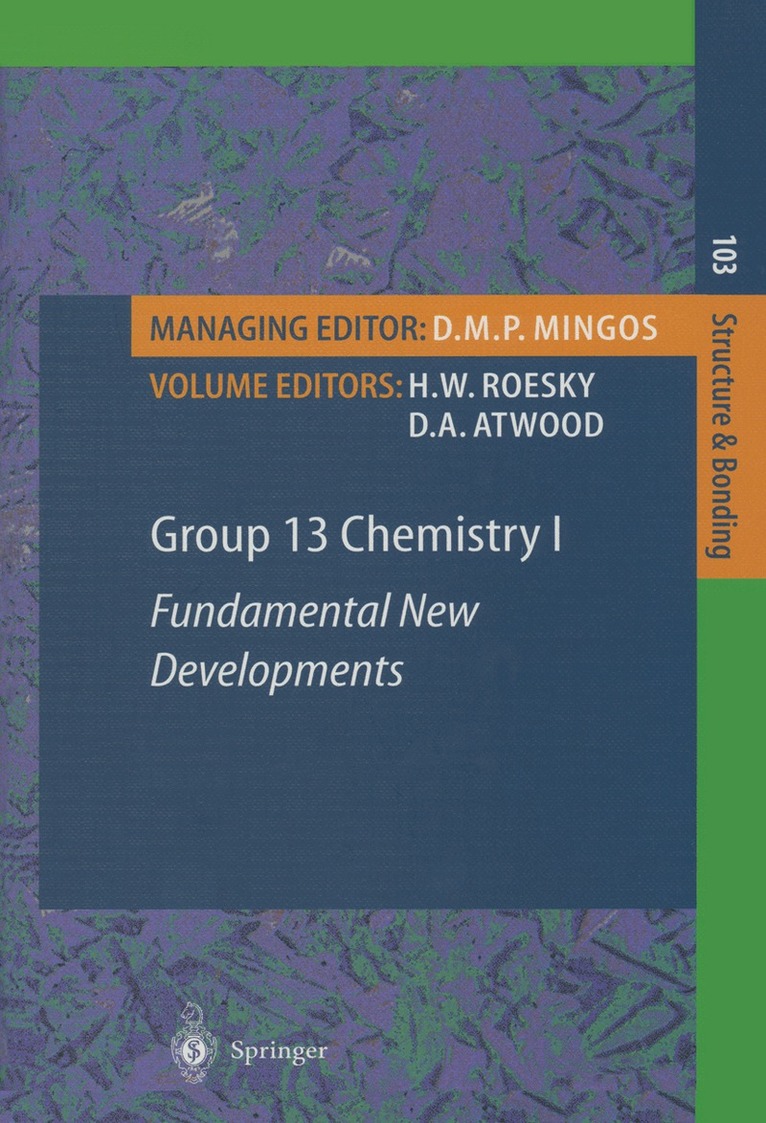
Over the last decade our view of chemistry has evolved substantially. Whereas individual researchers previously focused on specific areas of chemistry, such as inorganic, organic, etc. we now take a more holistic approach. Effective and efficient research projects now incorporate whatever aspects of the chemistry subdisciplines that are needed to complete the intended work. The main group elements have always been used in this manner. Depending on the use of the elements, the resulting work can be described under any heading of chemistry. The group 13 elements have been special in this regard due to the very unique characters of the constituent elements. Thus, there is a dramatic change in the properties of the elements when proceeding through the series, B, A1, Ga, In, T1. This difference is one of the main reasons why these elements have seen, and continue to see, such widespread usage in such disparate applications as organic synthesis, electronic and structural materials, and catalysis, to name but a few.
2 101 kr
Skickas inom 10-15 vardagar
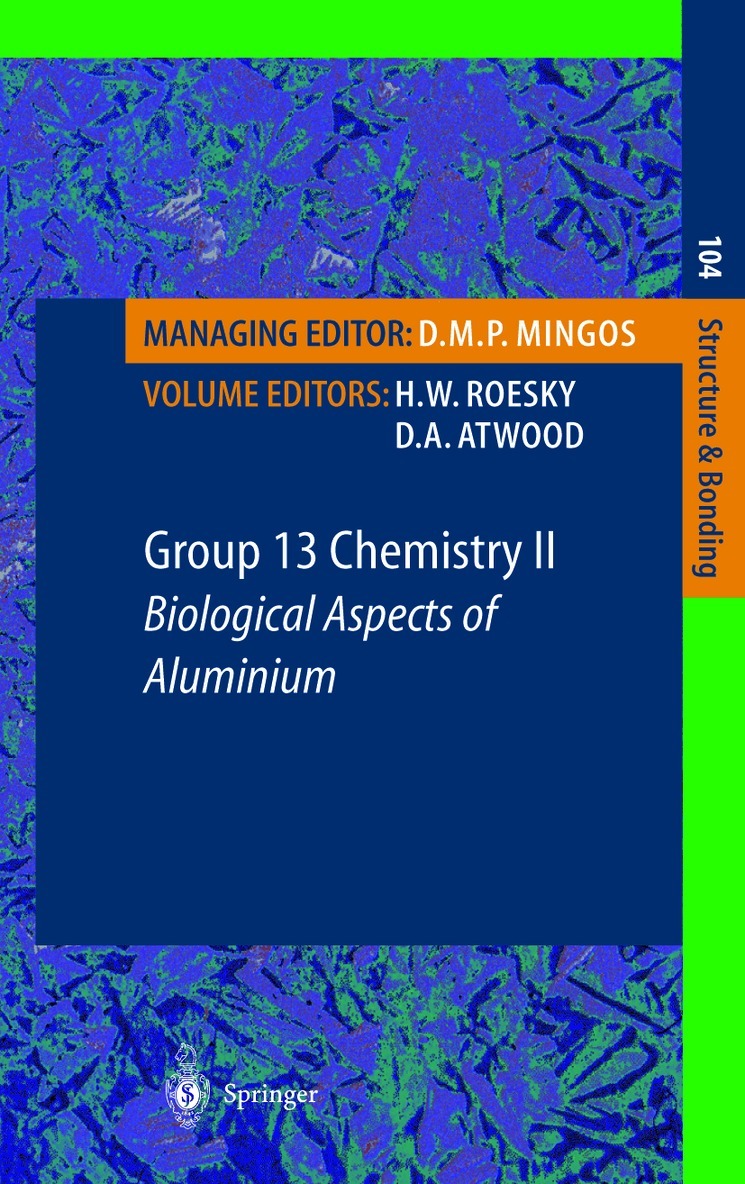
Aluminum, bound almost exclusively to oxygen in various combinations, is the most abundant metal in the earth's crust and, therefore, of great commercial potential. Once methods were developed (in the 1880's) to free useable quantities of the element from oxygen, applications for the element began developing rapidly. This growth has resulted in the ubiquity of the metal in today's world. Therefore it can be found intentionally introduced in many products in direct contact with human beings. It is commonly known that soluble forms of aluminum aretoxic to living organisms. However, aluminum is not known to be bioavailable under everyday conditions. In fact, the solubility product of common aluminum compounds, such as AI(OH)3 is so low as to make it essentially unavailable. This volume of Structure and Bonding seeks to provide in one source, a resource where the basic science related to aluminum toxicity may be obtained. It should be stressed that this volume is not intended to be a warning to avoid contact with aluminum. Living organisms have adequate defenses to prevent aluminum toxicity under normal conditions. Rather the volume was created to simply provide an understanding of the biological effects of aluminum. As such, the present volume should be considered in the context of the companion volumes in this three part series of Structure and Bonding. The first volume was devoted to fundamental developments in group 13 chemistry.
2 101 kr
Skickas inom 10-15 vardagar
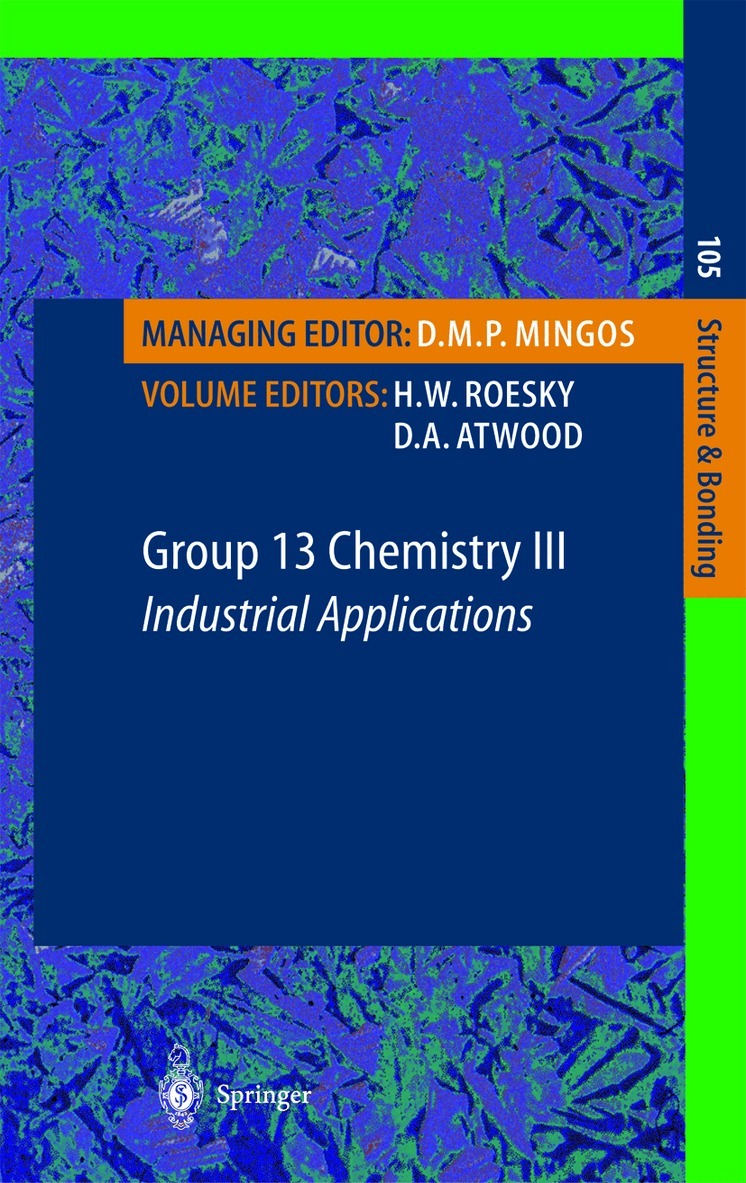
The present issue of Structure and Bonding is dedicated to applied group 13 chemistry, particularly for the elements boron and aluminum, and to a lesser degree gallium and indium. Although boron is a trace element (0.01 g kg 1) in the earth's crust, it has been concentrated in a few locations by geochemical processes and is relatively easy to mine as borax. Aluminum, on the other hand, is the most abundant metal in the earth's crust (82 g kg 1) and dispersed widely throughout the globe. Thus, boron and aluminum are readily available and their associated products or compounds are usually inexpensive and thereby easy to commercialize. The chapters were chosen to encompass both applied and fundamental aspects of their subiects. The first chapter 'Borates in Industrial Use' provides a complete, and perhaps, quintessential, coverage of compounds containing boron oxygen bonds. In the chapter Schubert explains the close relationship between the basic properties of the boron compounds and their associated uses. The remaining four chapters focus, to some degree, on aluminum. Since a great deal of literature exists in this area, these chapters are more focused on areas of emerging utility, and contain a great deal of fundamental information. Uhl's contribution in Chapter 2 provides basic synthesis and structural information for aluminum and gallium hydrazides. These types of compounds are being explored as potential molecular precursors to metal nitrides such as the important blue green laser material gallium nitride.
2 101 kr
Skickas inom 10-15 vardagar
Over the last decade our view of chemistry has evolved substantially. Whereas individual researchers previously focused on specific areas of chemistry, such as inorganic, organic, etc. we now take a more holistic approach. Effective and efficient research projects now incorporate whatever aspects of the chemistry subdisciplines that are needed to complete the intended work. The main group elements have always been used in this manner. Depending on the use of the elements, the resulting work can be described under any heading of chemistry. The group 13 elements have been special in this regard due to the very unique characters of the constituent elements. Thus, there is a dramatic change in the properties of the elements when proceeding through the series, B, A1, Ga, In, T1. This difference is one of the main reasons why these elements have seen, and continue to see, such widespread usage in such disparate applications as organic synthesis, electronic and structural materials, and catalysis, to name but a few.
2 101 kr
Skickas inom 10-15 vardagar
Aluminum, bound almost exclusively to oxygen in various combinations, is the most abundant metal in the earth's crust and, therefore, of great commercial potential. Once methods were developed (in the 1880's) to free useable quantities of the element from oxygen, applications for the element began developing rapidly. This growth has resulted in the ubiquity of the metal in today's world. Therefore it can be found intentionally introduced in many products in direct contact with human beings. It is commonly known that soluble forms of aluminum aretoxic to living organisms. However, aluminum is not known to be bioavailable under everyday conditions. In fact, the solubility product of common aluminum compounds, such as AI(OH)3 is so low as to make it essentially unavailable. This volume of Structure and Bonding seeks to provide in one source, a resource where the basic science related to aluminum toxicity may be obtained. It should be stressed that this volume is not intended to be a warning to avoid contact with aluminum. Living organisms have adequate defenses to prevent aluminum toxicity under normal conditions. Rather the volume was created to simply provide an understanding of the biological effects of aluminum. As such, the present volume should be considered in the context of the companion volumes in this three part series of Structure and Bonding. The first volume was devoted to fundamental developments in group 13 chemistry.
2 101 kr
Skickas inom 10-15 vardagar
The present issue of Structure and Bonding is dedicated to applied group 13 chemistry, particularly for the elements boron and aluminum, and to a lesser degree gallium and indium. Although boron is a trace element (0.01 g kg 1) in the earth's crust, it has been concentrated in a few locations by geochemical processes and is relatively easy to mine as borax. Aluminum, on the other hand, is the most abundant metal in the earth's crust (82 g kg 1) and dispersed widely throughout the globe. Thus, boron and aluminum are readily available and their associated products or compounds are usually inexpensive and thereby easy to commercialize. The chapters were chosen to encompass both applied and fundamental aspects of their subiects. The first chapter 'Borates in Industrial Use' provides a complete, and perhaps, quintessential, coverage of compounds containing boron oxygen bonds. In the chapter Schubert explains the close relationship between the basic properties of the boron compounds and their associated uses. The remaining four chapters focus, to some degree, on aluminum. Since a great deal of literature exists in this area, these chapters are more focused on areas of emerging utility, and contain a great deal of fundamental information. Uhl's contribution in Chapter 2 provides basic synthesis and structural information for aluminum and gallium hydrazides. These types of compounds are being explored as potential molecular precursors to metal nitrides such as the important blue green laser material gallium nitride.