• Fri frakt över 249 kr
  • •
  • Snabba leveranser
  • •
  • Billiga böcker
Kundservice

Du är på sajten för privatpersoner.

Företag, bibliotek eller offentlig verksamhet?

Du handlar på classic.bokus.com, där alla dina funktioner finns intakta.
Till classic.bokus.com
Bokus logotyp. Gå till startsidan.
  • Erbjudanden
  • Nyheter
  • Student
  • Topplistor
  • Barn & ungdom
  • Bokus Play
  • E-böcker
  • Pocketböcker
  • Spel & pussel

10% rabatt på allt med kod: NYSTART10 →

Sidfot

Mina sidor

    Hjälp

    • Kundservice
    • Vanliga frågor och svar
    • Frakt och leverans
    • Retur vid ångerrätt
    • Reklamera vara
    • Betalning
    • Köpvillkor
    • Allmänna villkor
    • Information om webbplatsens tillgänglighet

    Om Bokus

    • Om oss
    • Pressrum
    • För studenter
    • För företag
    • För bibliotek och offentlig verksamhet
    • För leverantörer
    • Hållbarhet

    Populärt

    • Aktuella erbjudanden
    • Presentkort
    • Studentlitteratur
    • Nya böcker
    • Topplistor
    • Signerade böcker
    • Engelska böcker

    Inspiration

    • Boktips
    • BookTok
    • Populära bokserier
    • Barnbokskaraktärer
    • Populära författare
    Logotyp för Bokus
    Följ oss på Facebook (extern länk)Följ oss på Instagram (extern länk)Följ oss på YouTube (extern länk)Följ oss på TikTok (extern länk)
    bokus @ CookiesAnpassa cookiesIntegritetspolicyKöpvillkor
    Till Citymail hemsida (extern länk)Till Budbee hemsida (extern länk)Till Postnord hemsida (extern länk)Till Schenker hemsida (extern länk)Till Early Bird hemsida (extern länk)Till Walleys hemsida (extern länk)
    1. Naturvetenskap och teknik
    2. Matematik och naturvetenskap
    3. Biologi
    4. Biokemi

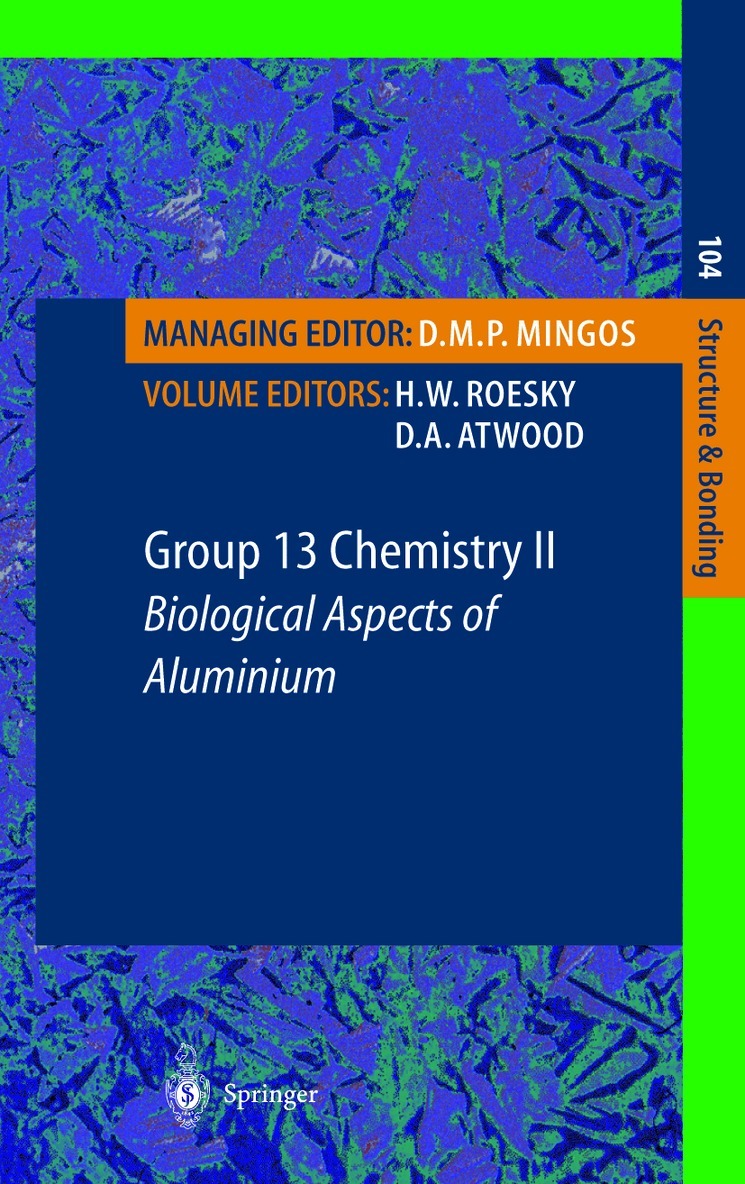
    Group 13 Chemistry II

    Biological Aspects of Aluminum

    AvH.W. Roesky,David A. Atwood

    Häftad, Engelska, 2010

    Del 104 i serien Structure and Bonding

    2 164 kr

    Beställningsvara. Skickas inom 10-15 vardagar. Fri frakt över 249 kr.

    Beskrivning

    Aluminum, bound almost exclusively to oxygen in various combinations, is the most abundant metal in the earth's crust and, therefore, of great commercial potential. Once methods were developed (in the 1880's) to free useable quantities of the element from oxygen, applications for the element began developing rapidly. This growth has resulted in the ubiquity of the metal in today's world. Therefore it can be found intentionally introduced in many products in direct contact with human beings. It is commonly known that soluble forms of aluminum aretoxic to living organisms. However, aluminum is not known to be bioavailable under everyday conditions. In fact, the solubility product of common aluminum compounds, such as AI(OH)3 is so low as to make it essentially unavailable. This volume of Structure and Bonding seeks to provide in one source, a resource where the basic science related to aluminum toxicity may be obtained. It should be stressed that this volume is not intended to be a warning to avoid contact with aluminum. Living organisms have adequate defenses to prevent aluminum toxicity under normal conditions. Rather the volume was created to simply provide an understanding of the biological effects of aluminum. As such, the present volume should be considered in the context of the companion volumes in this three part series of Structure and Bonding. The first volume was devoted to fundamental developments in group 13 chemistry.

    Produktinformation

    • Utgivningsdatum:2010-12-01
    • Mått:155 x 235 x 12 mm
    • Vikt:330 g
    • Format:Häftad
    • Språk:Engelska
    • Serie:Structure and Bonding
    • Antal sidor:202
    • Förlag:Springer-Verlag Berlin and Heidelberg GmbH & Co. KG
    • ISBN:9783642078545

    Utforska kategorier

    • Biokemi inom Naturvetenskap och teknik
    • Cellbiologi inom Naturvetenskap och teknik
    • Biovetenskap inom Naturvetenskap och teknik

    Innehållsförteckning

    • Acute Aluminum Intoxication.- A New Effect of Aluminum on Iron Metabolism in Mammalian Cells.- The Complexity of Aluminum-DNA Interactions: Relevance to Alzheimer’s and Other Neurological Diseases.- Aluminum: Interaction with Nucleotides and Nucleotidases and Analytical Aspects of Its Determination.- Aluminofluoride Complexes in the Etiology of Alzheimer’s Disease.- Fluoroaluminate Chemistry.