Idurre Alonso - Böcker
Visar alla böcker från författaren Idurre Alonso. Handla med fri frakt och snabb leverans.
3 produkter
3 produkter
588 kr
Tillfälligt slut
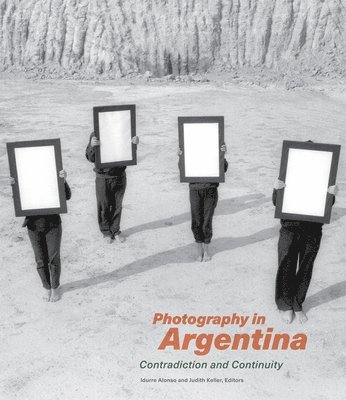
From its independence in 1810 until the economic crisis of 2001, Argentina has been seen, in the national and international collective imaginary, as a modern country with a powerful economic system, a massive European immigrant population, an especially strong middle class, and an almost nonexistent indigenous culture. In some ways, the early history of Argentina strongly resembles that of the United States, with its march to the prairies and frontier ideology, the image of the cowboy as a national symbol (equivalent to the Argentine gaucho), the importance of the immigrant population, and the advanced and liberal ideas of the founding fathers. But did Argentine history truly follow a linear path toward modernization? How did photography help shape or deconstruct notions associated with Argentina?Photography in Argentina examines the complexitiesof this country's history, stressing the heterogeneity of itsrealities, and especially the power of constructedphotographic images-that is, the practice of altering realityfor artistic expression, an important vein in Argentinephotography-in the configuration of a national imaginary.Influential specialists from Argentina have contributed essays on various topics, such as the shaping of national myths; the adaptation of gesture as related to the "disappeared" during the dictatorship period; the role of contemporary photography in the context of recent sociopolitical events; and the reinterpreting of traditional notions of documentary photography in Argentina and the rest of Latin America.A well- researched and beautifully laid out chronology provides an overall view that will be useful for general readers and specialists alike.
599 kr
Skickas inom 7-10 vardagar
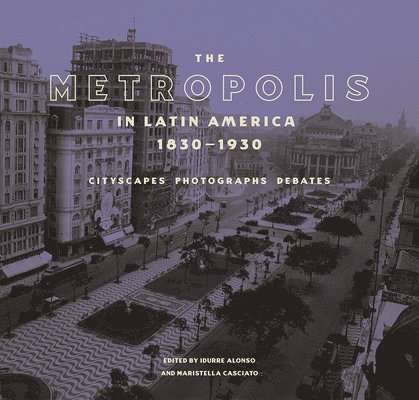
In the century between 1830 and 1930, following independence from Spain and Portugal, major cities in Latin America experienced large-scale growth, with the development of a new urban bourgeois elite interested in projects of modernization and rapid industrialization. At the same time, the lower classes were eradicated from old city districts and deported to the outskirts. The Metropolis in Latin America, 1830-1930 surveys this expansion, focusing on six capital cities-Havana, Mexico City, Rio de Janeiro, Buenos Aires, Santiago de Chile, and Lima-as it examines sociopolitical histories, town planning, art and architecture, photography, and film in relation to the metropolis. Drawing from the Getty Research Institute's vast collection of books, prints, and photographs from this period, largely unpublished until now, this volume reveals the cities' changes through urban panoramas, plans depicting new neighborhoods, and photographs of novel transportation systems, public amenities, civic spaces, and more. It illustrates the transformation of colonial cities into the monumental modern metropolises that, by the end of the 1920s, provided fertile ground for the emergence of today's Latin American megalapolis.
514 kr
Skickas inom 7-10 vardagar
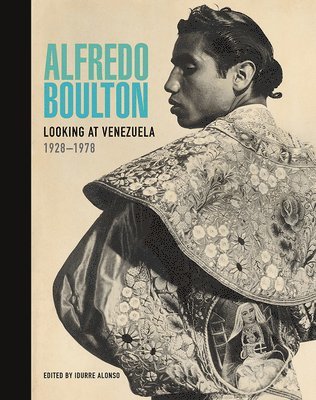
Alfredo Boulton (1908–1995) is considered one of the most important champions of modern art in Venezuela and a key intellectual of twentieth-century modernism. He was a pioneer of modern photography, an art critic, a researcher and historian of Venezuelan art, a friend to many of the great artists and architects of the twentieth century, and an expert on the imagery of the heroes of his country’s independence. Yet, Boulton is shockingly underrecognized outside of his native land. The few exhibitions related to his work have been focused exclusively on his photographic production; never has there been a project that looks at the full range of Boulton’s efforts, foregrounding his influence on the shaping of Venezuelan art. This volume addresses these lacunae by analyzing Boulton’s groundbreaking photographic practice, his central role in the construction of a modern national artistic canon, and his influence in formalizing and developing art history and criticism in Venezuela. Based on the extensive materials held in Boulton’s archive at the Getty Research Institute, Alfredo Boulton brings together essays by leading scholars in the field to offer a commanding, original perspective on his contributions to the formation of a distinctive modernity at home and beyond.