James A. Green - Böcker
Visar alla böcker från författaren James A. Green. Handla med fri frakt och snabb leverans.
9 produkter
9 produkter
2 183 kr
Skickas inom 3-6 vardagar
The persistent objector rule is said to provide states with an 'escape hatch' from the otherwise universal binding force of customary international law. It provides that if a state persistently objects to a newly emerging norm of customary international law during the formation of that norm, then the objecting state is exempt from the norm once it crystallises into law. The conceptual role of the rule may be interepreted as straightforward: to preserve the fundamentalist positivist notion that any norm of international law can only bind a state that has consented to be bound by it. In reality, however, numerous unanswered questions exist about the way that it works in practice. Through focused analysis of state practice, this monograph provides a detailed understanding of how the rule emerged and operates, how it should be conceptualised, and what its implications are for the binding nature of customary international law. It argues that the persistent objector rule ultimately has an important role to play in the mixture of consent and consensus that underpins international law.
393 kr
Skickas inom 7-10 vardagar
The persistent objector rule is said to provide states with an 'escape hatch' from the otherwise universal binding force of customary international law. It provides that if a state persistently objects to a newly emerging norm of customary international law during the formation of that norm, then the objecting state is exempt from the norm once it crystallises into law. The conceptual role of the rule may be interpreted as straightforward: to preserve the fundamentalist positivist notion that any norm of international law can only bind a state that has consented to be bound by it. In reality, however, numerous unanswered questions exist about the way that it works in practice. Through focused analysis of state practice, this monograph provides a detailed understanding of how the rule emerged and operates, how it should be conceptualised, and what its implications are for the binding nature of customary international law. It argues that the persistent objector rule ultimately has an important role to play in the mixture of consent and consensus that underpins international law.
663 kr
Skickas inom 10-15 vardagar
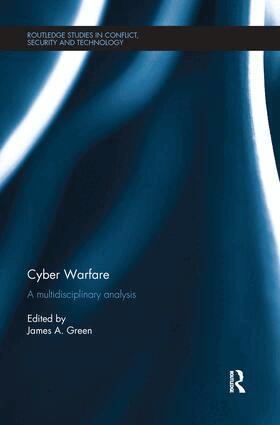
This book is a multi-disciplinary analysis of cyber warfare, featuring contributions by leading experts from a mixture of academic and professional backgrounds.Cyber warfare, meaning interstate cyber aggression, is an increasingly important emerging phenomenon in international relations, with state-orchestrated (or apparently state-orchestrated) computer network attacks occurring in Estonia (2007), Georgia (2008) and Iran (2010). This method of waging warfare – given its potential to, for example, make planes fall from the sky or cause nuclear power plants to melt down – has the capacity to be as devastating as any conventional means of conducting armed conflict. Every state in the world now has a cyber-defence programme and over 120 states also have a cyber-attack programme. While the amount of literature on cyber warfare is growing within disciplines, our understanding of the subject has been limited by a lack of cross-disciplinary engagement. In response, this book, drawn from the fields of computer science, military strategy, international law, political science and military ethics, provides a critical overview of cyber warfare for those approaching the topic from whatever angle. Chapters consider the emergence of the phenomena of cyber warfare in international affairs; what cyber-attacks are from a technological standpoint; the extent to which cyber-attacks can be attributed to state actors; the strategic value and danger posed by cyber conflict; the legal regulation of cyber-attacks, both as international uses of force and as part of an on-going armed conflict, and the ethical implications of cyber warfare.This book will be of great interest to students of cyber warfare, cyber security, military ethics, international law, security studies and IR in general.
1 278 kr
Skickas inom 7-10 vardagar
Collective self-defence can be defined as the use of military force by one or more states to aid another state that is an innocent victim of armed attack. However, it is a legal justification that is open to abuse and its exercise risks escalating conflict. Recent years have seen an unprecedented increase in the number of collective self-defence claims. It has been the main basis for US-led action in Syria (2014-) and was advanced by Russia in relation to its full-scale invasion of Ukraine (2022-). Yet there still has been little analysis of collective self-defence in international law. This book crucially progresses the debate on various fundamental and under-explored questions about the conceptual nature of collective self-defence and the requirements for its operation. Green provides the most detailed and extensive account of collective self-defence to date, at a time when it is being invoked more than ever before.
2 219 kr
Skickas inom 10-15 vardagar
This book is a multi-disciplinary analysis of cyber warfare, featuring contributions by leading experts from a mixture of academic and professional backgrounds.Cyber warfare, meaning interstate cyber aggression, is an increasingly important emerging phenomenon in international relations, with state-orchestrated (or apparently state-orchestrated) computer network attacks occurring in Estonia (2007), Georgia (2008) and Iran (2010). This method of waging warfare – given its potential to, for example, make planes fall from the sky or cause nuclear power plants to melt down – has the capacity to be as devastating as any conventional means of conducting armed conflict. Every state in the world now has a cyber-defence programme and over 120 states also have a cyber-attack programme.While the amount of literature on cyber warfare is growing within disciplines, our understanding of the subject has been limited by a lack of cross-disciplinary engagement. In response, this book, drawn from the fields of computer science, military strategy, international law, political science and military ethics, provides a critical overview of cyber warfare for those approaching the topic from whatever angle. Chapters consider the emergence of the phenomena of cyber warfare in international affairs; what cyber-attacks are from a technological standpoint; the extent to which cyber-attacks can be attributed to state actors; the strategic value and danger posed by cyber conflict; the legal regulation of cyber-attacks, both as international uses of force and as part of an on-going armed conflict, and the ethical implications of cyber warfare.This book will be of great interest to students of cyber warfare, cyber security, military ethics, international law, security studies and IR in general.
1 235 kr
Skickas inom 10-15 vardagar
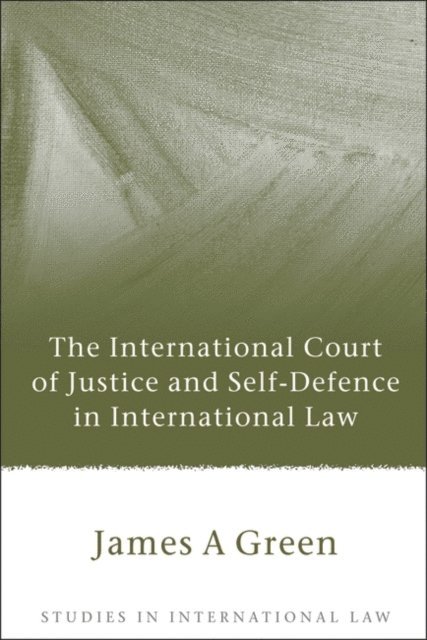
The legal rules governing the use of force between States are one of the most fundamental, and the most controversial, aspects of international law. An essential part of this subject is the question of when, and to what extent, a State may lawfully use force against another in self-defence. However, the parameters of this inherent right remain obscure, despite the best efforts of scholars and, notably, the International Court of Justice. This book examines the burgeoning relationship between the ICJ and the right of self-defence. Since 2003 there have been three major decisions of the ICJ that have dealt directly with the law governing self-defence actions, in contrast to only two such cases in the preceding fifty years. This, then, is an opportune moment to reconsider the jurisprudence of the Court on this issue. This book is the first of its kind to comprehensively draw together and then assess the merits of this jurisprudence. It argues that the contribution of the ICJ has been confused and unhelpful, and compounds inadequacies in existing customary international law.The ICJ's fundamental conception of a primary criterion of 'armed attack' as constituting a qualitatively grave use of force is brought into question. The book then goes on to examine the underlying causes of the problems that have emerged in the jurisprudence on this crucial issue. Winner of the American Society of International Law's Lieber Society Book Prize 2009 Dr Green's monograph demonstrates a thorough understanding of the law of self-defence, coupled with an informed and evaluative discussion of the role and function of the International Court. It is an impressive analysis of the International Court of Justice's jurisprudence on self-defence. Professor Iain Scobbie, Judge of the American Society of International Law's Lieber Society Book Prize 2009, Sir Joseph Hotung Research Professor, School of Oriental and African Studies, London James Green's "The International Court of Justice and Self-Defence in International Law" usefully draws together the jurisprudence of the International Court of Justice on the international law governing self-defence.The work could not be more timely in light of both contemporary State practice and the Court's recent controversial judgements on the topic. Of particular note is his analysis of the very complex, and as yet unsettled, notion of "armed attack." Professor Michael Schmitt, Chairman of the American Society of International Law's Lieber Society Book Prize Committee, Chair of Public International Law, Durham University Winner of the University of Reading Faculty of Social Sciences outputs prize for the best research output in 2010.
Crying as a Sign, a Symptom, and a Signal
Clinical, Emotional and Developmental Aspects of Infant and Toddler Crying
Inbunden, Engelska, 2000
659 kr
Skickas inom 7-10 vardagar
Clinics in Developmental Medicine No. 152 Crying as a Sign, a Symptom and a Signal brings the reader up to date on new evidence concerning the developmental and clinical significance of infant crying in the first few months and years of life. Initially studied as a sign of disease, crying is now being understood not only as a sign, but also as a symptom of problematic functioning in early development. We now know much more about normative patterns of development of infant crying and how they may be manifest in a variety of clinical settings (emergency room complaint, painful procedures, colic, temper tantrums, non-verbal and mentally challenged infants). This has brought about a new conceptualization of the significance of early infant crying which an international team of experts describe and examine. In this authoritative clinical text, both historical and methodological perspectives are brought to a multidisciplinary synopsis of the new understanding of this infant behavior.
Del 830 - Lecture Notes in Mathematics
Polynomial Representations of GL_n
with an Appendix on Schensted Correspondence and Littelmann Paths
Häftad, Engelska, 2006
409 kr
Skickas inom 10-15 vardagar
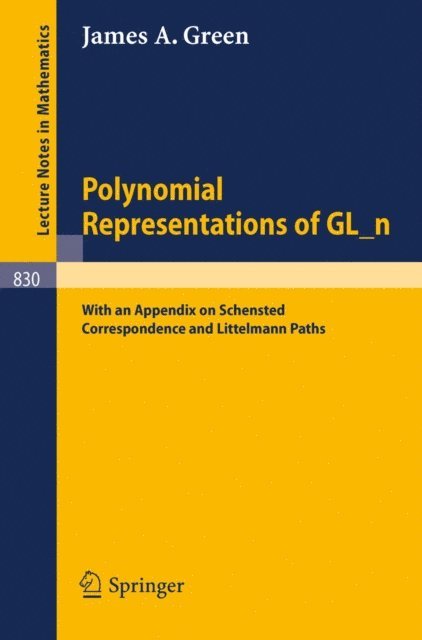
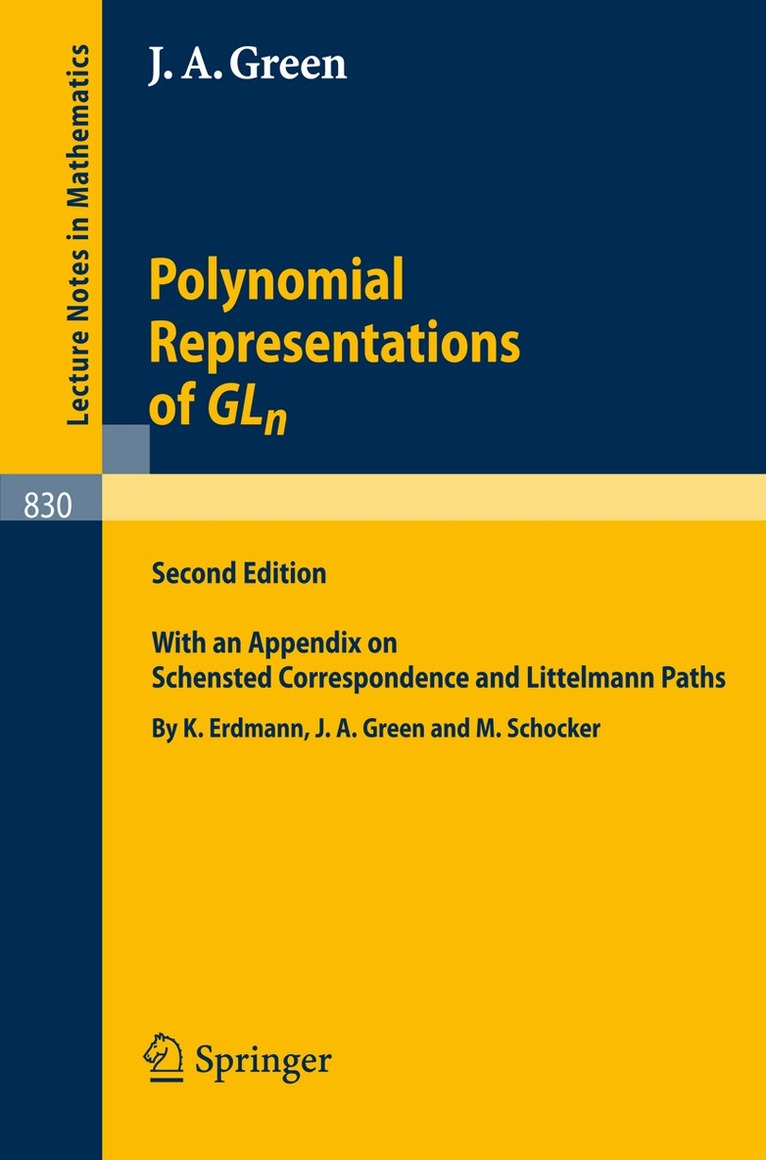
This second edition of “Polynomial representations of GL (K)” consists of n two parts. The ?rst part is a corrected version of the original text, formatted A in LT X, and retaining the original numbering of sections, equations, etc. E The second is an Appendix, which is largely independent of the ?rst part, but whichleadstoanalgebraL(n,r),de?nedbyP.Littelmann,whichisanalogous to the Schur algebra S(n,r). It is hoped that, in the future, there will be a structure theory of L(n,r) rather like that which underlies the construction of Kac-Moody Lie algebras. We use two operators which act on “words”. The ?rst of these is due to C. Schensted (1961). The second is due to Littelmann, and goes back to a1938paperbyG.deB.Robinsonontherepresentationsofa?nitesymmetric group.Littelmann’soperatorsformthebasisofhiselegantandpowerful“path model” of the representation theory of classical groups. In our Appendix we use Littelmann’s theory only in its simplest case, i.e. for GL . n Essential to my plan was to establish two basic facts connecting the op- ations of Schensted and Littelmann. To these “facts”, or rather conjectures, I gave the names Theorem A and Proposition B. Many examples suggested that these conjectures are true, and not particularly deep. But I could not prove either of them.
Polynomial Representations of GL_n : with an Appendix on Schensted Correspondence and Littelmann Paths
Engelska, 2014
634 kr
Skickas inom 5-8 vardagar