James K. Feibleman – författare
Visar alla böcker från författaren James K. Feibleman. Handla med fri frakt och snabb leverans.
33 produkter
Positive Democracy
Häftad, 2018
528 kr
Lägg i varukorg
The growth of the class struggle has been the occasion for much criticism of the democratic system. In his work, Feibleman examines the fundamental issues concerned and sets forth a program for positive democracy that is founded on the right relation between properties and citizens, guaranteeing …
Symposium on Kant
Av Edward G. Ballard, Richard L. Barber m. fl.
Häftad, 1964
552 kr
Lägg i varukorg
HE past does not change; it cannot, for what has happened T cannot be undone. Yet how are we to understand what has happened? Our perspective on it lies in the present, and is subject to continual change. These changes, made in the light of our new knowledge and new experience, call for fresh …
Studies in American Philosophy
Av Edward G. Ballard, James K. Feibleman m. fl.
Häftad, 1967
552 kr
Lägg i varukorg
Nature of the Philosophical Enterprise
Av Edward G. Ballard, Richard L. Barber m. fl.
Häftad, 1958
552 kr
Lägg i varukorg
Centennial Year Number
Av James K. Feibleman, Paul G. Morrison m. fl.
Häftad, 1959
1098 kr
Lägg i varukorg
The year 1959 has been called The Centennial Year in view of the anniversary of the publication of The Origin of SPecies and the centenary of the births of many who later contributed much to the philosophy of the recent past, such as Samuel Alexander, Henri Bergson, John Dewey and Edmund Husser!' …
Studies in Hegel
Reprint 1960
Av Alan B. Brinkley, James K. Feibleman m. fl.
Häftad, 1969
1098 kr
Lägg i varukorg
Studies in Social Philosophy
Av Edward G. Ballard, James K. Feibleman m. fl.
Häftad, 1962
1098 kr
Lägg i varukorg
Studies in Recent Philosophy
Av Andrew J. Reck, Harold N. Lee m. fl.
Häftad, 1963
552 kr
Lägg i varukorg
Studies in Philosophical Psychology
Av James K. Feibleman, Harold N. Lee m. fl.
Häftad, 1964
552 kr
Lägg i varukorg
Philosophical Logic
Av Robert L. Arrington, Peter M. Burkholder m. fl.
Häftad, 1968
1098 kr
Lägg i varukorg
With this issue we initiate the policy of expanding the scope of Tulane Studies in Philosophy to include, in addition to the work of members of the department, contributions from philosophers who have earned advanced degrees from Tulane and who are now teaching in other colleges and universities. …
Studies in Hegel
Reprint 1960
Av Edward G. Ballard, Robert C. Whittemore m. fl.
E-bok, 2012
1413 kr
Lägg i varukorg
Philosophical Logic
Av Donald H. Weiss, John C. Sallis m. fl.
E-bok, 2012
1459 kr
Lägg i varukorg
With this issue we initiate the policy of expanding the scope of Tulane Studies in Philosophy to include, in addition to the work of members of the department, contributions from philosophers who have earned advanced degrees from Tulane and who are now teaching in other colleges and universities. …
Studies in Recent Philosophy
Av Edward G. Ballard, James K. Feibleman m. fl.
E-bok, 2012
734 kr
Lägg i varukorg
Studies in Social Philosophy
Av Robert C. Whittemore, Andrew J. Reck m. fl.
E-bok, 2012
1459 kr
Lägg i varukorg
Centennial Year Number
Av Robert C. Whittemore, Carl H. Hamburg m. fl.
E-bok, 2012
1459 kr
Lägg i varukorg
The year 1959 has been called The Centennial Year in view of the anniversary of the publication of The Origin of SPecies and the centenary of the births of many who later contributed much to the philosophy of the recent past, such as Samuel Alexander, Henri Bergson, John Dewey and Edmund Husser!'' …
Symposium on Kant
Av Robert Whittemore, Louise Nisbet Roberts m. fl.
E-bok, 2013
734 kr
Lägg i varukorg
HE past does not change; it cannot, for what has happened T cannot be undone. Yet how are we to understand what has happened? Our perspective on it lies in the present, and is subject to continual change. These changes, made in the light of our new knowledge and new experience, call for fresh …
Nature of the Philosophical Enterprise
Av Robert C. Whittemore, Louise Nisbet Roberts m. fl.
E-bok, 2012
734 kr
Lägg i varukorg
Studies in Philosophical Psychology
Av Andrew J. Reck, Robert C. Whittemore m. fl.
E-bok, 2012
734 kr
Lägg i varukorg
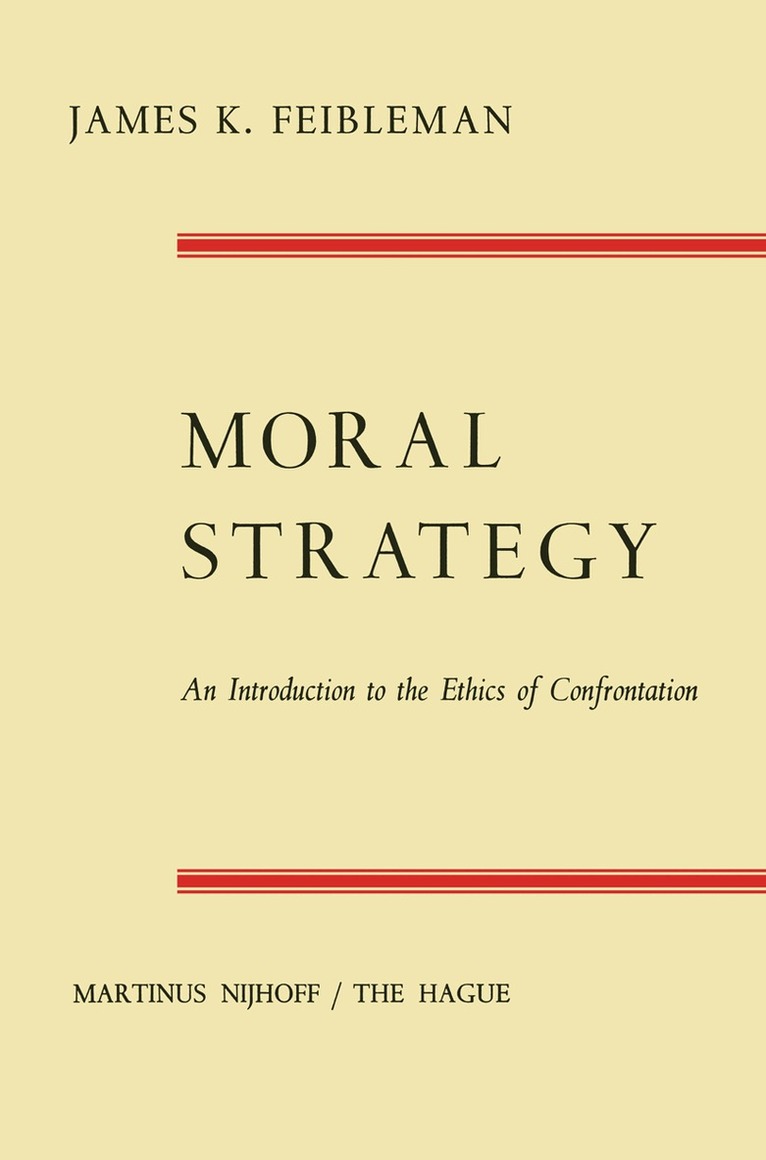
Moral Strategy
An Introduction to the Ethics of Confrontation
Häftad, 1967
552 kr
Lägg i varukorg
No statement, except one, can be made with which all philosophers would agree. The exception is this statement itself. The disagreement has the advantage that it gets all the proposals out into the open where they can be examined, but it has the dis advantage that the cogency of any one philosophy …
Foundations of empiricism
E-bok, 2012
1148 kr
Lägg i varukorg
For some centuries now the western world has endeavored to choose between rationalism and empiricism; or, when a choice was found impossible, somehow to reconcile them. But the particular brands of both which were taken for granted in confronting the problem were sUbjective: individual human …
Moral Strategy
An Introduction to the Ethics of Confrontation
E-bok, 2012
734 kr
Lägg i varukorg
No statement, except one, can be made with which all philosophers would agree. The exception is this statement itself. The disagreement has the advantage that it gets all the proposals out into the open where they can be examined, but it has the dis advantage that the cogency of any one philosophy …