Robert L. Arrington – författare
Visar alla böcker från författaren Robert L. Arrington. Handla med fri frakt och snabb leverans.
14 produkter
Western Ethics
An Historical Introduction
Häftad, 1997
5,0 utav 5 stjärnor. Totalt antal röster: (1)
479 kr
Lägg i varukorg
This volume provides a wide-ranging and lucid introducing to the major ethical theories found in the history of Western philosophy.
Wittgenstein and Philosophy of Religion
Av Mark Addis, Robert L. Arrington
Inbunden, 2000
2504 kr
Lägg i varukorg
An exciting introduction to the contribution which the later Wittgenstein made to the philosophy of religion. Although his writings on the subject have been few, Wittgenstein developed influential and controversial theories on both religion (and magic) which emphasize the distinctive nature of …
Wittgenstein and Philosophy of Religion
Av Mark Addis, Robert L. Arrington
Häftad, 2004
733 kr
Lägg i varukorg
Wittgenstein and Philosophy of Religion sheds new light on the perennial debate between faith and reason. It highlights the disagreements between Wittgenstein and religious sceptics, resulting in a collection that is both informative and stimulating. The themes discussed include Wittgenstein's …
World's Great Philosophers
E-bok, 2008
590 kr
Lägg i varukorg
The World''s Great Philosophers provides an introduction to and overview of some of the most profound and influential thinkers in the history of philosophy. Presents an introduction to and overview of some of the most profound and influential thinkers in the history of philosophy. Contains 40 …
The Ethics Of Magic: A Haunted Law Firm Novel
Av Robert Arrington, Robert L. Arrington
Häftad
244 kr
Lägg i varukorg
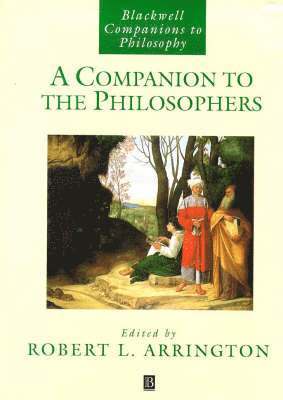
Companion to the Philosophers
Av Robert L. Arrington, Robert L. Arrington
Häftad, 2001
594 kr
Lägg i varukorg
A Companion to the Philosophers surveys the major philosophical thinkers in Western and non-Western traditions. Multicultural in its approach, it provides authoritative coverage of the major Chinese, Indian, Japanese, African, Jewish, and Islamic philosophers, as well as European and American …
World's Great Philosophers
Av Robert L. Arrington, Robert L. Arrington
Häftad, 2002
524 kr
Lägg i varukorg
The World's Great Philosophers provides an introduction to and overview of some of the most profound and influential thinkers in the history of philosophy. Presents an introduction to and overview of some of the most profound and influential thinkers in the history of philosophy.Contains 40 essays, …
Wittgenstein and Philosophy of Religion
Av Robert L. Arrington, Mark Addis
E-bok, 2002
866 kr
Lägg i varukorg
An exciting introduction to the contribution which the later Wittgenstein made to the philosophy of religion. Although his writings on the subject have been few, Wittgenstein developed influential and controversial theories on both religion (and magic) which emphasize the distinctive nature of …
Wittgenstein and Philosophy of Religion
Av Robert L. Arrington, Mark Addis
E-bok, 2002
847 kr
Lägg i varukorg
An exciting introduction to the contribution which the later Wittgenstein made to the philosophy of religion. Although his writings on the subject have been few, Wittgenstein developed influential and controversial theories on both religion (and magic) which emphasize the distinctive nature of …
Companion to the Philosophers
Inbunden, 1998
2359 kr
Lägg i varukorg
A Companion to the Philosophers surveys the major philosophical thinkers in Western and non-Western traditions. Multicultural in its approach, it provides authoritative coverage of the major Chinese, Indian, Japanese, African, Jewish, and Islamic philosophers, as well as European and American …
Philosophical Logic
Av Robert L. Arrington, Peter M. Burkholder m. fl.
Häftad, 1968
1098 kr
Lägg i varukorg
With this issue we initiate the policy of expanding the scope of Tulane Studies in Philosophy to include, in addition to the work of members of the department, contributions from philosophers who have earned advanced degrees from Tulane and who are now teaching in other colleges and universities. …
Philosophical Logic
Av Donald H. Weiss, John C. Sallis m. fl.
E-bok, 2012
1459 kr
Lägg i varukorg
With this issue we initiate the policy of expanding the scope of Tulane Studies in Philosophy to include, in addition to the work of members of the department, contributions from philosophers who have earned advanced degrees from Tulane and who are now teaching in other colleges and universities. …
Companion to the Philosophers
2008
435 kr
Tillfälligt slut
A Companion to the Philosophers surveys the major philosophical thinkers in Western and non-Western traditions. Multicultural in its approach, it provides authoritative coverage of the major Chinese, Indian, Japanese, African, Jewish, and Islamic philosophers, as well as European and American …