James R. Martel - Böcker
Visar alla böcker från författaren James R. Martel. Handla med fri frakt och snabb leverans.
7 produkter
7 produkter
3 264 kr
Skickas inom 10-15 vardagar
This groundbreaking handbook reviews, consolidates, and develops the growth of scholarship on ideology as it occurs as part of our political landscape and within the systems of thought and belief that collectively constitute our political subjectivity.It presents ideology functioning on the level of imagination and representation not only as a written and verbal language but also as expressed through architecture, art, media technologies, work, ritual practices, and other forms of material practice. It suggests how there are critical material aspects whenever human beings interact with the world and how ideology serves to map that interaction. Bringing together a multidisciplinary team of expert contributors, this handbook emphasizes the diversity of existing research and details the key developments in the area from across the globe.The Routledge Handbook on the Lived Experience of Ideology is an authoritative key reference text for students, academics, and researchers of ideologies, critical theory, feminism, postcolonial theory, affect theory, political theory, critical legal studies, political science, and, more broadly, sociology, anthropology, sociology, philosophy, and cultural and communication studies.The Routledge Handbook on the Lived Experience of Ideology is part of the mini-series Routledge Handbooks on Political Ideologies, Practices and Interpretations, edited by Michael Freeden.
1 466 kr
Skickas inom 7-10 vardagar
Although Haitian revolutionaries were not the intended audience for the Declaration of the Rights of Man, they heeded its call, demanding rights that were not meant for them. This failure of the French state to address only its desired subjects is an example of the phenomenon James R. Martel labels "misinterpellation." Complicating Althusser's famous theory, Martel explores the ways that such failures hold the potential for radical and anarchist action. In addition to the Haitian Revolution, Martel shows how the revolutionary responses by activists and anticolonial leaders to Woodrow Wilson's Fourteen Points speech and the Arab Spring sprang from misinterpellation. He also takes up misinterpellated subjects in philosophy, film, literature, and nonfiction, analyzing works by Nietzsche, Kafka, Woolf, Fanon, Ellison, Ta-Nehisi Coates, and others to demonstrate how characters who exist on the margins offer a generally unrecognized anarchist form of power and resistance. Timely and broad in scope, The Misinterpellated Subject reveals how calls by authority are inherently vulnerable to radical possibilities, thereby suggesting that all people at all times are filled with revolutionary potential.
362 kr
Skickas inom 7-10 vardagar
Although Haitian revolutionaries were not the intended audience for the Declaration of the Rights of Man, they heeded its call, demanding rights that were not meant for them. This failure of the French state to address only its desired subjects is an example of the phenomenon James R. Martel labels "misinterpellation." Complicating Althusser's famous theory, Martel explores the ways that such failures hold the potential for radical and anarchist action. In addition to the Haitian Revolution, Martel shows how the revolutionary responses by activists and anticolonial leaders to Woodrow Wilson's Fourteen Points speech and the Arab Spring sprang from misinterpellation. He also takes up misinterpellated subjects in philosophy, film, literature, and nonfiction, analyzing works by Nietzsche, Kafka, Woolf, Fanon, Ellison, Ta-Nehisi Coates, and others to demonstrate how characters who exist on the margins offer a generally unrecognized anarchist form of power and resistance. Timely and broad in scope, The Misinterpellated Subject reveals how calls by authority are inherently vulnerable to radical possibilities, thereby suggesting that all people at all times are filled with revolutionary potential.
1 111 kr
Skickas inom 7-10 vardagar
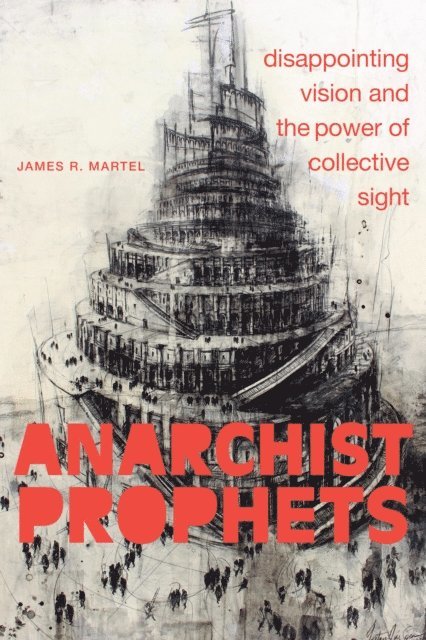
In Anarchist Prophets James R. Martel juxtaposes anarchism with what he calls archism in order to theorize the potential for a radical democratic politics. He shows how archism-a centralized and hierarchical political form that is a secularization of ancient Greek and Hebrew prophetic traditions-dominates contemporary politics through a prophet’s promises of peace and prosperity or the threat of violence. Archism is met by anarchism, in which a community shares a collective form of judgment and vision. Martel focuses on the figure of the anarchist prophet, who leads efforts to regain the authority for the community that archism has stolen. The goal of anarchist prophets is to render themselves obsolete and to cede power back to the collective so as to not become archist themselves. Martel locates anarchist prophets in a range of philosophical, literary, and historical examples, from Hobbes and Nietzsche to Mary Shelley and Octavia Butler to Kurdish resistance in Syria and the Spanish Revolution. In so doing, Martel highlights how anarchist forms of collective vision and action can provide the means to overthrow archist authority.
296 kr
Skickas inom 7-10 vardagar
In Anarchist Prophets James R. Martel juxtaposes anarchism with what he calls archism in order to theorize the potential for a radical democratic politics. He shows how archism-a centralized and hierarchical political form that is a secularization of ancient Greek and Hebrew prophetic traditions-dominates contemporary politics through a prophet’s promises of peace and prosperity or the threat of violence. Archism is met by anarchism, in which a community shares a collective form of judgment and vision. Martel focuses on the figure of the anarchist prophet, who leads efforts to regain the authority for the community that archism has stolen. The goal of anarchist prophets is to render themselves obsolete and to cede power back to the collective so as to not become archist themselves. Martel locates anarchist prophets in a range of philosophical, literary, and historical examples, from Hobbes and Nietzsche to Mary Shelley and Octavia Butler to Kurdish resistance in Syria and the Spanish Revolution. In so doing, Martel highlights how anarchist forms of collective vision and action can provide the means to overthrow archist authority.
1 331 kr
Skickas inom 5-8 vardagar
Using the theory of encryption of power in a tight connection with the theory of archism sheds light on sovereignty and thus politics.Archism is that prevailing form of power that seeks to go nameless insofar as it claims to be ubiquitous and just how politics is. The theory of encryption of power explains how the use of language monopolizes and hides power, preventing access to it through the denial and neutralization of differences based on class, race, and gender. Archism and the theory of encryption of power are intimately linked: one potentializes and sharpens the other to bring together an especially pernicious form of sovereignty and its role in our world. Coloniality exists because it encrypts power. The encryption of power hides the ubiquity of archism and, in this way, preserves and enhances its power. A transcendent model, one that poses as ordinary, dictates from a vanishing point of invisibility—outside language and any relation—the conditions to which every and any form of beingness must abide in order to be and thus to exercise power.This collection, edited by James R. Martel and Ricardo Sanín-Restrepo, explores these questions in parallel with decolonial theory and critical and subaltern studies, using conceptual tools that allow us to think difference without the interference of the void of normality, a position from where the possible may come to be. In the name of the people, the people are made vulnerable to dispossession and exclusion; in the name of democracy, democracy is undermined and potentially destroyed. Theorizing encryption challenges the linkages between liberalism and colonialism, capitalism and sovereignty, constitution and economy, and their claims of necessity.
177 kr
Skickas inom 7-10 vardagar
The human body is the locus of meaning, personhood, and our sense of the possibility of sanctity. The desecration of the human corpse is a matter of universal revulsion, taboo in virtually all human cultures. Not least for this reason, the unburied corpse quickly becomes a focal point of political salience, on the one hand seeming to express the contempt of state power toward the basic claims of human dignity—while on the other hand simultaneously bringing into question the very legitimacy of that power. In Unburied Bodies: Subversive Corpses and the Authority of the Dead, James Martel surveys the power of the body left unburied to motivate resistance, to bring forth a radically new form of agency, and to undercut the authority claims made by state power. Ranging across time and space from the battlefields of ancient Thebes to the streets of Ferguson, Missouri, and taking in perspectives from such writers as Sophocles, Machiavelli, Walter Benjamin, Hannah Arendt, James Baldwin, Judith Butler, Thomas Lacqueur, and Bonnie Honig, Martel asks why the presence of the abandoned corpse can be seen by both authorities and protesters as a source of power, and how those who have been abandoned or marginalized by structures of authority can find in a lifeless body fellow accomplices in their aspirations for dignity and humanity.