Jan Dejnozka – författare
Visar alla böcker från författaren Jan Dejnozka. Handla med fri frakt och snabb leverans.
3 produkter
3 produkter
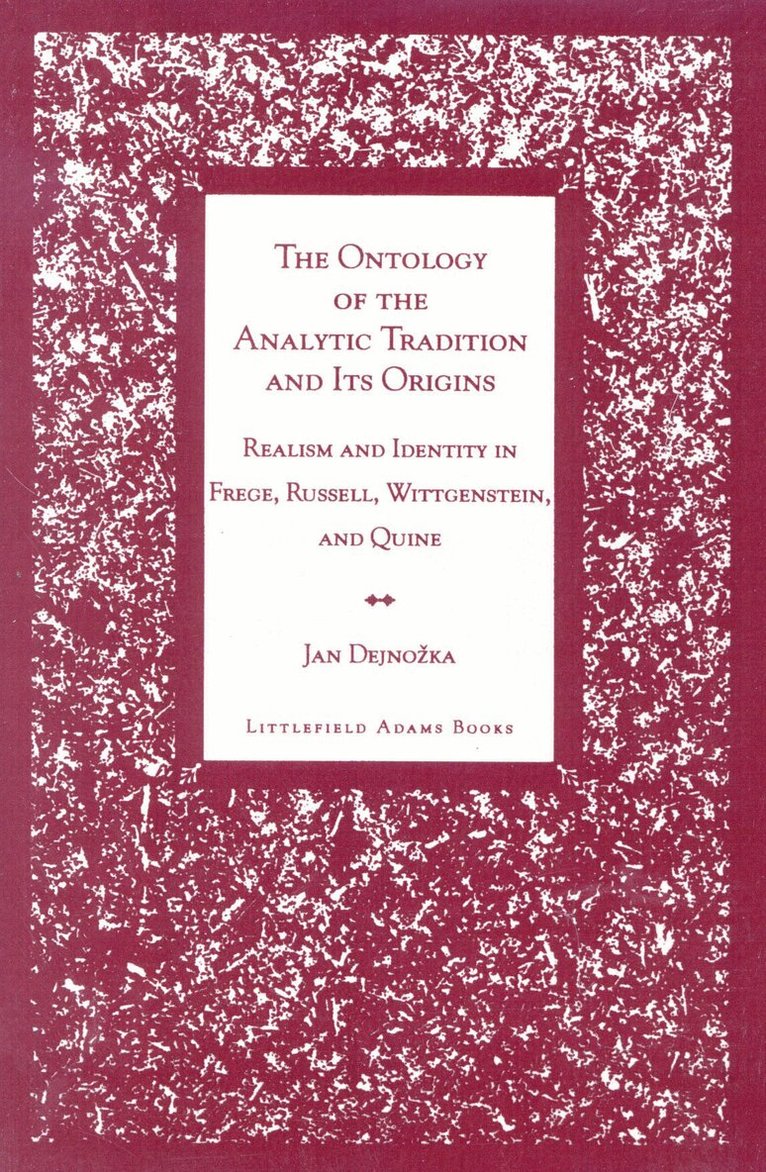
Ontology of the Analytic Tradition and Its Origins
Realism and Identity in Frege, Russell, Wittgenstein, and Quine
Häftad, Engelska, 1996
942 kr
Skickas inom 10-15 vardagar
The analytic movement advertised its 'linguistic turn' as a radical break from the two-thousand-year-old substance tradition. But this is an illusion. On the fundamental level of ontology, there is enough reformulation and presupposition of traditional 'no entity without identity' themes to analogize Frege, Russell, Wittgenstein, and Quine to Aristotle as paradigmatic of modified realism. Thus the pace of ontology is glacial. Frege and Russell, not Wittgenstein and Quine, emerge as the true analytic progenitors of 'no entity without identity,' offering between them at least twenty-nine private language arguments and sixty-four 'no entity without identity' theories.
1 705 kr
Skickas inom 10-15 vardagar
First published in 1999, this volume re-examines Bertrand Russell’s views on modal logic and logical relevance, arguing that Russell does in fact accommodate modality and modal logic. The author, Jan Dejnožka, draws together Russell’s comments and perspectives from throughout his canon in order to demonstrate a coherent view on logical modality and logical relevance. To achieve this, Dejnožka explores questions including whether Russell has a possible worlds logic, Rescher’s case against Russell, Russell’s three levels of modality and the motives and origins of Russell’s theory of modality.
496 kr
Skickas inom 10-15 vardagar
First published in 1999, this volume re-examines Bertrand Russell’s views on modal logic and logical relevance, arguing that Russell does in fact accommodate modality and modal logic. The author, Jan Dejnožka, draws together Russell’s comments and perspectives from throughout his canon in order to demonstrate a coherent view on logical modality and logical relevance. To achieve this, Dejnožka explores questions including whether Russell has a possible worlds logic, Rescher’s case against Russell, Russell’s three levels of modality and the motives and origins of Russell’s theory of modality.