Jane Hamlett - Böcker
Visar alla böcker från författaren Jane Hamlett. Handla med fri frakt och snabb leverans.
8 produkter
8 produkter
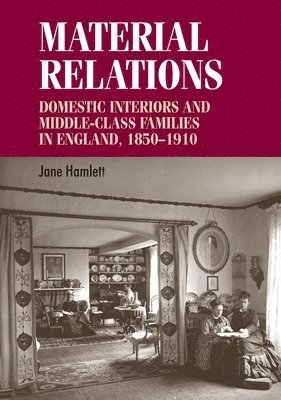
Material Relations
Domestic Interiors and Middle–Class Families in England, 1850–1910
Inbunden, Engelska, 2010
1 100 kr
Skickas inom 5-8 vardagar
Material relations tells the story of nineteenth- and early twentieth-century middle-class families by exploring the domestic spaces they inhabited and the material goods they prized. By opening the doors of the house, the book sheds new light on aspects of family life including love, marriage, sex, childhood and death. Historians have argued that as the nineteenth century waned, domestic spaces became increasingly private. Material relations challenges this, contending that domestic space created a complex series of family intimacies. Drawing upon novels, advice manuals and magazines, alongside sources for everyday use such as diaries, autobiographies, sale catalogues and inventories, wills and photographs, this fascinating book will be of particular interest to scholars and students of modern history, English literature, cultural studies, social geography, history of art and history of design.
Material Relations
Domestic Interiors and Middle–Class Families in England, 1850–1910
Häftad, Engelska, 2016
364 kr
Skickas inom 5-8 vardagar
Material relations, now available in paperback, tells the story of nineteenth- and early twentieth-century middle-class families by exploring the domestic spaces they inhabited and the material goods they prized. By opening the doors of the house, the book sheds new light on aspects of family life including love, marriage, sex, childhood and death. Historians have argued that as the nineteenth century waned, domestic spaces became increasingly private. Material relations challenges this, contending that domestic space created a complex series of family intimacies. Drawing upon novels, advice manuals and magazines, alongside sources for everyday use such as diaries, autobiographies, sale catalogues and inventories, wills and photographs, this fascinating book will be of particular interest to scholars and students of modern history, English literature, cultural studies, social geography, history of art and history of design.
475 kr
Skickas inom 10-15 vardagar
What does material culture tell us about gendered identities and how does gender reveal the meaning of spaces and things? If we look at the objects that we own, covet and which surround us in our everyday culture, there is a clear connection between ideas about gender and the material world. This book explores the material culture of the past to shed light on historical experiences and identities. Some essays focus on specific objects, such as an eighteenth-century jug or a 20th powder puff, others on broader material environments, such as the sixteenth-century guild or the interior of a 20th century pub, while still others focus on the paraphernalia associated with certain actions, such as letter-writing or maintaining 18th century men's hair.Written by scholars in a range of history-related disciplines, the essays in this book offer exposés of current research methods and interests. These demonstrate to students how a relationship between material culture and gender is being addressed, while also revealing a variety of intellectual approaches and topics.
730 kr
Skickas inom 10-15 vardagar
The essays in this collection explore both organizational intentions and inhabitants' experiences in a diverse range of British residential institutions during a period when such provision was dramatically increasing.
373 kr
Skickas inom 7-10 vardagar
During the 19th century the home, as both a cultural construct and a set of lived practices, became more powerful in the Western world than ever before. The West saw an unprecedented period of imperial expansion, industrialisation and commercialization that transformed both where and how people made their homes. Scientific advances and increasing mass production also changed homes materially, bringing in domestic technologies and new goods.This volume explores how homes and homemaking were imagined and practiced across the globe in the 19th century. For instance, not only did the acquisition of empires lead to the establishment of Western European homes in new terrains, but it also buttressed the way in which Europeans saw themselves, as the guardians of superior cultures, patriarchal relationships and living practices.During this period a powerful shared cultural idea of home emerged – championed by a growing urban middle class – that constructed home as a refuge from a chaotic and noisy industrialised world. Gender was an essential part of this idea. Both masculine and feminine virtues were expected to underpin the ideal home: a greater emphasis was placed on an ideal of the male breadwinner and the need for women to maintain the domestic material fabric and emotional environment was stressed. While these ideas were shared and propagated in print culture across Western Europe and North America there were huge differences in how they were realised and practiced. Home was experienced differently according to class and race; different forms of identity and levels of socio-economic resource fashioned a variety of home-making practices. While demonstrating the cultural importance of home, this book reveals the various ways in which home was lived in the 19th century.
1 159 kr
Skickas inom 7-10 vardagar
During the 19th century the home, as both a cultural construct and a set of lived practices, became more powerful in the Western world than ever before. The West saw an unprecedented period of imperial expansion, industrialisation and commercialization that transformed both where and how people made their homes. Scientific advances and increasing mass production also changed homes materially, bringing in domestic technologies and new goods.This volume explores how homes and homemaking were imagined and practiced across the globe in the 19th century. For instance, not only did the acquisition of empires lead to the establishment of Western European homes in new terrains, but it also buttressed the way in which Europeans saw themselves, as the guardians of superior cultures, patriarchal relationships and living practices.During this period a powerful shared cultural idea of home emerged – championed by a growing urban middle class – that constructed home as a refuge from a chaotic and noisy industrialised world. Gender was an essential part of this idea. Both masculine and feminine virtues were expected to underpin the ideal home: a greater emphasis was placed on an ideal of the male breadwinner and the need for women to maintain the domestic material fabric and emotional environment was stressed. While these ideas were shared and propagated in print culture across Western Europe and North America there were huge differences in how they were realised and practiced. Home was experienced differently according to class and race; different forms of identity and levels of socio-economic resource fashioned a variety of home-making practices. While demonstrating the cultural importance of home, this book reveals the various ways in which home was lived in the 19th century.
235 kr
Skickas
Pet Revolution tracks the British love affair with pets over the last two centuries, showing how the kinds of pets we keep, as well as how we relate to and care for them, has changed radically. The book describes the growth of pet foods and medicines, the rise of pet shops, and the development of veterinary care, creating the pet economy. Most importantly, pets have played a powerful emotional role in families across all social classes, creating new kinds of relationships and home lives.For the first time, through a history of companion animals and the humans who lived with them, this book puts the story of the ‘pet revolution’ alongside other revolutions – industrial, agricultural, political – to highlight how animals contributed to modern British life.
2 220 kr
Skickas inom 10-15 vardagar
The essays in this collection explore both organizational intentions and inhabitants' experiences in a diverse range of British residential institutions during a period when such provision was dramatically increasing.