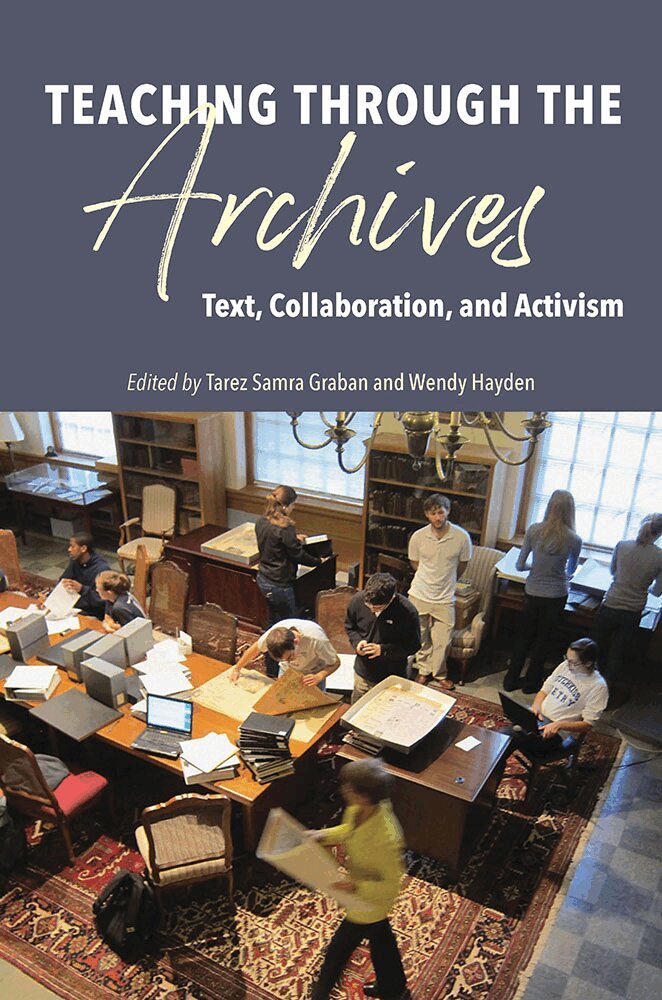
Disruptive pedagogies for archival researchIn a cultural moment when institutional repositories carry valuable secrets to the present and past, this collection argues for the critical, intellectual, and social value of archival instruction. Graban and Hayden and 37 other contributors examine how undergraduate and graduate courses in rhetoric, history, community literacy, and professional writing can successfully engage students in archival research in its many forms, and successfully model mutually beneficial relationships between archivists, instructors, and community organizations.Combining new and established voices from related fields, each of the book’s three sections includes a range of form-disrupting pedagogies. Section I focuses on how approaching the archive primarily as textfosters habits of mind essential for creating and using archives, for critiquing or inventing knowledge-making practices, and for being good stewards of private and public collections. Section II argues for conducting archival projects as collaboration through experiential learning and for developing a preservationist consciousness through disciplined research. Section III details praxis for revealing, critiquing, and intervening in historic racial omissions and gaps in the archives in which we all work.Ultimately, contributors explore archives as sites of activism while also raising important questions that persist in rhetoric and composition scholarship, such as how to decolonize research methodologies, how to conduct teaching and research that promote social justice, and how to shift archival consciousness toward more engaged notions of democracy. This collection highlights innovative classroom and curricular course models for teaching with and through the archives in rhetoric and composition and beyond.
By studying the multiracial Jewish organisation Hatzaad Harishon, Janice W. Fernheimer’s Stepping into Zion considers the question “Who is a Jew?” - a critical rhetorical issue with far-reaching consequences for Jews and non-Jews alike.Hatzaad Harishon (“The First Step”) was a New York-based, multiracial Jewish organisation that worked to increase recognition and legitimacy of black Jews in the sixties and seventies. In Stepping into Zion, Janice W. Fernheimer examines the history and archives of Hatzaad Harishon to illuminate the definition and borders of Jewish identity, which have critical relevance to Jews of all traditions as well as to non-Jews.Fernheimer focuses on a period when white Jewish identity was in flux and deeply influenced by the Civil Rights and Black Power movements. In 1964, white and black Jews formed Hatzaad Harishon to foster interaction and unity between black and white Jewish communities. They raised the question of who or what constitutes Jewishness or Jewish identity, and in searching for an answer succeeded - both historically and rhetorically - in gaining increased recognition for black Jews. Fernheimer traces how members of Hatzaad Harishon, who did not share the same set of definitions, were able to create common ground in a process she terms “interruptive invention.”Through insightful interpretation of Hatzaad Harishon’s archival materials, Fernheimer chronicles the group’s successes and failures within the larger rhetorical history of conflicts that emerge when cultural identities shift or expand. Stepping into Zion offers “interruptive invention” as a framework for understanding and changing certain dominant discourses about racial and religious identity, allowing those who may lack institutional power or authority to begin to claim it.
Considers the question “Who is a Jew?”— a critical rhetorical issue with far-reaching consequences for Jews and non-Jews alike Hatzaad Harishon ("The First Step") was a New York-based, multiracial Jewish organization that worked to increase recognition and legitimacy for Black Jews in the sixties and seventies. In Stepping into Zion, Janice W. Fernheimer examines the history and archives of Hatzaad Harishon to illuminate the shifting definitions and borders of Jewish identity, which have critical relevance to Jews of all traditions as well as to non-Jews. Fernheimer focuses on a period when Jewish identity was in flux and deeply influenced by the Civil Rights and Black Power movements. In 1964, white and Black Jews formed Hatzaad Harishon to foster interaction and unity between Black and white Jewish communities. They raised the question of who or what constitutes Jewishness or Jewish identity, and in searching for an answer succeeded—both historically and rhetorically—in gaining increased recognition for Black Jews. Fernheimer traces how, despite deep disagreement over definitions, members of Hatzaad Harishon were able to create common ground in a process she terms "interruptive invention": an incremental model for rhetorical success that allows different groups to begin and continue important but difficult discussions when they share little common ground or make unequal claims to institutional and discursive power, or when the nature of common ground is precisely what is at stake. Consequently, they provide a practical way out of the seemingly incommensurable stalemate incompatible worldviews present. Through insightful interpretations of Hatzaad Harishon''s archival materials, Fernheimer chronicles the group''s successes and failures within the larger rhetorical history of conflicts that emerge when cultural identities shift or expand.
Disruptive pedagogies for archival researchIn a cultural moment when institutional repositories carry valuable secrets to the present and past, this collection argues for the critical, intellectual, and social value of archival instruction. Graban and Hayden and 37 other contributors examine how undergraduate and graduate courses in rhetoric, history, community literacy, and professional writing can successfully engage students in archival research in its many forms, and successfully model mutually beneficial relationships between archivists, instructors, and community organizations.Combining new and established voices from related fields, each of the book’s three sections includes a range of form-disrupting pedagogies. Section I focuses on how approaching the archive primarily as textfosters habits of mind essential for creating and using archives, for critiquing or inventing knowledge-making practices, and for being good stewards of private and public collections. Section II argues for conducting archival projects as collaboration through experiential learning and for developing a preservationist consciousness through disciplined research. Section III details praxis for revealing, critiquing, and intervening in historic racial omissions and gaps in the archives in which we all work.Ultimately, contributors explore archives as sites of activism while also raising important questions that persist in rhetoric and composition scholarship, such as how to decolonize research methodologies, how to conduct teaching and research that promote social justice, and how to shift archival consciousness toward more engaged notions of democracy. This collection highlights innovative classroom and curricular course models for teaching with and through the archives in rhetoric and composition and beyond.
By studying the multiracial Jewish organisation Hatzaad Harishon, Janice W. Fernheimer’s Stepping into Zion considers the question “Who is a Jew?” - a critical rhetorical issue with far-reaching consequences for Jews and non-Jews alike.Hatzaad Harishon (“The First Step”) was a New York-based, multiracial Jewish organisation that worked to increase recognition and legitimacy of black Jews in the sixties and seventies. In Stepping into Zion, Janice W. Fernheimer examines the history and archives of Hatzaad Harishon to illuminate the definition and borders of Jewish identity, which have critical relevance to Jews of all traditions as well as to non-Jews.Fernheimer focuses on a period when white Jewish identity was in flux and deeply influenced by the Civil Rights and Black Power movements. In 1964, white and black Jews formed Hatzaad Harishon to foster interaction and unity between black and white Jewish communities. They raised the question of who or what constitutes Jewishness or Jewish identity, and in searching for an answer succeeded - both historically and rhetorically - in gaining increased recognition for black Jews. Fernheimer traces how members of Hatzaad Harishon, who did not share the same set of definitions, were able to create common ground in a process she terms “interruptive invention.”Through insightful interpretation of Hatzaad Harishon’s archival materials, Fernheimer chronicles the group’s successes and failures within the larger rhetorical history of conflicts that emerge when cultural identities shift or expand. Stepping into Zion offers “interruptive invention” as a framework for understanding and changing certain dominant discourses about racial and religious identity, allowing those who may lack institutional power or authority to begin to claim it.
Considers the question “Who is a Jew?”— a critical rhetorical issue with far-reaching consequences for Jews and non-Jews alike Hatzaad Harishon ("The First Step") was a New York-based, multiracial Jewish organization that worked to increase recognition and legitimacy for Black Jews in the sixties and seventies. In Stepping into Zion, Janice W. Fernheimer examines the history and archives of Hatzaad Harishon to illuminate the shifting definitions and borders of Jewish identity, which have critical relevance to Jews of all traditions as well as to non-Jews. Fernheimer focuses on a period when Jewish identity was in flux and deeply influenced by the Civil Rights and Black Power movements. In 1964, white and Black Jews formed Hatzaad Harishon to foster interaction and unity between Black and white Jewish communities. They raised the question of who or what constitutes Jewishness or Jewish identity, and in searching for an answer succeeded—both historically and rhetorically—in gaining increased recognition for Black Jews. Fernheimer traces how, despite deep disagreement over definitions, members of Hatzaad Harishon were able to create common ground in a process she terms "interruptive invention": an incremental model for rhetorical success that allows different groups to begin and continue important but difficult discussions when they share little common ground or make unequal claims to institutional and discursive power, or when the nature of common ground is precisely what is at stake. Consequently, they provide a practical way out of the seemingly incommensurable stalemate incompatible worldviews present. Through insightful interpretations of Hatzaad Harishon''s archival materials, Fernheimer chronicles the group''s successes and failures within the larger rhetorical history of conflicts that emerge when cultural identities shift or expand.