Janick Marina Schaufelbuehl – författare
Visar alla böcker från författaren Janick Marina Schaufelbuehl. Handla med fri frakt och snabb leverans.
2 produkter
2 produkter
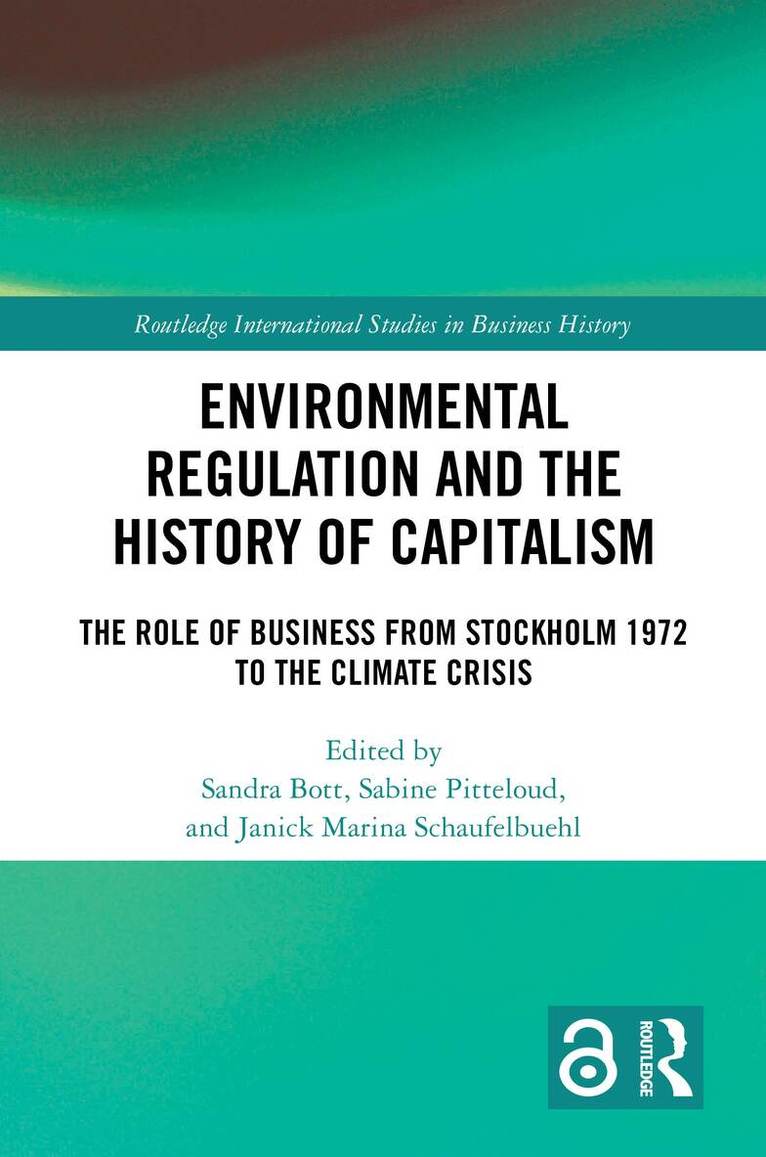
Environmental Regulation and the History of Capitalism
The Role of Business from Stockholm 1972 to the Climate Crisis
Inbunden, Engelska, 2025
2 176 kr
Skickas inom 10-15 vardagar
This edited collection examines the historical role of business actors in climate and environmental governance since the 1970s. Through a compilation of recent, evidence-based historical research, this book unveils the origins of contemporary challenges in regulating environmental pollution. With original case studies, it offers a nuanced understanding of the environmental counter-offensive orchestrated by business leaders, associations, and think tanks post-1972, following the United Nations' pivotal Stockholm Conference on the Human Environment. Readers are presented with insights into the historical maneuvers of business entities aimed at mitigating regulatory risks, co-creating expertise, and framing the environmental debate. From revealing the tactics employed by various business actors to exploring the emergence of market-driven environmentalism, this volume offers a comprehensive exploration of the intricate dynamics shaping environmental policy. By contextualizing specificities and complexities, it enriches contemporary narratives on business influence and power dynamics within global capitalism. This book primarily caters to scholars across diverse historical disciplines, including business history, international relations, environmental history, and the history of capitalism. Additionally, it holds relevance for social scientists studying contemporary issues, policymakers grappling with environmental challenges, and those seeking a deeper understanding of the historical dimensions of climate governance.The Open Access version of this book, available at http://www.taylorfrancis.com, has been made available under a Creative Commons Attribution-Non Commercial-No Derivatives (CC BY-NC-ND) 4.0 license.
613 kr
Skickas inom 10-15 vardagar
The first book to shed light on what caused corporate executives to pursue a pro-globalization agenda over the last eight decadesCrusading for Globalization tells the story of an extraordinarily influential group of business executives at the helms of the largest US multinational corporations and their quest to drive globalization forward over the last eight decades. Janick Marina Schaufelbuehl argues that the spectacular expansion of international investment, trade, and production after 1945 cannot be understood without considering the role played by these corporate globalizers and the organization they created, the US Council (today's United States Council for International Business). By shaping governmental policy through their congressional lobbying and close connections to successive presidential administrations, US Council members, including executives from General Electric, Coca Cola, and IBM, among others, consistently fought for ever more market deregulation, culminating in the creation of the World Trade Organization in 1995.Crusading for Globalization is also a book about those who opposed the growing might of multinationals. In the years immediately after World War II, resistance came from business protectionists, before labor and policymakers from the Global South joined the effort in the early 1970s. Schaufelbuehl breaks new ground by offering a panorama of this early anti-globalization movement, and by showing how the leaders of multinationals organized to limit its political influence. She also examines continuities between this early movement and the opposition to globalization that emerged at the beginning of the twenty-first century from the left and the populist right and discusses how business responded by promoting corporate social responsibility and voluntary guidelines.The first book to shed light on what caused corporate executives to pursue a pro-globalization agenda and to examine their methods for dealing with their opponents, Crusading for Globalization reveals the historical roots of today's disparities in wealth and income distribution.