Jason König - Böcker
Visar alla böcker från författaren Jason König. Handla med fri frakt och snabb leverans.
14 produkter
14 produkter
720 kr
Skickas inom 7-10 vardagar
From the first to third century AD Greek athletics flourished as never before. This book offers exciting readings of those developments. Drawing on a wide range of evidence, it sheds light on practices of athletic competition and athletic education in the Roman Empire. In addition it examines some of the ways in which athletic activity was represented within different texts and contexts. Most importantly, the book shows how discussion and representation of athletics could become entangled with many other areas of cultural debate, and used as a vehicle for many different varieties of authorial self-presentation and cultural self-scrutiny. It also argues for complex connections between different areas of athletic representation, particularly between literary and epigraphical texts. It offers re-interpretations of a number of major authors, especially Lucian, Dio Chrysostom, Pausanias, Silius Italicus, Galen and Philostratus.
577 kr
Skickas inom 7-10 vardagar
The Romans commanded the largest and most complex empire the world had ever seen, or would see until modern times. The challenges, however, were not just political, economic and military: Rome was also the hub of a vast information network, drawing in worldwide expertise and refashioning it for its own purposes. This fascinating collection of essays considers the dialogue between technical literature and imperial society, drawing on, developing and critiquing a range of modern cultural theories (including those of Michel Foucault and Edward Said). How was knowledge shaped into textual forms, and how did those forms encode relationships between emperor and subjects, theory and practice, Roman and Greek, centre and periphery? Ordering Knowledge in the Roman Empire will be required reading for those concerned with the intellectual and cultural history of the Roman Empire, and its lasting legacy in the medieval world and beyond.
1 734 kr
Skickas inom 7-10 vardagar
From the first to third century AD Greek athletics flourished as never before. This book offers exciting readings of those developments. Drawing on a wide range of evidence, it sheds light on practices of athletic competition and athletic education in the Roman Empire. In addition it examines some of the ways in which athletic activity was represented within different texts and contexts. Most importantly, the book shows how discussion and representation of athletics could become entangled with many other areas of cultural debate, and used as a vehicle for many different varieties of authorial self-presentation and cultural self-scrutiny. It also argues for complex connections between different areas of athletic representation, particularly between literary and epigraphical texts. It offers re-interpretations of a number of major authors, especially Lucian, Dio Chrysostom, Pausanias, Silius Italicus, Galen and Philostratus.
1 282 kr
Skickas inom 7-10 vardagar
The Romans commanded the largest and most complex empire the world had ever seen, or would see until modern times. The challenges, however, were not just political, economic and military: Rome was also the hub of a vast information network, drawing in worldwide expertise and refashioning it for its own purposes. This fascinating collection of essays considers the dialogue between technical literature and imperial society, drawing on, developing and critiquing a range of modern cultural theories (including those of Michel Foucault and Edward Said). How was knowledge shaped into textual forms, and how did those forms encode relationships between emperor and subjects, theory and practice, Roman and Greek, centre and periphery? Ordering Knowledge in the Roman Empire will be required reading for those concerned with the intellectual and cultural history of the Roman Empire, and its lasting legacy in the medieval world and beyond.
Saints and Symposiasts
The Literature of Food and the Symposium in Greco-Roman and Early Christian Culture
Inbunden, Engelska, 2012
1 598 kr
Skickas inom 7-10 vardagar
Greek traditions of writing about food and the symposium had a long and rich afterlife in the first to fifth centuries CE, in both Greco-Roman and early Christian culture. This book provides an account of the history of the table-talk tradition, derived from Plato's Symposium and other classical texts, focusing among other writers on Plutarch, Athenaeus, Methodius and Macrobius. It also deals with the representation of transgressive, degraded, eccentric types of eating and drinking in Greco-Roman and early Christian prose narrative texts, focusing especially on the Letters of Alciphron, the Greek and Roman novels, especially Apuleius, the Apocryphal Acts of the Apostles and the early saints' lives. It argues that writing about consumption and conversation continued to matter: these works communicated distinctive ideas about how to talk and how to think, distinctive models of the relationship between past and present, distinctive and often destabilising visions of identity and holiness.
462 kr
Skickas inom 7-10 vardagar
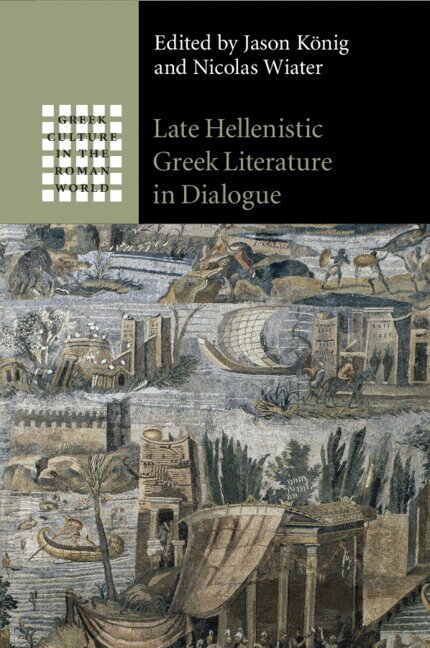
Late Hellenistic Greek literature, both prose and poetry, stands out for its richness and diversity. Recent work has tended to take an author-by-author approach that underestimates the interconnectedness of the literary culture of the period. The chapters assembled here set out to change that by offering new readings of a wide range of late Hellenistic texts and genres, including historiography, geography, rhetoric and philosophy, together with many verse texts and inscriptions. In the process, they offer new insights into the various ways in which late Hellenistic literature engaged with its social, cultural and political contexts, while interrogating and revising some of the standard narratives of the relationship between late Hellenistic and imperial Greek literary culture, which are too often studied in isolation from each other. As a whole the book prompts us to rethink the place of late Hellenistic literature within the wider landscape of Greek and Roman literary history.
685 kr
Skickas inom 7-10 vardagar
There is a rich body of encyclopaedic writing which survives from the two millennia before the Enlightenment. This book sheds new light on that material. It traces the development of traditions of knowledge ordering which stretched back to Pliny and Varro and others in the classical world. It works with a broad concept of encyclopaedism, resisting the idea that there was any clear pre-modern genre of the 'encyclopaedia', and showing instead how the rhetoric and techniques of comprehensive compilation left their mark on a surprising range of texts. In the process it draws attention to both remarkable similarities and striking differences between conventions of encyclopaedic compilation in different periods, with a focus primarily on European/Mediterranean culture. The book covers classical, medieval (including Byzantine and Arabic) and Renaissance culture in turn, and combines chapters which survey whole periods with others focused closely on individual texts as case studies.
1 702 kr
Skickas inom 7-10 vardagar
The circulation of books was the motor of classical civilization. However, books were both expensive and rare, and so libraries - private and public, royal and civic - played key roles in articulating intellectual life. This collection, written by an international team of scholars, presents a fundamental reassessment of how ancient libraries came into being, how they were organized and how they were used. Drawing on papyrology and archaeology, and on accounts written by those who read and wrote in them, it presents new research on reading cultures, on book collecting and on the origins of monumental library buildings. Many of the traditional stories told about ancient libraries are challenged. Few were really enormous, none were designed as research centres, and occasional conflagrations do not explain the loss of most ancient texts. But the central place of libraries in Greco-Roman culture emerges more clearly than ever.
1 770 kr
Skickas inom 7-10 vardagar
There is a rich body of encyclopaedic writing which survives from the two millennia before the Enlightenment. This book sheds new light on that material. It traces the development of traditions of knowledge ordering which stretched back to Pliny and Varro and others in the classical world. It works with a broad concept of encyclopaedism, resisting the idea that there was any clear pre-modern genre of the 'encyclopaedia', and showing instead how the rhetoric and techniques of comprehensive compilation left their mark on a surprising range of texts. In the process it draws attention to both remarkable similarities and striking differences between conventions of encyclopaedic compilation in different periods, with a focus primarily on European/Mediterranean culture. The book covers classical, medieval (including Byzantine and Arabic) and Renaissance culture in turn, and combines chapters which survey whole periods with others focused closely on individual texts as case studies.
1 838 kr
Skickas inom 7-10 vardagar
How did ancient scientific and knowledge-ordering writers make their work authoritative? This book answers that question for a wide range of ancient disciplines, from mathematics, medicine, architecture and agriculture, through to law, historiography and philosophy - focusing mainly, but not exclusively, on the literature of the Roman Empire. It draws attention to habits that these different fields had in common, while also showing how individual texts and authors manipulated standard techniques of self-authorisation in distinctive ways. It stresses the importance of competitive and assertive styles of self-presentation, and also examines some of the pressures that pulled in the opposite direction by looking at authors who chose to acknowledge the limitations of their own knowledge or resisted close identification with narrow versions of expert identity. A final chapter by Sir Geoffrey Lloyd offers a comparative account of scientific authority and expertise in ancient Chinese, Indian and Mesopotamian culture.
604 kr
Skickas inom 7-10 vardagar
How did ancient scientific and knowledge-ordering writers make their work authoritative? This book answers that question for a wide range of ancient disciplines, from mathematics, medicine, architecture and agriculture, through to law, historiography and philosophy - focusing mainly, but not exclusively, on the literature of the Roman Empire. It draws attention to habits that these different fields had in common, while also showing how individual texts and authors manipulated standard techniques of self-authorisation in distinctive ways. It stresses the importance of competitive and assertive styles of self-presentation, and also examines some of the pressures that pulled in the opposite direction by looking at authors who chose to acknowledge the limitations of their own knowledge or resisted close identification with narrow versions of expert identity. A final chapter by Sir Geoffrey Lloyd offers a comparative account of scientific authority and expertise in ancient Chinese, Indian and Mesopotamian culture.
Saints and Symposiasts
The Literature of Food and the Symposium in Greco-Roman and Early Christian Culture
Häftad, Engelska, 2020
584 kr
Skickas inom 7-10 vardagar
Greek traditions of writing about food and the symposium had a long and rich afterlife in the first to fifth centuries CE, in both Greco-Roman and early Christian culture. This book provides an account of the history of the table-talk tradition, derived from Plato's Symposium and other classical texts, focusing among other writers on Plutarch, Athenaeus, Methodius and Macrobius. It also deals with the representation of transgressive, degraded, eccentric types of eating and drinking in Greco-Roman and early Christian prose narrative texts, focusing especially on the Letters of Alciphron, the Greek and Roman novels, especially Apuleius, the Apocryphal Acts of the Apostles and the early saints' lives. It argues that writing about consumption and conversation continued to matter: these works communicated distinctive ideas about how to talk and how to think, distinctive models of the relationship between past and present, distinctive and often destabilising visions of identity and holiness.
1 431 kr
Skickas inom 7-10 vardagar
Late Hellenistic Greek literature, both prose and poetry, stands out for its richness and diversity. Recent work has tended to take an author-by-author approach that underestimates the interconnectedness of the literary culture of the period. The chapters assembled here set out to change that by offering new readings of a wide range of late Hellenistic texts and genres, including historiography, geography, rhetoric and philosophy, together with many verse texts and inscriptions. In the process, they offer new insights into the various ways in which late Hellenistic literature engaged with its social, cultural and political contexts, while interrogating and revising some of the standard narratives of the relationship between late Hellenistic and imperial Greek literary culture, which are too often studied in isolation from each other. As a whole the book prompts us to rethink the place of late Hellenistic literature within the wider landscape of Greek and Roman literary history.
604 kr
Skickas inom 7-10 vardagar
The circulation of books was the motor of classical civilization. However, books were both expensive and rare, and so libraries - private and public, royal and civic - played key roles in articulating intellectual life. This collection, written by an international team of scholars, presents a fundamental reassessment of how ancient libraries came into being, how they were organized and how they were used. Drawing on papyrology and archaeology, and on accounts written by those who read and wrote in them, it presents new research on reading cultures, on book collecting and on the origins of monumental library buildings. Many of the traditional stories told about ancient libraries are challenged. Few were really enormous, none were designed as research centres, and occasional conflagrations do not explain the loss of most ancient texts. But the central place of libraries in Greco-Roman culture emerges more clearly than ever.