Jean-Baptiste Humbert – författare
Visar alla böcker från författaren Jean-Baptiste Humbert. Handla med fri frakt och snabb leverans.
4 produkter
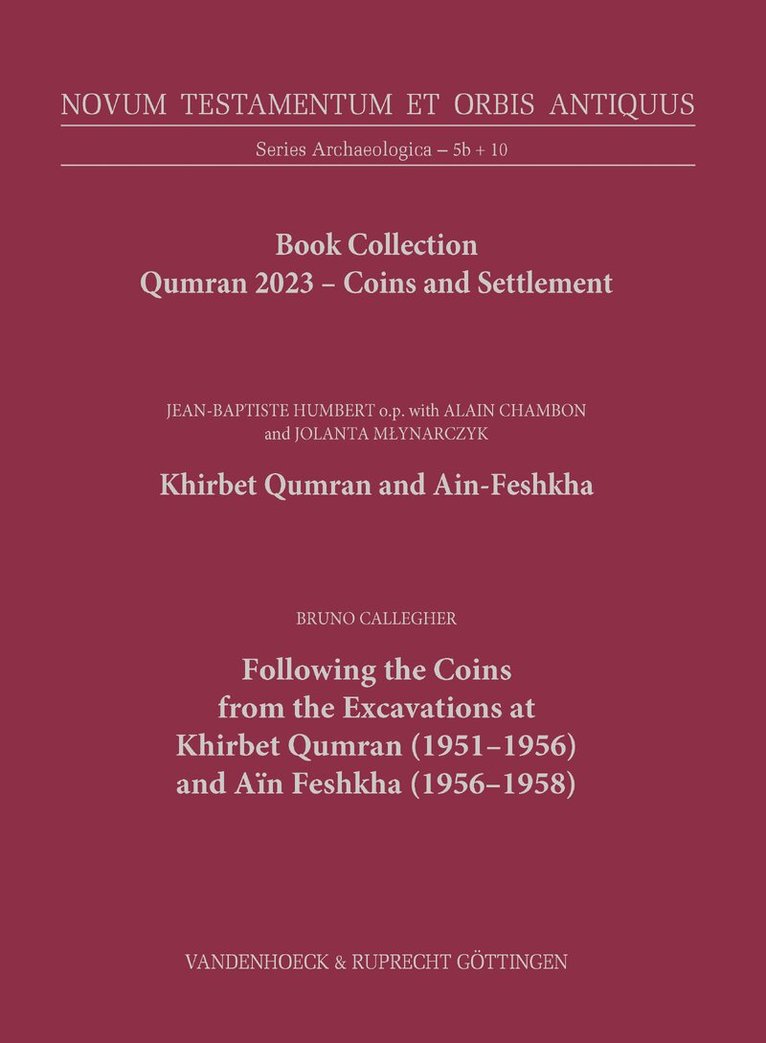
Buchpaket Qumran 2023 – Coins and Settlement
Av Bruno Callegher, Jean-Baptiste Humbert
Inbunden, 2024
9273 kr
Lägg i varukorg
Khirbet Qumran and Ain-Feshkha III A:For 60 years Qumran research has been focused on epigraphy, exegesis, and the historical sources of the Dead Sea Scrolls. Now the time has come to provide researchers with a complete documentation.Following the Coins from the Excavations at Khirbet Qumran …
Khirbet Qumrân and Aïn Feshkha IV A
Qumran Cave 11Q: Archaeology and New Scroll Fragments
Av Jean-Baptiste Humbert, Marcello Fidanzio
Inbunden, 2019
4856 kr
Lägg i varukorg
Text in English and French. Qumran Cave 11Q was discovered by Bedouin in 1956. In the cave, remains of around 30 Dead Sea Scrolls were found, a few of them in very good state of preservation (the Temple Scroll, the Psalm Scroll, the Paleo Leviticus Scroll, and the Targum Job Scroll). The cave was …
Khirbet Qumran and Ain Feshkha IV A
Qumran Cave 11Q: Archaeology and New Scroll Fragments
Av Marcello Fidanzio, Jean-Baptiste Humbert
E-bok, 2019
4456 kr
Lägg i varukorg
Qumran Cave 11Q was discovered by Bedouin in 1956. In the cave, remains of around 30 Dead Sea Scrolls were found, a few of them in very good state of preservation (the Temple Scroll, the Psalm Scroll, the Paleo Leviticus Scroll, and the Targum Job Scroll). The cave was excavated by Roland de Vaux …
Khirbet Qumran and Ain-Feshkha III A (in English translation)
Roland de Vaux'' excavations (1951–1956). The Archaeology of Qumran. Reassessment of the interpretation Peripheral constructions of the site
Av Jean-Baptiste Humbert, Jean-Baptiste Humbert
E-bok, 2023
3737 kr
Lägg i varukorg
For 60 years Qumran research has been focused on epigraphy, exegesis, and the historical sources of the Dead Sea Scrolls. The manuscripts are now published and accessible, and research is turning in a positive way to the archaeology of the site and its context. The time has come to provide …