Jean-Claude Falmagne - Böcker
Visar alla böcker från författaren Jean-Claude Falmagne. Handla med fri frakt och snabb leverans.
11 produkter
11 produkter
1 002 kr
Skickas inom 5-8 vardagar
This book presents the basic concepts of classical psychophysics, derived from Gustav Fechner, as seen from the perspective of modern measurement theory. The theoretical discussion is elucidated with examples and numerous problems, and solutions to one-quarter of the problems are provided in the text.
1 034 kr
Skickas inom 10-15 vardagar
Sometime in the late sixties, one of the editors of this volume realized that the mathematica psychologists in Europe-an odd lot mostly concentrated in Germany, the Netherlands, France, England and Belgium-were suffering from an acute sense of isolation. The papers that they presented at meetings of their national or regional societies had to be 'sanitized' to the point of misrepresentation. They were misunderstood. The mood was grim, depression was lurking. He decided that urgent action was required: a European gathering of mathematical psychologists was called in April 1971. Not being foolhardy, however, he took the precaution of choosing Paris as the meeting place. Around thirty mathematical psychologists received an invitation. They all came, justifying at least Paris's reputation. The meeting took place at the 'Maison des Belges' of the Cite Universitaire, Boulevard Jourdan, in front of the Parc Montsouris. As far as everyone remembers, the meeting was a full success. A happy birth had taken place. This editor then irresponsibly accepted a position in a university in the US, leaving an infant to the whims of the passers-by. Fortunately, a godfather came along. The next meeting took place in Nijmegen, in November 1971, under the loving care of Eddy Roskam. A tradition was established. The third meeting was in Oxford (1972); then in Marseilles (1973), Regensburg (1974), Stirling (1975), Stockholm (1976) . . . The infant became a toddler, then a vigorous child. This annual meeting is now an important event in the field.
1 064 kr
Skickas inom 10-15 vardagar
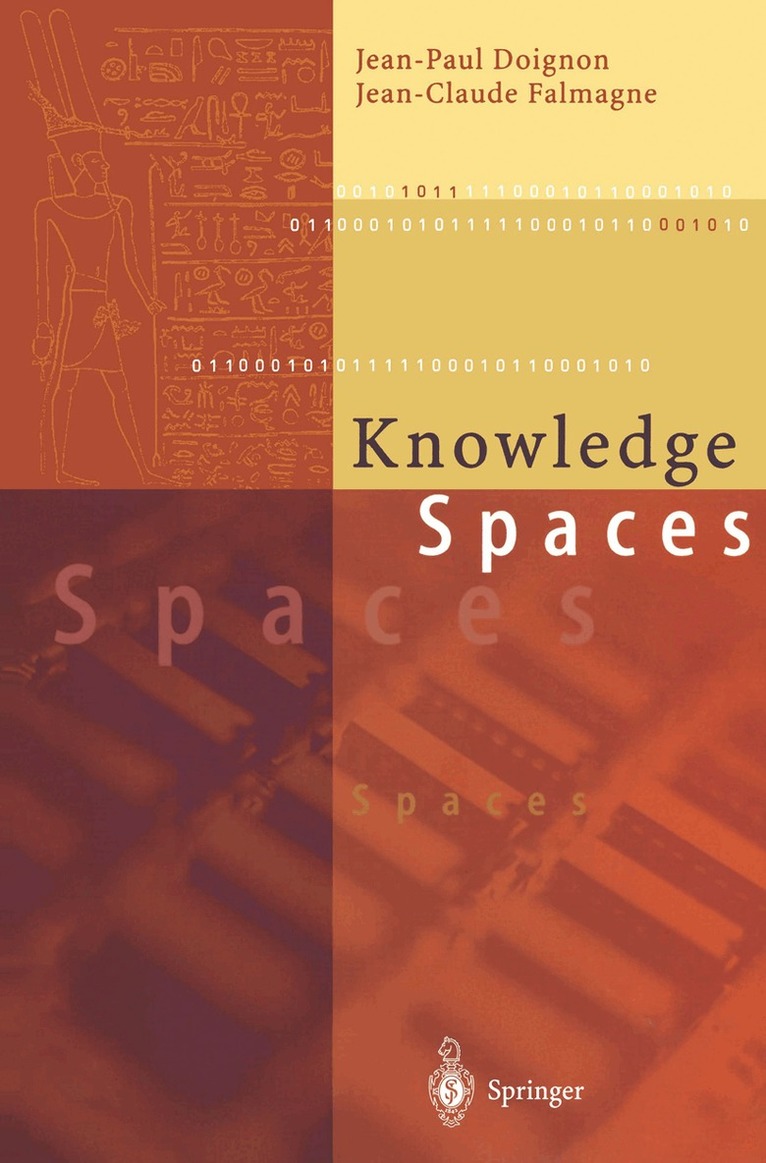
Knowledge spaces offer a rigorous mathematical foundation for various practical systems of knowledge assessment. An example is offered by the ALEKS system (Assessment and LEarning in Knowledge Spaces), a software for the assessment of mathematical knowledge. From a mathematical standpoint, knowledge spaces generalize partially ordered sets. They are investigated both from a combinatorial and a stochastic viewpoint. The results are applied to real and simulated data. The book gives a systematic presentation of research and extends the results to new situations. It is of interest to mathematically oriented readers in education, computer science and combinatorics at research and graduate levels. The text contains numerous examples and exercises and an extensive bibliography.
1 064 kr
Skickas inom 10-15 vardagar
The focus of this book is a mathematical structure modeling a physical or biological system that can be in any of a number of ‘states. ’ Each state is characterized by a set of binary features, and di?ers from some other nei- bor state or states by just one of those features. In some situations, what distinguishes a state S from a neighbor state T is that S has a particular f- ture that T does not have. A familiar example is a partial solution of a jigsaw puzzle, with adjoining pieces. Such a state can be transformed into another state, that is, another partial solution or the ?nal solution, just by adding a single adjoining piece. This is the ?rst example discussed in Chapter 1. In other situations, the di?erence between a state S and a neighbor state T may reside in their location in a space, as in our second example, in which in which S and T are regions located on di?erent sides of some common border. We formalize the mathematical structure as a semigroup of ‘messages’ transforming states into other states. Each of these messages is produced by the concatenation of elementary transformations called ‘tokens (of infor- tion). ’ The structure is speci?ed by two constraining axioms. One states that any state can be produced from any other state by an appropriate kind of message. The other axiom guarantees that such a production of states from other states satis?es a consistency requirement.
1 804 kr
Skickas inom 10-15 vardagar
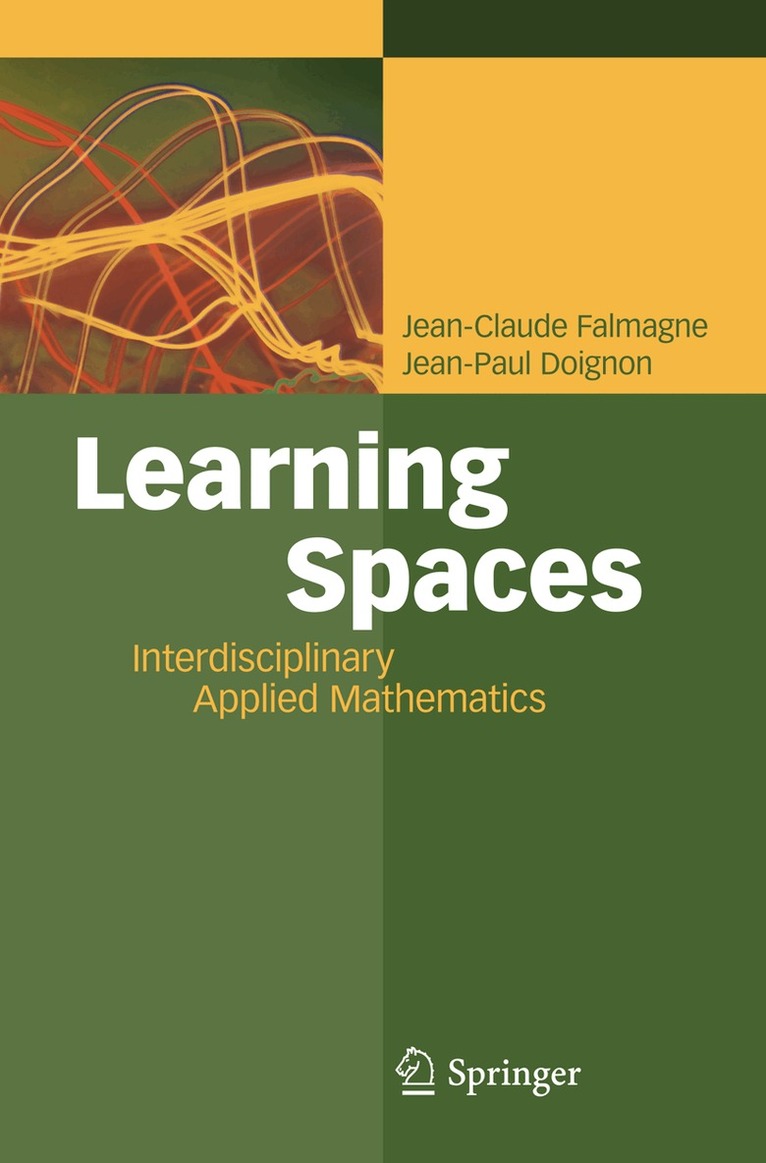
Learning spaces offer a rigorous mathematical foundation for practical systems of educational technology. Learning spaces generalize partially ordered sets and are special cases of knowledge spaces. The various structures are investigated from the standpoints of combinatorial properties and stochastic processes. Leaning spaces have become the essential structures to be used in assessing students' competence of various topics. A practical example is offered by ALEKS, a Web-based, artificially intelligent assessment and learning system in mathematics and other scholarly fields. At the heart of ALEKS is an artificial intelligence engine that assesses each student individually and continously.The book is of interest to mathematically oriented readers in education, computer science, engineering, and combinatorics at research and graduate levels. Numerous examples and exercises are included, together with an extensive bibliography.
1 064 kr
Skickas inom 10-15 vardagar
The focus of this book is a mathematical structure modeling a physical or biological system that can be in any of a number of ‘states. ’ Each state is characterized by a set of binary features, and di?ers from some other nei- bor state or states by just one of those features. In some situations, what distinguishes a state S from a neighbor state T is that S has a particular f- ture that T does not have. A familiar example is a partial solution of a jigsaw puzzle, with adjoining pieces. Such a state can be transformed into another state, that is, another partial solution or the ?nal solution, just by adding a single adjoining piece. This is the ?rst example discussed in Chapter 1. In other situations, the di?erence between a state S and a neighbor state T may reside in their location in a space, as in our second example, in which in which S and T are regions located on di?erent sides of some common border. We formalize the mathematical structure as a semigroup of ‘messages’ transforming states into other states. Each of these messages is produced by the concatenation of elementary transformations called ‘tokens (of infor- tion). ’ The structure is speci?ed by two constraining axioms. One states that any state can be produced from any other state by an appropriate kind of message. The other axiom guarantees that such a production of states from other states satis?es a consistency requirement.
1 064 kr
Skickas inom 10-15 vardagar
The book describes up-to-date applications and relevant theoretical results. These applications come from various places, but the most important one, numerically speaking, is the internet based educational system ALEKS. The ALEKS system is bilingual English-Spanish and covers all of mathematics, from third grade to the end of high school, and chemistry. It is also widely used in higher education because US students are often poorly prepared when they reach the university level. The chapter by Taagepera and Arasasingham deals with the application of knowledge spaces, independent of ALEKS, to the teaching of college chemistry. The four chapters by Albert and his collaborators strive to give cognitive interpretations to the combinatoric structures obtained and used by the ALEKS system. The contribution by Eppstein is technical and develops means of searching the knowledge structure efficiently.
1 564 kr
Skickas inom 5-8 vardagar
Learning spaces offer a rigorous mathematical foundation for practical systems of educational technology. Learning spaces generalize partially ordered sets and are special cases of knowledge spaces. The various structures are investigated from the standpoints of combinatorial properties and stochastic processes. Leaning spaces have become the essential structures to be used in assessing students' competence of various topics. A practical example is offered by ALEKS, a Web-based, artificially intelligent assessment and learning system in mathematics and other scholarly fields. At the heart of ALEKS is an artificial intelligence engine that assesses each student individually and continously.The book is of interest to mathematically oriented readers in education, computer science, engineering, and combinatorics at research and graduate levels. Numerous examples and exercises are included, together with an extensive bibliography.
1 064 kr
Skickas inom 10-15 vardagar
The book describes up-to-date applications and relevant theoretical results. These applications come from various places, but the most important one, numerically speaking, is the internet based educational system ALEKS. The ALEKS system is bilingual English-Spanish and covers all of mathematics, from third grade to the end of high school, and chemistry. It is also widely used in higher education because US students are often poorly prepared when they reach the university level. The chapter by Taagepera and Arasasingham deals with the application of knowledge spaces, independent of ALEKS, to the teaching of college chemistry. The four chapters by Albert and his collaborators strive to give cognitive interpretations to the combinatoric structures obtained and used by the ALEKS system. The contribution by Eppstein is technical and develops means of searching the knowledge structure efficiently.
536 kr
Skickas inom 10-15 vardagar
The authors describe systematic methods for uncovering scientific laws a priori, on the basis of intuition, or “Gedanken Experiments”. Mathematical expressions of scientific laws are, by convention, constrained by the rule that their form must be invariant with changes of the units of their variables.
536 kr
Skickas inom 10-15 vardagar
The authors describe systematic methods for uncovering scientific laws a priori, on the basis of intuition, or “Gedanken Experiments”. Mathematical expressions of scientific laws are, by convention, constrained by the rule that their form must be invariant with changes of the units of their variables.