• Fri frakt över 249 kr
  • •
  • Snabba leveranser
  • •
  • Billiga böcker
Kundservice

Du är på sajten för privatpersoner.

Företag, bibliotek eller offentlig verksamhet?

Du handlar på classic.bokus.com, där alla dina funktioner finns intakta.
Till classic.bokus.com
Bokus logotyp. Gå till startsidan.
  • Erbjudanden
  • Nyheter
  • Student
  • Topplistor
  • Barn & ungdom
  • Bokus Play
  • E-böcker
  • Pocketböcker
  • Spel & pussel

10% rabatt på allt med kod NYSTART10 →

Sidfot

Mina sidor

    Hjälp

    • Kundservice
    • Vanliga frågor och svar
    • Frakt och leverans
    • Retur vid ångerrätt
    • Reklamera vara
    • Betalning
    • Köpvillkor
    • Allmänna villkor
    • Information om webbplatsens tillgänglighet

    Om Bokus

    • Om oss
    • Pressrum
    • För studenter
    • För företag
    • För bibliotek och offentlig verksamhet
    • För leverantörer
    • Hållbarhet

    Populärt

    • Aktuella erbjudanden
    • Presentkort
    • Studentlitteratur
    • Nya böcker
    • Topplistor
    • Signerade böcker
    • Engelska böcker

    Inspiration

    • Boktips
    • BookTok
    • Populära bokserier
    • Barnbokskaraktärer
    • Populära författare
    Logotyp för Bokus
    Följ oss på Facebook (extern länk)Följ oss på Instagram (extern länk)Följ oss på YouTube (extern länk)Följ oss på TikTok (extern länk)
    bokus @ CookiesAnpassa cookiesIntegritetspolicyKöpvillkor
    Till Citymail hemsida (extern länk)Till Budbee hemsida (extern länk)Till Postnord hemsida (extern länk)Till Schenker hemsida (extern länk)Till Early Bird hemsida (extern länk)Till Walleys hemsida (extern länk)
    1. Psykologi och pedagogik
    2. Psykologi

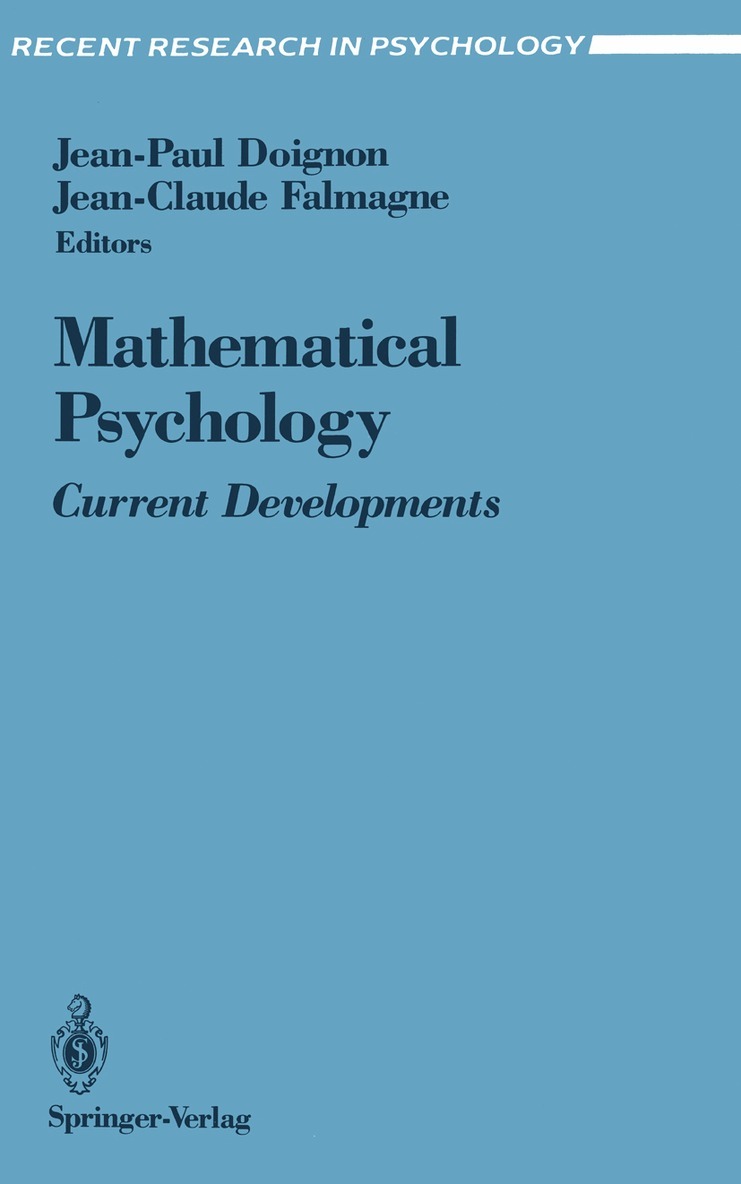
    Mathematical Psychology

    Current Developments

    AvJean-Paul Doignon,Jean-Claude Falmagne

    Häftad, Engelska, 1991

    Del i serien Recent Research in Psychology

    1 054 kr

    Beställningsvara. Skickas inom 10-15 vardagar. Fri frakt över 249 kr.

    Beskrivning

    Sometime in the late sixties, one of the editors of this volume realized that the mathematica psychologists in Europe-an odd lot mostly concentrated in Germany, the Netherlands, France, England and Belgium-were suffering from an acute sense of isolation. The papers that they presented at meetings of their national or regional societies had to be 'sanitized' to the point of misrepresentation. They were misunderstood. The mood was grim, depression was lurking. He decided that urgent action was required: a European gathering of mathematical psychologists was called in April 1971. Not being foolhardy, however, he took the precaution of choosing Paris as the meeting place. Around thirty mathematical psychologists received an invitation. They all came, justifying at least Paris's reputation. The meeting took place at the 'Maison des Belges' of the Cite Universitaire, Boulevard Jourdan, in front of the Parc Montsouris. As far as everyone remembers, the meeting was a full success. A happy birth had taken place. This editor then irresponsibly accepted a position in a university in the US, leaving an infant to the whims of the passers-by. Fortunately, a godfather came along. The next meeting took place in Nijmegen, in November 1971, under the loving care of Eddy Roskam. A tradition was established. The third meeting was in Oxford (1972); then in Marseilles (1973), Regensburg (1974), Stirling (1975), Stockholm (1976) . . . The infant became a toddler, then a vigorous child. This annual meeting is now an important event in the field.

    Produktinformation

    • Utgivningsdatum:1991-10-11
    • Mått:156 x 244 x 25 mm
    • Vikt:729 g
    • Format:Häftad
    • Språk:Engelska
    • Serie:Recent Research in Psychology
    • Antal sidor:453
    • Förlag:Springer-Verlag New York Inc.
    • ISBN:9780387976655

    Utforska kategorier

    • Psykologi inom Psykologi och pedagogik
    • Sociologi inom Samhälle och politik

    Innehållsförteckning

    • 1. Measurement Theory.- Ordinal Independence and Functional Equations in the Theory of Psychological Difference.- The Principle of Invariance with Special Reference to Perception.- Scalar Invariance in Opponent Colour Theory and the ‘Discounting the Background’ Principle.- Additive Representation of Preferences, a New Foundation of Decision Analysis; The Algebraic Approach.- Bisector Spaces: Geometry for Triadic Data.- 2. Probabilistic Choice and Decision.- On the Interpretation of Strict Utility Choice Models.- Belief Functions, Convex Capacities, and Decision Making.- Probabilistic Measurement Theory.- Circularity in Conjoint Paired Comparisons.- Random Utility Representations of Binary Choice Probabilities.- Connectionist Models of Decision Making.- Uniqueness in Attribute Weighting and in Representation of Qualitative Probabilities.- 3. Knowledge Representation and Psychometrics.- Constructing Knowledge Spaces from Judgements with Differing Degrees of Certainty.- Knowledge Representation of Spatial Relations.- A Rasch Model for the Speed-Accuracy Tradeoff in Time Limited Tests.- Testing Finite State Models of Performance in Objective Tests Using Items with ‘None of the Above’ as an Option.- On Power Series Models and the Specifically Objective Assessment of Change in Event Frequencies.- 4. Information Processing and Cognitive Modelling.- Statistical Inference for Multinomial Processing Tree Models.- Comparison Between Stochastic Models for Visual Selection.- Conflicting Strategies in Dual Control Problems with Different Goals.- A Feature Model for Unfolding and Experimental Results.- A Response Time Theory of Perceptual Independence.- A General Adaptive Filter Model for Human Associative Memory.- Author Index.