Jeffrey H. Smith – författare
Visar alla böcker från författaren Jeffrey H. Smith. Handla med fri frakt och snabb leverans.
3 produkter
3 produkter
270 kr
Skickas inom 10-15 vardagar
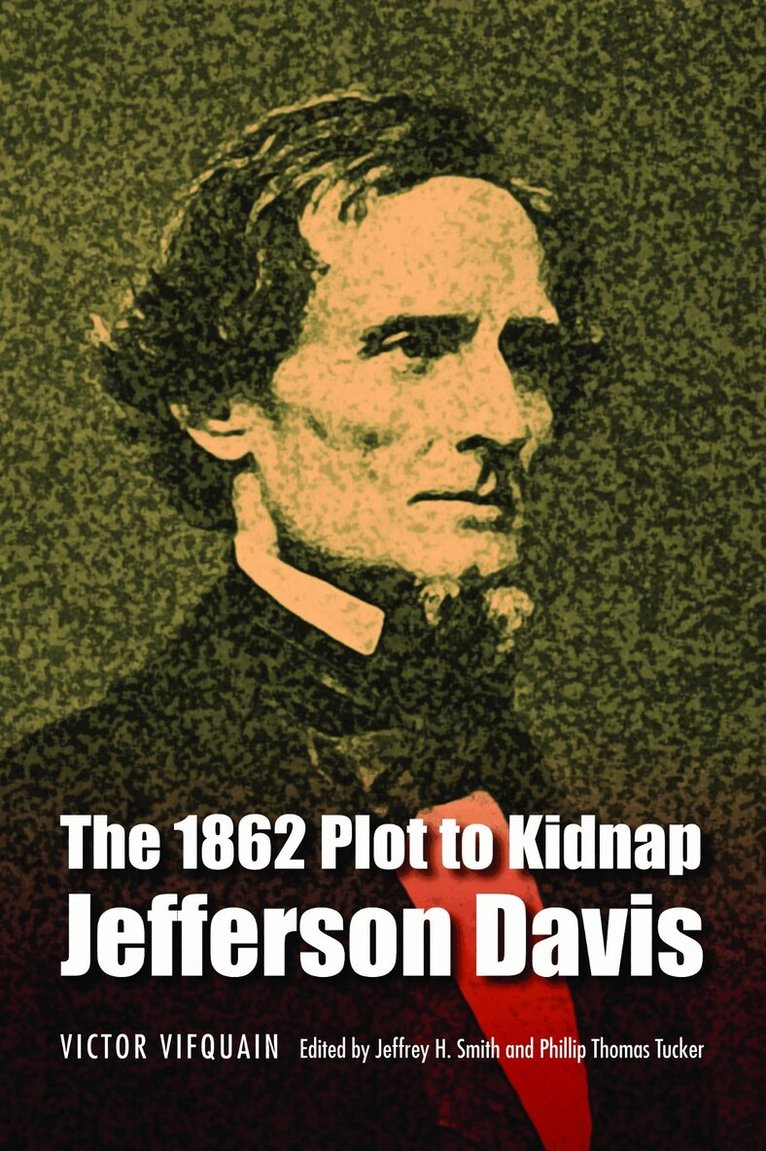
Victor Vifquain's memoir is an engaging, firsthand account of a bold attempt to kidnap the president of the Confederate States of America. Archived for nearly a century, the chronicle of this previously unknown and daring plot has been brought to light by historians Jeffrey H. Smith, Vifquain's great-great grandson, and Phillip Thomas Tucker in a meticulously edited and annotated volume. The plot to ride into Richmond and capture Jefferson Davis was concocted by three brash adventurers, who, using pseudonyms from The Three Musketeers, were soon involved in escapades worthy of Dumas's trio. This stunning story provides a fresh perspective on Richmond during the Civil War and a personal account of a scheme devised to bring an early end to the war.
1 468 kr
Skickas inom 5-8 vardagar
The purpose of this monograph, which is aimed at the graduate level and beyond, is to obtain a deeper understanding of Quillen's model categories. A model category is a category together with three distinguished classes of maps, called weak equivalences, cofibrations, and fibrations. Model categories have become a standard tool in algebraic topology and homological algebra and, increasingly, in other fields where homotopy theoretic ideas are becoming important, such as algebraic $K$-theory and algebraic geometry.The authors' approach is to define the notion of a homotopical category, which is more general than that of a model category, and to consider model categories as special cases of this. A homotopical category is a category with only a single distinguished class of maps, called weak equivalences, subject to an appropriate axiom. This enables one to define ""homotopical"" versions of such basic categorical notions as initial and terminal objects, colimit and limit functors, cocompleteness and completeness, adjunctions, Kan extensions, and universal properties.There are two essentially self-contained parts, and part II logically precedes part I. Part II defines and develops the notion of a homotopical category and can be considered as the beginnings of a kind of ""relative"" category theory. The results of part II are used in part I to obtain a deeper understanding of model categories. The authors show in particular that model categories are homotopically cocomplete and complete in a sense stronger than just the requirement of the existence of small homotopy colimit and limit functors. A reader of part II is assumed to have only some familiarity with the above-mentioned categorical notions. Those who read part I, and especially its introductory chapter, should also know something about model categories.
298 kr
Skickas inom 5-8 vardagar