Johanna Schoen – författare
Visar alla böcker från författaren . Handla med fri frakt och snabb leverans.
12 produkter
12 produkter
Häftad, Engelska, 2022
319 kr
Skickas inom 5-8 vardagar
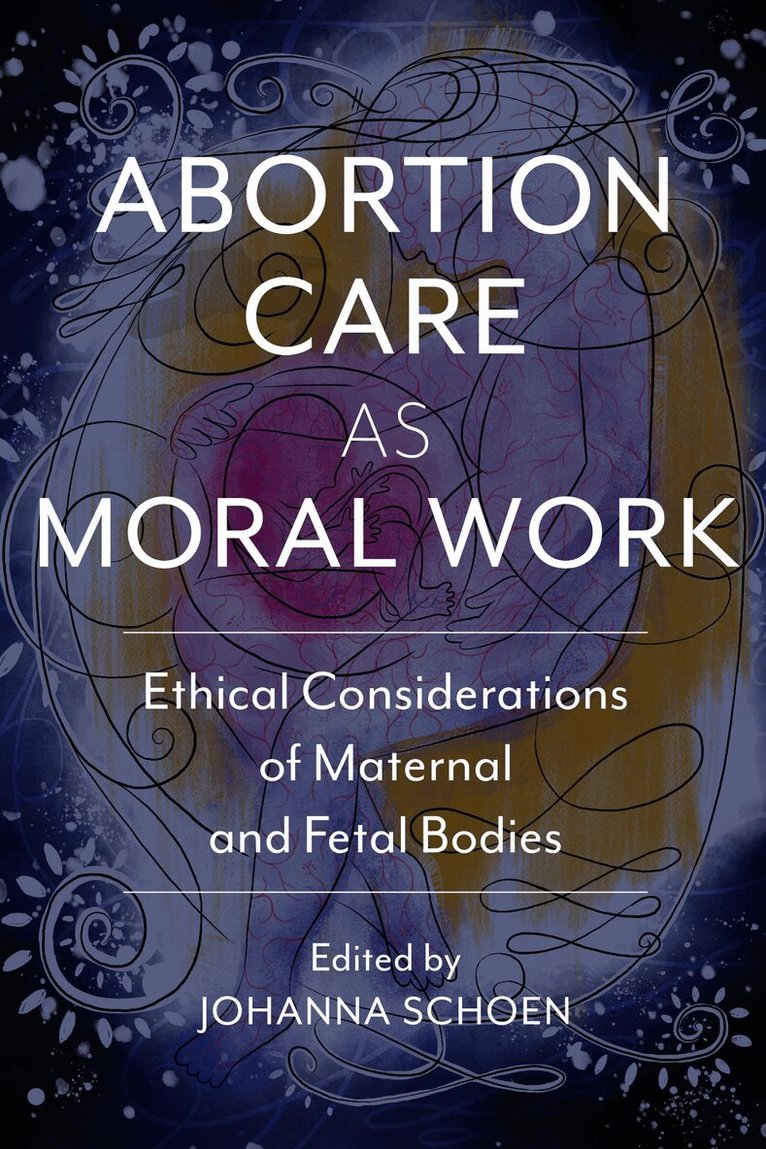
Abortion Care as Moral Work brings together the voices of abortion providers, abortion counselors, clinic owners, neonatologists, bioethicists, and historians to discuss how and why providing abortion care is moral work. The collection offers voices not usually heard as clinicians talk about their work and their thoughts about life and death. In four subsections--Providers, Clinics, Conscience, and The Fetus--the contributions in this anthology explore the historical context and present-day challenges to the delivery of abortion care. Contributing authors address the motivations that lead abortion providers to offer abortion care, discuss the ways in which anti-abortion regulations have made it increasingly difficult to offer feminist-inspired services, and ponder the status of the fetus and the ethical frameworks supporting abortion care and fetal research. Together these essays provide a feminist moral foundation to reassert that abortion care is moral work.
E-bok
Engelska, 201293 kr
Läs direkt efter köp
In 2003, North Carolina became the third U.S. state to apologize and the first to call for compensation to victims of state-ordered sterilizations carried out between 1929 and 1975. The decision was prompted largely by a series of articles in the Winston-Salem Journal. The stories were inspired in part by the meticulous research of Johanna Schoen, who was granted unique access to the papers of the North Carolina Eugenics Board and to summaries of the case histories of nearly 7600 victims — men, women, and children as young as ten years old — most of whom had been sterilized without their consent. In 2011, a gubernatorial task force held public hearings to gather testimony from the victims and their families before recommending in early 2012 that each living victim be granted $50,000 compensation. The restitution proposal requires legislative approval before funds can be dispersed.In this UNC Press Short, excerpted from Choice and Coercion, Schoen explains the legal construction of North Carolina’s sterilization program, which lasted far longer than similar programs in other states, and demonstrates through the stories of several women how the state was able to deny women who were poor, uneducated, African American, or “promiscuous” reproductive autonomy in multiple ways.UNC Press Shorts excerpt compelling, shorter narratives from selected best-selling books published by the University of North Carolina Press and present them as engaging, quick reads. Presented exclusively as e-books, these shorts present essential concepts, defining moments, and concise introductions to topics. They are intended to stir the imagination and courage exploration of the original publications from which they are drawn.
Häftad, Engelska, 2005
453 kr
Skickas inom 10-15 vardagar
In August 2003, North Carolina became the first U.S. state to offer restitution to victims of state-ordered sterilizations carried out by its eugenics program between 1929 and 1975. The decision was prompted by newspaper stories based on the research of Johanna Schoen, who was granted unique access to summaries of 7,500 case histories and the papers of the North Carolina Eugenics Board. In this book, Schoen situates the state's reproductive politics in a national and global context. Widening her focus to include birth control, sterilization, and abortion policies across the nation, she demonstrates how each method for limiting unwanted pregnancies had the potential both to expand and to limit women's reproductive choices. Such programs overwhelmingly targeted poor and nonwhite populations, yet they also extended a measure of reproductive control to poor women that was previously out of reach. On an international level, the United States has influenced reproductive health policies by, for example, tying foreign aid to the recipients' compliance with U.S. notions about family planning. The availability of U.S.-funded family planning aid has proved to be a double-edged sword, offering unprecedented opportunities to poor women while subjecting foreign patients to medical experimentation that would be considered unacceptable at home. Drawing on the voices of health and science professionals, civic benefactors, and American women themselves, Schoen's study allows deeper understandings of the modern welfare state and the lives of women.
E-bok
Engelska, 2006337 kr
Läs direkt efter köp
In August 2003, North Carolina became the first U.S. state to offer restitution to victims of state-ordered sterilizations carried out by its eugenics program between 1929 and 1975. The decision was prompted largely by a series of articles in the Winston-Salem Journal. These stories were inspired in part by the research of Johanna Schoen, who was granted unique access to summaries of 7,500 case histories and the papers of the North Carolina Eugenics Board.In this book, Schoen situates the state’s reproductive politics in a national and global context. Widening her focus to include birth control, sterilization, and abortion policies across the nation, she demonstrates how each method for limiting unwanted pregnancies had the potential both to expand and to limit women’s reproductive choices. Such programs overwhelmingly targeted poor and nonwhite populations, yet they also extended a measure of reproductive control to poor women that was previously out of reach.On an international level, the United States has influenced reproductive health policies by, for example, tying foreign aid to the recipients'' compliance with U.S. notions about family planning. The availability of U.S.-funded family planning aid has proved to be a double-edged sword, offering unprecedented opportunities to poor women while subjecting foreign patients to medical experimentation that would be considered unacceptable at home.Drawing on the voices of health and science professionals, civic benefactors, and American women themselves, Schoen’s study allows deeper understandings of the modern welfare state and the lives of women.
Inbunden, Engelska, 2022
786 kr
Skickas inom 5-8 vardagar
Abortion Care as Moral Work brings together the voices of abortion providers, abortion counselors, clinic owners, neonatologists, bioethicists, and historians to discuss how and why providing abortion care is moral work. The collection offers voices not usually heard as clinicians talk about their work and their thoughts about life and death. In four subsections--Providers, Clinics, Conscience, and The Fetus--the contributions in this anthology explore the historical context and present-day challenges to the delivery of abortion care. Contributing authors address the motivations that lead abortion providers to offer abortion care, discuss the ways in which anti-abortion regulations have made it increasingly difficult to offer feminist-inspired services, and ponder the status of the fetus and the ethical frameworks supporting abortion care and fetal research. Together these essays provide a feminist moral foundation to reassert that abortion care is moral work.
Häftad, Engelska, 2024
286 kr
Skickas inom 5-8 vardagar
Just over fifty years ago on January 22, 1973, the United States Supreme Court decision on Roe v. Wade assured millions of women that abortion was a protected constitutional right due to a woman’s right to privacy. In the context of the burgeoning women’s rights movement, it seemed like an inalienable victory: women might become equal to men in their right to determine what would happen to their bodies. This was a hard-won fight that reached back to colonial America and slavery, but on June 24, 2022, the decision was shockingly reversed by the Supreme Court in Dobbs v. Jackson Women’s Health Organization. What happened? What transpired socially, politically, legally, in religious institutions and in popular culture in the half-century when “the right to choose” led to this stunning transformation in American society? Roe v. Wade: Fifty Years After, coedited by Rhae Lynn Barnes and Catherine Clinton for the History in the Headlines series, brings together a team of world-renowned scholars, prizewinning historians, and Pulitzer Prize-winning public intellectuals who specialize in reproductive history. They assembled at Harvard University in the weeks following the Dobbs decision to talk through the centuries-long history of abortion in what became the United States, how its representation changed in the law and popular culture, and how a wellspring of social movements on both the right and left led to a fifty-year showdown over some of the most outstanding human questions: What is life? When does it begin? Who has the right to end it? Who has the right to determine what happens to someone else’s body? How can the law define and restrict women’s reproductive health? And how have race, class, geography, sexuality, and other factors shaped who gets to be a part of answering these questions? The international impact of the struggles for reproductive freedom for women within the United States comes into sharp focus within this important volume, shedding light on past, present, and future dimensions of reproductive freedom for all Americans.
Inbunden, Engelska, 2024
2 085 kr
Skickas inom 3-6 vardagar
Just over fifty years ago on January 22, 1973, the United States Supreme Court decision on Roe v. Wade assured millions of women that abortion was a protected constitutional right due to a woman’s right to privacy. In the context of the burgeoning women’s rights movement, it seemed like an inalienable victory: women might become equal to men in their right to determine what would happen to their bodies. This was a hard-won fight that reached back to colonial America and slavery, but on June 24, 2022, the decision was shockingly reversed by the Supreme Court in Dobbs v. Jackson Women’s Health Organization. What happened? What transpired socially, politically, legally, in religious institutions and in popular culture in the half-century when “the right to choose” led to this stunning transformation in American society? Roe v. Wade: Fifty Years After, coedited by Rhae Lynn Barnes and Catherine Clinton for the History in the Headlines series, brings together a team of world-renowned scholars, prizewinning historians, and Pulitzer Prize-winning public intellectuals who specialize in reproductive history. They assembled at Harvard University in the weeks following the Dobbs decision to talk through the centuries-long history of abortion in what became the United States, how its representation changed in the law and popular culture, and how a wellspring of social movements on both the right and left led to a fifty-year showdown over some of the most outstanding human questions: What is life? When does it begin? Who has the right to end it? Who has the right to determine what happens to someone else’s body? How can the law define and restrict women’s reproductive health? And how have race, class, geography, sexuality, and other factors shaped who gets to be a part of answering these questions? The international impact of the struggles for reproductive freedom for women within the United States comes into sharp focus within this important volume, shedding light on past, present, and future dimensions of reproductive freedom for all Americans.
E-bok
Engelska, 2015404 kr
Läs direkt efter köp
Abortion is--and always has been--an arena for contesting power relations between women and men. When in 1973 the Supreme Court made the procedure legal throughout the United States, it seemed that women were at last able to make decisions about their own bodies. In the four decades that followed, however, abortion became ever more politicized and stigmatized. Abortion after Roe chronicles and analyzes what the new legal status and changing political environment have meant for abortion providers and their patients. Johanna Schoen sheds light on the little-studied experience of performing and receiving abortion care from the 1970s--a period of optimism--to the rise of the antiabortion movement and the escalation of antiabortion tactics in the 1980s to the 1990s and beyond, when violent attacks on clinics and abortion providers led to a new articulation of abortion care as moral work. As Schoen demonstrates, more than four decades after the legalization of abortion, the abortion provider community has powerfully asserted that abortion care is a moral good.
E-bok
Engelska, 20151 135 kr
Läs direkt efter köp
Abortion is — and always has been — an arena for contesting power relations between women and men. When in 1973 the Supreme Court made the procedure legal throughout the United States, it seemed that women were at last able to make decisions about their own bodies. In the four decades that followed, however, abortion became ever more politicized and stigmatized. Abortion after Roe chronicles and analyzes what the new legal status and changing political environment have meant for abortion providers and their patients. Johanna Schoen sheds light on the little-studied experience of performing and receiving abortion care from the 1970s — a period of optimism — to the rise of the antiabortion movement and the escalation of antiabortion tactics in the 1980s to the 1990s and beyond, when violent attacks on clinics and abortion providers led to a new articulation of abortion care as moral work. As Schoen demonstrates, more than four decades after the legalization of abortion, the abortion provider community has powerfully asserted that abortion care is a moral good.
Häftad, Engelska, 2017
439 kr
Skickas inom 10-15 vardagar
Abortion is - and always has been - an arena for contesting power relations between women and men. When in 1973 the Supreme Court made the procedure legal throughout the United States, it seemed that women were at last able to make decisions about their own bodies. In the four decades that followed, however, abortion became ever more politicized and stigmatized. Abortion after Roe chronicles and analyzes what the new legal status and changing political environment have meant for abortion providers and their patients. Johanna Schoen sheds light on the little-studied experience of performing and receiving abortion care from the 1970s - a period of optimism - to the rise of the antiabortion movement and the escalation of antiabortion tactics in the 1980s to the 1990s and beyond, when violent attacks on clinics and abortion providers led to a new articulation of abortion care as moral work. As Schoen demonstrates, more than four decades after the legalization of abortion, the abortion provider community has powerfully asserted that abortion care is a moral good.
E-bok
PDF, Engelska, 2006337 kr
Läs direkt efter köp
In August 2003, North Carolina became the first U.S. state to offer restitution to victims of state-ordered sterilizations carried out by its eugenics program between 1929 and 1975. The decision was prompted largely by a series of articles in the Winston-Salem Journal. These stories were inspired in part by the research of Johanna Schoen, who was granted unique access to summaries of 7,500 case histories and the papers of the North Carolina Eugenics Board.In this book, Schoen situates the state’s reproductive politics in a national and global context. Widening her focus to include birth control, sterilization, and abortion policies across the nation, she demonstrates how each method for limiting unwanted pregnancies had the potential both to expand and to limit women’s reproductive choices. Such programs overwhelmingly targeted poor and nonwhite populations, yet they also extended a measure of reproductive control to poor women that was previously out of reach.On an international level, the United States has influenced reproductive health policies by, for example, tying foreign aid to the recipients'' compliance with U.S. notions about family planning. The availability of U.S.-funded family planning aid has proved to be a double-edged sword, offering unprecedented opportunities to poor women while subjecting foreign patients to medical experimentation that would be considered unacceptable at home.Drawing on the voices of health and science professionals, civic benefactors, and American women themselves, Schoen’s study allows deeper understandings of the modern welfare state and the lives of women.
E-bok
PDF, Engelska, 2015269 kr
Läs direkt efter köp
Abortion is — and always has been — an arena for contesting power relations between women and men. When in 1973 the Supreme Court made the procedure legal throughout the United States, it seemed that women were at last able to make decisions about their own bodies. In the four decades that followed, however, abortion became ever more politicized and stigmatized. Abortion after Roe chronicles and analyzes what the new legal status and changing political environment have meant for abortion providers and their patients. Johanna Schoen sheds light on the little-studied experience of performing and receiving abortion care from the 1970s — a period of optimism — to the rise of the antiabortion movement and the escalation of antiabortion tactics in the 1980s to the 1990s and beyond, when violent attacks on clinics and abortion providers led to a new articulation of abortion care as moral work. As Schoen demonstrates, more than four decades after the legalization of abortion, the abortion provider community has powerfully asserted that abortion care is a moral good.