John B. Little - Böcker
Visar alla böcker från författaren John B. Little. Handla med fri frakt och snabb leverans.
2 produkter
2 produkter
965 kr
Skickas inom 7-10 vardagar
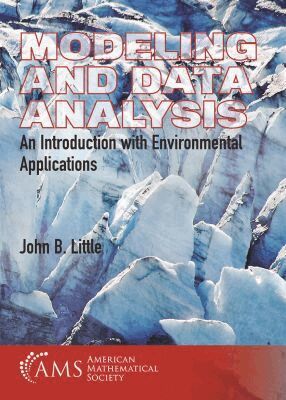
Can we coexist with the other life forms that have evolved on this planet? Are there realistic alternatives to fossil fuels that would sustainably provide for human society's energy needs and have fewer harmful effects? How do we deal with threats such as emergent diseases? Mathematical models--equations of various sorts capturing relationships between variables involved in a complex situation--are fundamental for understanding the potential consequences of choices we make. Extracting insights from the vast amounts of data we are able to collect requires analysis methods and statistical reasoning.This book on elementary topics in mathematical modeling and data analysis is intended for an undergraduate ``liberal arts mathematics''-type course but with a specific focus on environmental applications. It is suitable for introductory courses with no prerequisites beyond high school mathematics. A great variety of exercises extends the discussions of the main text to new situations and/or introduces new real-world examples. Every chapter ends with a section of problems, as well as with an extended chapter project which often involves substantial computing work either in spreadsheet software or in the ${\tt R}$ statistical package.
1 005 kr
Skickas inom 7-10 vardagar
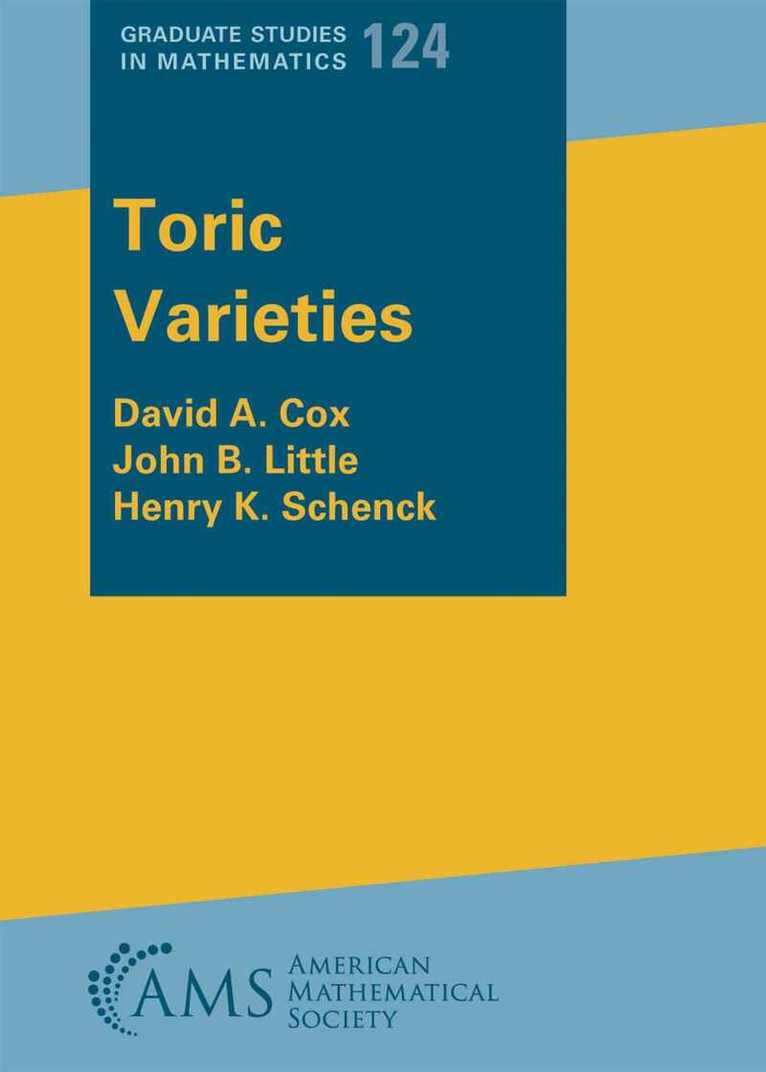
Toric varieties form a beautiful and accessible part of modern algebraic geometry. This book covers the standard topics in toric geometry; a novel feature is that each of the first nine chapters contains an introductory section on the necessary background material in algebraic geometry. Other topics covered include quotient constructions, vanishing theorems, equivariant cohomology, GIT quotients, the secondary fan, and the minimal model program for toric varieties. The subject lends itself to rich examples reflected in the 134 illustrations included in the text. The book also explores connections with commutative algebra and polyhedral geometry, treating both polytopes and their unbounded cousins, polyhedra. There are appendices on the history of toric varieties and the computational tools available to investigate nontrivial examples in toric geometry.Readers of this book should be familiar with the material covered in basic graduate courses in algebra and topology, and to a somewhat lesser degree, complex analysis. In addition, the authors assume that the reader has had some previous experience with algebraic geometry at an advanced undergraduate level. The book will be a useful reference for graduate students and researchers who are interested in algebraic geometry, polyhedral geometry, and toric varieties.