John Barnie - Böcker
Visar alla böcker från författaren John Barnie. Handla med fri frakt och snabb leverans.
10 produkter
10 produkter
99 kr
Tillfälligt slut
162 kr
Kommande
133 kr
Skickas
Walking the razor edge between grim reality and stoicism, John Barnie once again brings his intelligence, wit and prescient anger to bear on the world we inhabit and the world we are making. In spine-chilling imagery and with a linguistic dexterity that makes words shine, we are taken to a landscape that is exquisite and familiar, yet simultaneously overwhelmed with wreckage and grief. Staring not only into time’s abyss, but into the carnage wrought by human desire for more and more.Prophetic in the tradition of Robinson Jeffers, but with the lyric compression of William Carlos Williams, whose words provide the epigraph for this collection, Barnie imagines his quiet rural homeland occupied and brutalised in the central sequence, ‘Occupied’: ‘the safety net / so full of holes you couldn’t catch a whale in it […]/ I knew the days of iridescence were lost for ever.’ (‘Iridescence’) While in ‘M.A.D.: The Sequel’ rhymes skip along with an irony reminiscent of William Blake’s use of nursery rhyme metre to convey horror. As the world is incinerated we hear: ‘cry if you must / there was no one to gather / the heart’s dust.’
145 kr
Skickas
In a tight sequence of 33 poems, In the Shadow of the Yew, John Barnie leads us through ‘the cemetery of hopes’ (Conrad). A layered monologue in a distinctive voice that is incisive and deeply questioning, Barnie asks whether the suffering of humanity and the suffering we inflict renders our species a curse. ‘...better than both / is the one who has never been born, / who has not seen the evil / that is done under the sun.’ says the writer of Ecclesiastes, and Barnie sits in a long line of writers who consider that the natural world would be better off without us. There’s a note of Leopardi, Hardy, Beckett, Cioran and, above all, Robinson Jeffers in this unflinching collection, with a tone that builds on Jeffers’s The Double Axe and its philosophy of inhumanism.And yet, at the heart of this collection, is tenderness and compassion. Woven through poems that refuse to turn away from war and torture, starvation, greed, injustice and suffering, there are glimpses of a childhood by the banks of the Usk, fragments of the stories of friends and loved ones and homage to writers who have come before the poet. And there is a litany of extinct flora and fauna interspersed through the sequence as well as lines mourning so much loss:six hundred million birds have disappeared from Europe what tonnage is that how many hearts pattering faster than rain on a canopy of leavesAt heart there is a delight in the world that humanity is laying waste to, a yearning for life that is otherwise and the repeated cry: What do we do now?
133 kr
Skickas
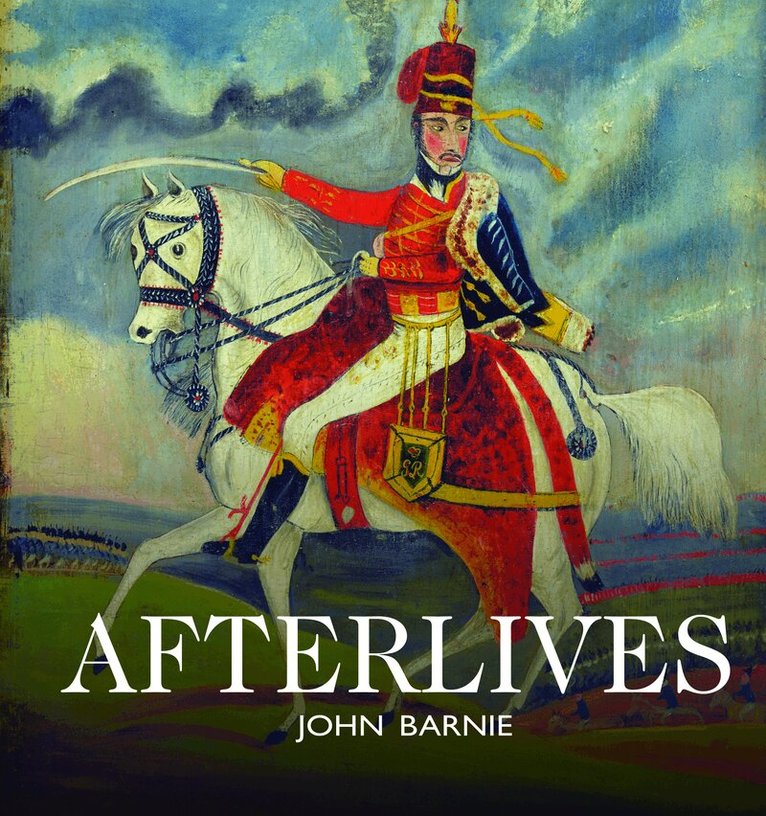
Afterlives sees John Barnie engaging with images once again, as he did in his book A Year of Flowers. Here, Barnie deploys his skills of perception to respond to a group of paintings in Peter Lord’s art collection. These are images that have been familiar to Barnie for years, yet he approaches them with characteristic freshness and humanity. There are no mere descriptions here. Rather, Barnie inhabits the images, speaking from within or engaging with their subjects as a persona just outside the frame. And as he does so, we are taken on a narrative journey, gaining insight into not only how poetry and art interrogate one another, but how each image, peered at ‘through thick cracking varnish’, reveals layers of history and the mores that accrete into hierarchies, prejudices, injustices and the inability to read one another across cultural gaps. The poems in Afterlives reverberate with the ghosts from the pictures, whose roles are still being played out in the divisive echo-chambers of today’s insiders and outsiders. Rich with social commentary, delivered with wit, and sometimes a hint of mischief, there is a serious intent at work here: the voice of those who know ‘whose tragedy they are in’—‘their own’. And who know also that they: ‘will defy anything / that gets in their way’.It is rare that I read a poetry volume at one sitting. But I did so with this one. Indeed, in its delicacy and wit, and in Barnie’s deeply appealing pleasure in his book’s subject-matter—something that radiates from it throughout—I am left wondering if A Year of Flowers might just be the best piece of work that he has given us so far—Matthew Jarvis, reviewing A Year of Flowers in Poetry Wales
131 kr
Skickas
“We need more writers with bite. We have lived in the flatlands too long,” writes John Barnie in one of his ‘observations’ (‘Art in the Flatlands’). And bite he delivers. Ranging across politics, history, culture, ecological disaster, the meaning of truth, poetry, what we mean by identity and more… Barnie shares a window onto the world that is both erudite and particular. Leaning towards pessimism in a darkening world, these observations are often provocative, not from any bullish desire to antagonise, but as the result of mining a rationalist line of thought with an honesty and consistency that is applied as much to the author as to his subjects. There is a clarity here that some may find uncomfortable, but the aim is always dialogue above agreement; intellectual engagement above cheap solutions and sentimentality. Barnie asks us to think, consider and dig deeper, but most of all he asks that we “…live richly among our secondary self-created meanings, while recognising them for what they are. To face without flinching the nullity of the great void.” (‘Varieties of Meaning’) Tsunami Days is a vital collection of essays for those prepared to engage with its unflinching observations.
213 kr
Skickas inom 3-6 vardagar
133 kr
Skickas inom 11-20 vardagar
This generous Selected Poems from John Barnie includes work from seven of his previous collections: Borderland (1984), Lightning Country (1987), Clay (1989), The Confirmation (1992), The City (1993), Heroes (1996) and At the Salt Hotel (2003). His poetry celebrates the natural world – its otherness from ourselves – whilst also tackling the increasingly destructive impact of humans on that world. A secondary theme running throughout the book is the manner in which small-town life, while undoubtedly secure, is also deeply confining. This ecological and sceptical outlook is aligned with a deep affinity with, and boundless curiosity about, nature and our precarious place in it.This Selected Poems is notable for both its breadth of form and its depth of thought. Those familiar with Barnie's work will enjoy having a selection from his varied output.Those unfamiliar will be pleasantly surprised at the range and quality of his poetry.John Barnie was born and raised in Abergavenny, and was a student in Birmingham in the 1960s. He has published work in a wide variety of journals and anthologies and has won a Welsh Arts Council Prize for Literature. He now lives in Aberystwyth and until recently was Editor of the influential magazine of diverse international writing, Planet.
112 kr
Skickas inom 11-20 vardagar
the first decade of the twenty-first century'. It represents a strand of contemporary thought at once Barnie's but also that of a wider, if relatively silent section of the general public. The essays are antagonistic to 'junk culture', political expediency, cultural imperialism, globalisation and reject any depiction of the natural world that sentimentalises its realities. Central to the book is Barnie's atheism (his value system is dependent on scientific 'proof' rather than cultural mores) which gives a strand in the book in which he painstakingly disects biblical texts and confronts what he believes a major contemporary problem: the influence of the literalists and creationists of modern religion. The debunking is done with engaging relish. The reader will also be engaged by another strand of vivid essays concerning Barnie's personal engagement with the natural. Barnie's insights are hard won and lucidly expressed. The essays are liberal, humanist and informed by varying degrees of altruism, environmentalism and culture. They are concerned with humanity and how it responds to and is manipulated and exploited by capitalism, religion, politics and technology, and by how buying into this exploitation (knowingly or not) has created a reduction in human experience (junk culture, short-termism, the cult of self) and human capacity of experience. Barnie doesn't set out to be popular (or unpopular), the careful, informed setting out of argument and opinion is one of the book's strengths.
145 kr
Skickas
Set in a future that may not be too distant, the ice caps have melted and the Atlantic Conveyor of warm water from the tropics to the North Atlantic has collapsed, plunging North America and Europe into a new ice age.Famine, death and conflict stalk the frozen continents, but in the city-state of Banda, one Assault Corps lieutenant questions the totalitarian regime, making himself vulnerable just as he meets and falls in love with Galathea, the embodiment of warmth and beauty absent from their society. As they begin to explore the forbidden past together, Banda braces for the next attack…