John Bruns - Böcker
Visar alla böcker från författaren John Bruns. Handla med fri frakt och snabb leverans.
5 produkter
5 produkter
413 kr
Skickas inom 7-10 vardagar
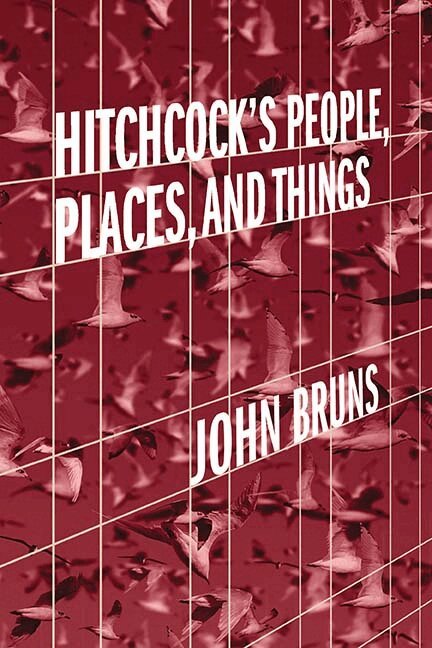
Hitchcock’s People, Places, and Things argues that Alfred Hitchcock was as much a filmmaker of things and places as he was of people. Drawing on the thought of Bruno Latour, John Bruns traces the complex relations of human and nonhuman agents in Hitchcock’s films with the aim of mapping the Hitchcock landscape cognitively, affectively, and politically. Yet this book does not promise that such a map can or will cohere, for Hitchcock was just as adept at misdirection as he was at direction. Bearing this in mind and true to the Hitchcock spirit, Hitchcock’s People, Places, and Things anticipates that people will stumble into the wrong places at the wrong time, places will be made uncanny by things, and things exchanged between people will act as (not-so) secret agents that make up the perilous landscape of Hitchcock’s work.This book offers new readings of well-known Hitchcock films, including The Lodger, Shadow of a Doubt, Psycho, The Birds, and Marnie, as well as insights into lesser-discussed films such as I Confess and Family Plot. Additional close readings of the original theatrical trailer for Psycho and a Hitchcock-directed episode of Alfred Hitchcock Presents expand the Hitchcock landscape beyond conventional critical borders. In tracing the network of relations in Hitchcock’s work, Bruns brings new Hitchcockian tropes to light. For students, scholars, and serious fans, the author promises a thrilling critical navigation of the Hitchcock landscape, with frequent “mental shake-ups” that Hitchcock promised his audience.
1 370 kr
Skickas inom 10-15 vardagar
Hitchcock’s People, Places, and Things argues that Alfred Hitchcock was as much a filmmaker of things and places as he was of people. Drawing on the thought of Bruno Latour, John Bruns traces the complex relations of human and nonhuman agents in Hitchcock’s films with the aim of mapping the Hitchcock landscape cognitively, affectively, and politically. Yet this book does not promise that such a map can or will cohere, for Hitchcock was just as adept at misdirection as he was at direction. Bearing this in mind and true to the Hitchcock spirit, Hitchcock’s People, Places, and Things anticipates that people will stumble into the wrong places at the wrong time, places will be made uncanny by things, and things exchanged between people will act as (not-so) secret agents that make up the perilous landscape of Hitchcock’s work.This book offers new readings of well-known Hitchcock films, including The Lodger, Shadow of a Doubt, Psycho, The Birds, and Marnie, as well as insights into lesser-discussed films such as I Confess and Family Plot. Additional close readings of the original theatrical trailer for Psycho and a Hitchcock-directed episode of Alfred Hitchcock Presents expand the Hitchcock landscape beyond conventional critical borders. In tracing the network of relations in Hitchcock’s work, Bruns brings new Hitchcockian tropes to light. For students, scholars, and serious fans, the author promises a thrilling critical navigation of the Hitchcock landscape, with frequent “mental shake-ups” that Hitchcock promised his audience.
2 430 kr
Skickas inom 10-15 vardagar
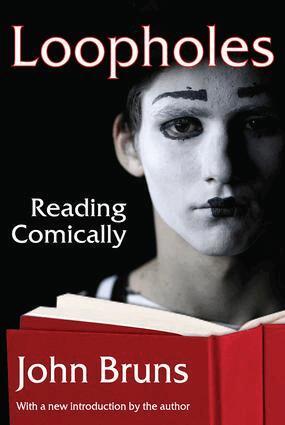
Much writing about comedy in the last twenty years has only trivialized comedy as cheap or as temporary distraction from things that "really matter." It has either presented exhaustive taxonomies of kinds of humor--like wit, puns, jokes, humor, satire, irony--or engaged in pointless political endgames, moral dialogues, or philosophical perceptions. Comedy is rarely presented as a mode of thought in its own right, as a way of understanding, not something to be understood.Bruns' guiding assumption is that comedy is not simply a literary or theatrical genre, to be diff erentiated from tragedy or from romance, but a certain way of disclosing, perhaps undoing, the way the world is organized. When we view the world in terms of what is incompatible, we are reading comically. In this sense, comedy exists outside the alternatives of tragic and comic.Loopholes argues that trivialization of comedy comes from fear that it will address our anxieties with honesty-- and it is this truth that scares us. John Bruns discusses comedy as a mode of thought with a cognitive function. It is a domain of human understanding, a domain far more troubling and accessible than we care to acknowledge. To "read comically" we must accept our fears. If we do so, we will realize what Bruns refers to as the most neglected premise of comedy, that the world itself is a loophole--both incomplete and limitless.
686 kr
Skickas inom 10-15 vardagar
Much writing about comedy tends to begin and end with Aristotle's claim that comedy is inferior to tragedy, trivializing comedy as cheap or as a temporary distraction from things that "really matter." Such writing either presents exhaustive taxonomies of kinds of humor—like wit, puns, jokes, humor, satire, irony—or engages in pointless political endgames, moral dialogues, or philosophical perceptions. Comedy is rarely presented as a mode of thought in its own right, as a way of understanding, not something to be understood.John Bruns' guiding assumption is that comedy is not simply a literary or theatrical genre, to be differentiated from tragedy or from romance, but a certain way of disclosing, perhaps undoing, the way the world is organized. When we view the world in terms of what is incompatible, we are reading comically. In this sense, comedy exists outside the alternatives of tragic and comic.Loopholes argues that trivialization of comedy comes from fear that it will address our anxieties with honesty—and it is this truth that scares us. John Bruns discusses comedy as a mode of thought with a cognitive function. It is a domain of human understanding, a domain far more troubling and accessible than we care to acknowledge. To "read comically" we must accept our fears. If we do so, we will realize what Bruns refers to as the most neglected premise of comedy, that the world itself is a loophole—both incomplete and limitless.
671 kr
Kommande
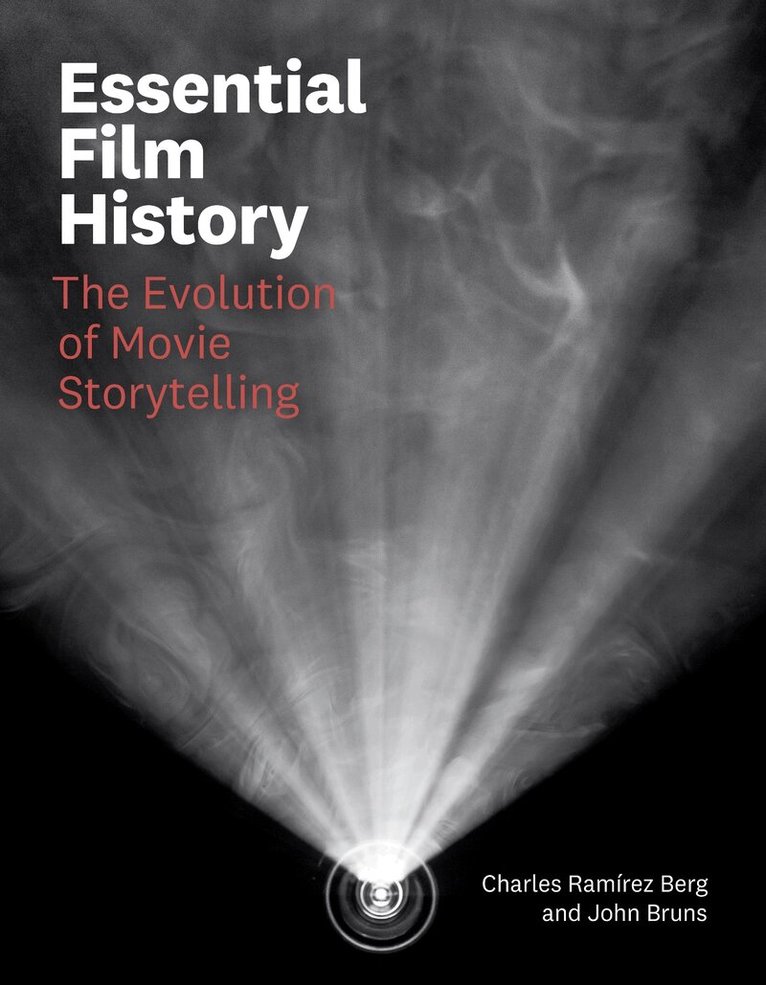
A guide to the fundamentals of understanding film history, filmmaking, and film appreciation.Film is not just a medium; it is also a language—and a global one at that. Essential Film History describes how this language emerged and how it has matured over the course of more than 125 years. Beginning with the experiments of the late nineteenth century, and tracking the development of cinematic storytelling, commercial distribution, and audience reception into the era of digital recording, Charles Ramírez Berg and John Bruns offer a comprehensive course in both the history and artistry of film.Essential Film History breaks cinematic language into three core components: image, sound, and narrative. Between the 1890s and 1940s, this audiovisual language both consolidated and spread, becoming comprehensible worldwide. Since then, filmmakers have adapted and extended the language of cinema to suit an ever-growing range of aesthetic and narrative projects, from documentaries and full-length animation to avant-garde and made-for-TV movies. Covering major figures, studios, and events as well as key technological and sociopolitical developments, Essential Film History is an indispensable guide to the evolution of cinematic style.