John Haffenden - Böcker
Visar alla böcker från författaren John Haffenden. Handla med fri frakt och snabb leverans.
16 produkter
16 produkter
764 kr
Skickas inom 3-6 vardagar
Following the acclaimed first volume, Among the Mandarins, this is the second and concluding volume of the authorized biography of William Empson, one of the foremost poets and literary critics of the twentieth century.Against the Christians begins during the Second World War and follows Empson's turbulent years of writing wartime propaganda for the BBC. As Chinese Editor, he organised broadcasts to China and propaganda programmes for the Home Service, during which time his friends and colleagues included the prickly George Orwell. The effectiveness of Empson's work for the BBC provoked the Nazi propagandist Hans Fritzsche to call him a 'curly-headed Jew' -- a charge which gave him enormous satisfaction.In 1947 he returned to China, where he was caught up in the Communist siege of the Peking and witnessed Mao Tse-tung's triumphant entry. 'I was there for the honeymoon between the universities and the communists; we were being kept up to the mark rather firmly.' He saw 'the dragooning of independent thought and the hysteria of the confession meetings'. In the late 1940s he also taught in the USA, where he relished the irony of his situation. 'My position here really seems to me very dramatic; there can be few other people in the world who are receiving pay simultaneously and without secrecy from the Chinese Communists, the British Socialists, and the capitalist Rockefeller machine.'From 1953 to 1971 he held the Chair of English Literature at Sheffield, where he engaged more vigorously than ever before in public controversy, being driven by a desire to correct the wrong-headed orthodoxies of modern literary criticism -- most notably 'neo-Christianity'. He acquired massive publicity for his views on the wickedness of Christianity when he published Milton's God in 1961: 'The poem is wonderful because it is an awful warning. The effort of reconsidering Milton's God, who makes the poem so good just because he is so sickeningly bad, is a basic one for the European mind.' Haffenden presents a full account of the work on Milton, along with analyses of Empson's many other writings on subjects including Marlowe, Donne, Marvell, and Coleridge, and The Structure of Complex Words (1951).In a full and candid study of the public and private Empson, John Haffenden enables the reader to understand one of the most gifted, eccentric, witty, and controversial figures of our age -- a giant of modern literature and criticism.
828 kr
Skickas inom 7-10 vardagar
This edited collection of letters by William Empson (1906-1984), one of the foremost writers and literary critics of the twentieth century, ranges across the entirety of his career. Parts of the correspondence record the development of ideas that were to come to fruition in seminal texts including Seven Types of Ambiguity, The Structure of Complex Words, and Milton's God. The topics of other letters range from Shakespeare's Dark Lady to Marvell's marriage and Byron's bisexuality. Empson relished correspondence that was combative, if not downright aggressive. As a result, parts of this edition take the form of a serial disputation with other critics of the period, including Frank Kermode, Helen Gardner, Philip Hobsbaum, and I. A. Richards. Other notable correspondents include A. Alvarez, Bonamy Dobrée, Leslie Fiedler, Graham Hough, C. K. Ogden, George Orwell, Kathleen Raine, John Crowe Ransom, Christopher Ricks, Laura Riding, A. L. Rowse, Stephen Spender, E. M. W. Tillyard, Rosemond Tuve, John Wain, and G. Wilson Knight.All readers of literary history and criticism will stand to benefit from this edition. Empson is universally credited as the man who 'invented' modern literary criticism, so that all of his writings make a signal addition to the canon of his works. This selection provides a context for the evaluation of Empson's total literary output; and in many letters Empson seeks to defend his ideas against both published and personal attacks. This volume not only fills in all the missing links, it adds up to a completely new volume of critical writings by Empson.
639 kr
Skickas inom 7-10 vardagar
This edited collection of letters by William Empson (1906-1984), one of the foremost writers and literary critics of the twentieth century, ranges across the entirety of his career. Parts of the correspondence record the development of ideas that were to come to fruition in seminal texts including Seven Types of Ambiguity , The Structure of Complex Words , and Milton's God . The topics of other letters range from Shakespeare's Dark Lady to Marvell's marriage and Byron's bisexuality. Empson relished correspondence that was combative, if not downright aggressive. As a result, parts of this edition take the form of a serial disputation with other critics of the period, including Frank Kermode, Helen Gardner, Philip Hobsbaum, and I. A. Richards. Other notable correspondents include A. Alvarez, Bonamy Dobr?e, Leslie Fiedler, Graham Hough, C. K. Ogden, George Orwell, Kathleen Raine, John Crowe Ransom, Christopher Ricks, Laura Riding, A. L. Rowse, Stephen Spender, E. M. W. Tillyard, Rosemond Tuve, John Wain, and G. Wilson Knight.All readers of literary history and criticism will stand to benefit from this edition. Empson is universally credited as the man who 'invented' modern literary criticism, so that all of his writings make a signal addition to the canon of his works. This selection provides a context for the evaluation of Empson's total literary output; and in many letters Empson seeks to defend his ideas against both published and personal attacks. This volume not only fills in all the missing links, it adds up to a completely new volume of critical writings by Empson.
659 kr
Skickas inom 7-10 vardagar
Following the acclaimed first volume, Among the Mandarins , this is the second and concluding volume of the authorized biography of William Empson, one of the foremost poets and literary critics of the twentieth century.Against the Christians begins during the Second World War and follows Empson's turbulent years of writing wartime propaganda for the BBC. As Chinese Editor, he organised broadcasts to China and propaganda programmes for the Home Service, during which time his friends and colleagues included the prickly George Orwell. The effectiveness of Empson's work for the BBC provoked the Nazi propagandist Hans Fritzsche to call him a 'curly-headed Jew' -- a charge which gave him enormous satisfaction.In 1947 he returned to China, where he was caught up in the Communist siege of the Peking and witnessed Mao Tse-tung's triumphant entry. 'I was there for the honeymoon between the universities and the communists; we were being kept up to the mark rather firmly.' He saw 'the dragooning of independent thought and the hysteria of the confession meetings'. In the late 1940s he also taught in the USA, where he relished the irony of his situation. 'My position here really seems to me very dramatic; there can be few other people in the world who are receiving pay simultaneously and without secrecy from the Chinese Communists, the British Socialists, and the capitalist Rockefeller machine.'From 1953 to 1971 he held the Chair of English Literature at Sheffield, where he engaged more vigorously than ever before in public controversy, being driven by a desire to correct the wrong-headed orthodoxies of modern literary criticism -- most notably 'neo-Christianity'. He acquired massive publicity for his views on the wickedness of Christianity when he published Milton's God in 1961: 'The poem is wonderful because it is an awful warning. The effort of reconsidering Milton's God, who makes the poem so good just because he is so sickeningly bad, is a basic one for the European mind.' Haffenden presents a full account of the work on Milton, along with analyses of Empson's many other writings on subjects including Marlowe, Donne, Marvell, and Coleridge, and The Structure of Complex Words (1951).In a full and candid study of the public and private Empson, John Haffenden enables the reader to understand one of the most gifted, eccentric, witty, and controversial figures of our age -- a giant of modern literature and criticism.
1 224 kr
Skickas inom 10-15 vardagar
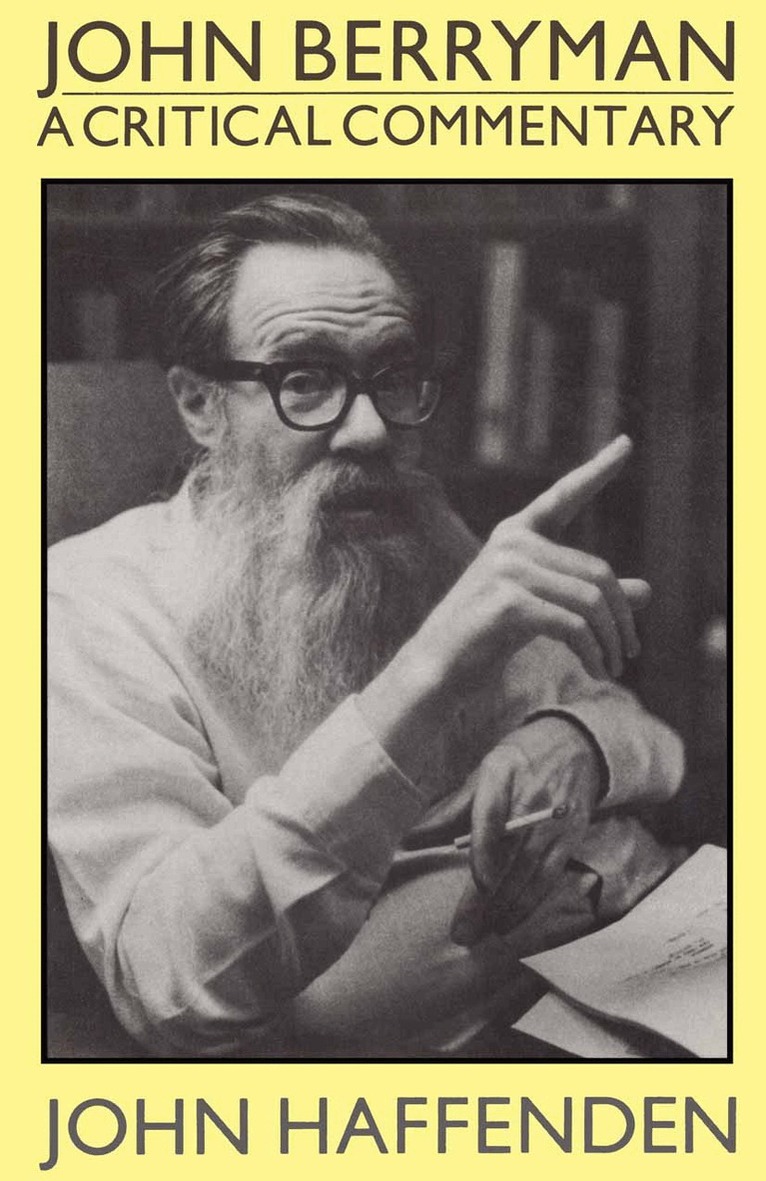
The poetry of John Berryman occupies an incomparable place in modern American literature. This study traces the composition of the major poems, and interprets Berryman's characteristic trials and his imaginative triumphs. In Homage to Mistress Bradstreet , which Edmund Wilson called ' the most distinguished long poem by an American since The Waste Land ', Berryman set himself enormous problems of theme and form, and overcame them with the vigorous and exciting craft that is described in this book. He transformed his personal concerns and historical interests into a fully achieved artistic unity, a poem which succeeds both as lyric and as drama. Similarly, in forging the thirteen-year 'epic' of The Dream Songs , 'the tragical history of Henry', as the poet himself called it, Berryman resolutely confronted chosen models such as Don Quixote and The Iliad , and eventually realised his own design and a unique poetic voice. 'I set up the 'Bradstreet' poem as an attack on 'The WasteLand' ' Berryman said in his National Book Award Acceptance Speech; 'I set up ' The Dream Songs ' as hostile to every visible tendency in both American and English poetry...The aim was the same in both poems: the reproduction or invention of the motions of a human personality, free and determined, in one case feminine, in the other masculine.' A chief feature of this study is the remarkably extensive use John Haffenden has made of primary research materials - manuscript drafts, notes, marginalia, diary entries and letters, all of which are printed here for the first time - to illuminate and explain the poems. This book is both a critical analysis of Berryman's mature works and an internal narrative of the poet's struggles and success. It includes comprehensive notes and commentary on 'The Dream Songs' and on 'Delusions, Etc.' , as well as an authoritative discussion and assesment of 'Love & Fame'.
2 169 kr
Skickas inom 10-15 vardagar
Originally published in 1985, fourteen foremost writers of fiction give detailed accounts of their writings in this absorbing collection by John Haffenden, whom The Sunday Times has applauded for having ‘perfected’ the art of the literary interview. Bringing together discussions with a wide range of authors in Britain at the time, the volume contains interviews with Martin Amis, Malcolm Bradbury, Anita Brookner, Angela Carter, William Golding, Russell Hoban, David Lodge, Ian McEwan, Iris Murdoch, V.S. Pritchett, Salman Rushdie, David Storey, Emma Tennant and Fay Weldon.John Haffenden questions them about the creative process, about specific works – including Golding’s Rites of Passage, Hoban’s Riddley Walker, Murdoch’s The Philosopher’s Pupil and Rushdie’s Midnight’s Children and Shame – and about the ideas and visions which inform those works. The writers provide lively, fascinating and often definitive responses which offer many insights into the value and function of fiction. The volume also includes discussions of cultural context and of narrative techniques and kinds – realist, postmodernist, fabulous – offering immediate material for critical debate. For all who are interested in twentieth century fiction it is essential reading.
585 kr
Skickas inom 10-15 vardagar
Originally published in 1985, fourteen foremost writers of fiction give detailed accounts of their writings in this absorbing collection by John Haffenden, whom The Sunday Times has applauded for having ‘perfected’ the art of the literary interview. Bringing together discussions with a wide range of authors in Britain at the time, the volume contains interviews with Martin Amis, Malcolm Bradbury, Anita Brookner, Angela Carter, William Golding, Russell Hoban, David Lodge, Ian McEwan, Iris Murdoch, V.S. Pritchett, Salman Rushdie, David Storey, Emma Tennant and Fay Weldon.John Haffenden questions them about the creative process, about specific works – including Golding’s Rites of Passage, Hoban’s Riddley Walker, Murdoch’s The Philosopher’s Pupil and Rushdie’s Midnight’s Children and Shame – and about the ideas and visions which inform those works. The writers provide lively, fascinating and often definitive responses which offer many insights into the value and function of fiction. The volume also includes discussions of cultural context and of narrative techniques and kinds – realist, postmodernist, fabulous – offering immediate material for critical debate. For all who are interested in twentieth century fiction it is essential reading.
5 665 kr
Skickas inom 10-15 vardagar
This set comprises of 40 volumes covering nineteenth and twentieth century European and American authors. These volumes will be available as a complete set, mini boxed sets (by theme) or as individual volumes. This second set compliments the first 68 volume set of Critical Heritage published by Routledge in October 1995.
834 kr
Skickas inom 10-15 vardagar
This set comprises of 40 volumes covering nineteenth and twentieth century European and American authors. These volumes will be available as a complete set, mini boxed sets (by theme) or as individual volumes. This second set compliments the first 68 volume set of Critical Heritage published by Routledge in October 1995.
629 kr
Skickas inom 7-10 vardagar
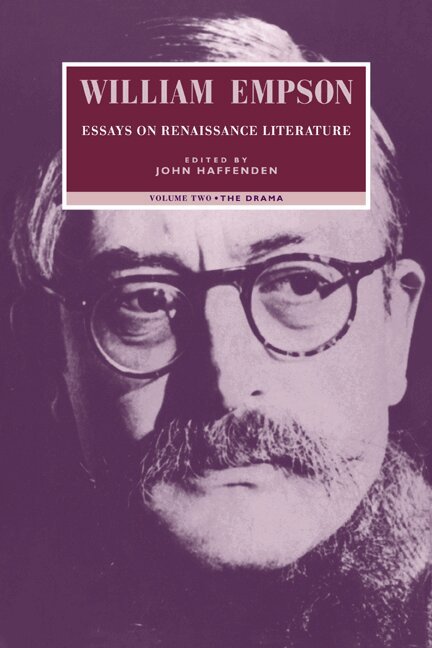
This collection of William Empson's essays on Elizabethan and Jacobean drama is the second volume of his writings on Renaissance literature. Edited with an introduction by the leading Empson scholar John Haffenden, the contents range from famous essays on The Spanish Tragedy, Volpone, The Alchemist and The Duchess of Malfi to a sprightly piece on Elizabethan spirits. In addition, there are previously unpublished essays which revisit critical controversies, and a magnificent, provocative study of A Midsummer Night's Dream which ventures a major new reading of the play. 'I am attracted by the notion of a hearty indifference to one's own and other people's feelings, when a fragment of the truth is in question,' Empson stated. The incomparable Empson here fights his own critical corner with unequalled zest, intelligence and insight.
1 371 kr
Skickas inom 7-10 vardagar
This collection of William Empson's essays on Elizabethan and Jacobean drama is the second volume of his writings on Renaissance literature. Edited with an introduction by the leading Empson scholar John Haffenden, the contents range from famous essays on The Spanish Tragedy, Volpone, The Alchemist and The Duchess of Malfi to a sprightly piece on Elizabethan spirits. In addition, there are previously unpublished essays which revisit critical controversies, and a magnificent, provocative study of A Midsummer Night's Dream which ventures a major new reading of the play. 'I am attracted by the notion of a hearty indifference to one's own and other people's feelings, when a fragment of the truth is in question,' Empson stated. The incomparable Empson here fights his own critical corner with unequalled zest, intelligence and insight.
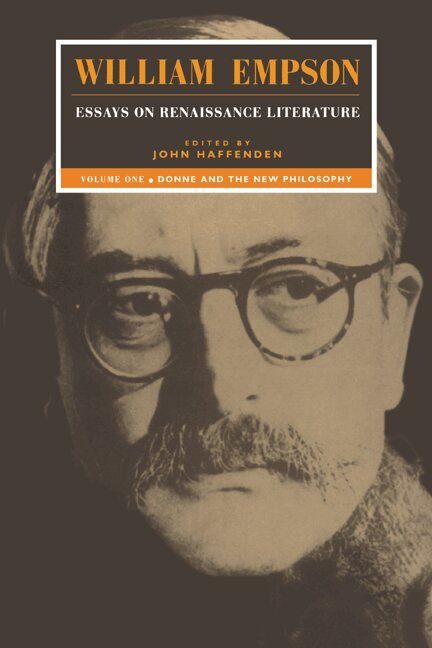
William Empson: Essays on Renaissance Literature: Volume 1, Donne and the New Philosophy
Häftad, Engelska, 1995
644 kr
Skickas inom 7-10 vardagar
Following the success in paperback of William Empson's Essays on Shakespeare (1986), this first volume of his Essays on Renaissance Literature (1993) now appears in an accessible format. The volume gathers Empson's passionate and controversial essays on John Donne in the context of contemporary science, and includes previously unpublished pieces on some of the most influential Renaissance writers and scientists. Edited and introduced by leading Empson scholar John Haffenden, this is a book for anyone interested in the Renaissance, the history of science, and the history of literary criticism. 'Some of these passages have a sweep as grand as Empson found in Donne.' Eric Griffiths, The Times Literary Supplement 'Empson's achievement here as elsewhere comes from the generosity of spirit which made him consistently a great critic.' The New York Review of Books
648 kr
Skickas
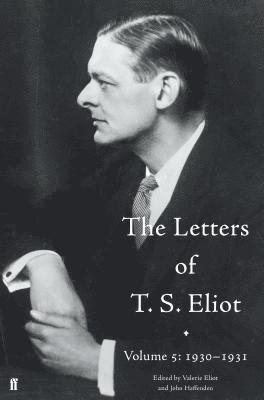
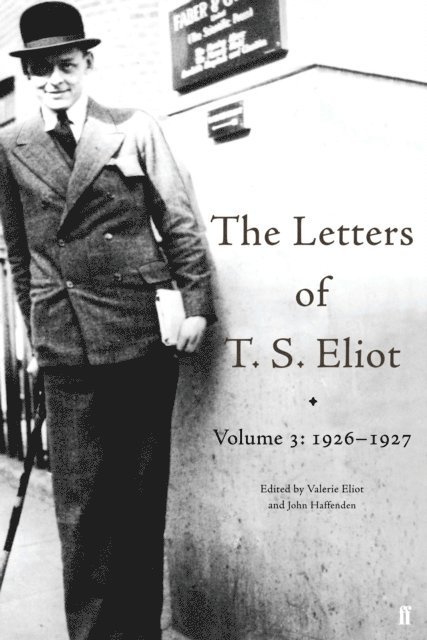
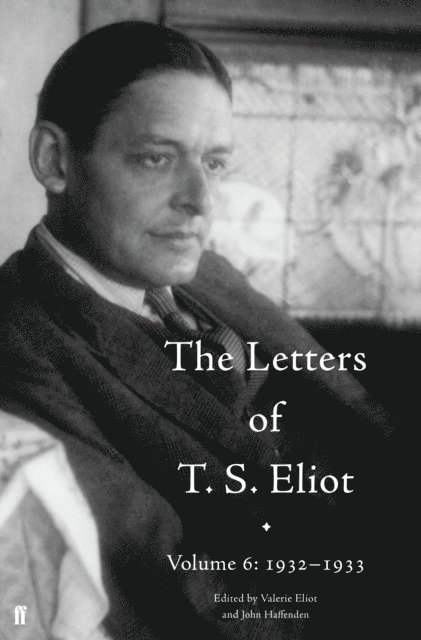
'The book amounts to a comprehensive literary history of the time.' David Sexton, Evening StandardVolume 5 of The Letters of T. S. Eliot finds the poet, between the ages of forty-two and forty-four, reckoning with the strict implications of his Christian faith for his life, his work, and his poetry.The letters between Eliot and his associates, family and friends - his correspondents range from the Archbishop of York and the American philosopher Paul Elmer More to the writers Virginia Woolf, Herbert Read and Ralph Hodgson - serve to illuminate the ways in which his Anglo-Catholic convictions could, at times, prove a self-chastising and even alienating force. 'Anyone who has been moving among intellectual circles and comes to the Church, may experience an odd and rather exhilarating feeling of isolation,' he remarks. Notwithstanding, he becomes fully involved in doctrinal controversy: he espouses the Church as an arena of discipline and order.Eliot's relationship with his wife, Vivien, continues to be turbulent, and at times desperate, as her mental health deteriorates and the communication between husband and wife threatens, at the coming end of the year, to break down completely. At the close of this volume Eliot will accept a visiting professorship at Harvard University, which will take him away from England and Vivien for the academic year 1932-33.
2 401 kr
Skickas inom 10-15 vardagar
First published in 1982, The Life of John Berryman draws on extensive research in the USA and on an enormous collection of hitherto unpublished materials – journals, letters, stories and poetry –to build a biography that recounts in absorbing detail the public and private stages of John Berry man’s career. It also offers an intimate portrait of a creative artist: his compulsive self-presentation and self-reproach, his moral and artistic dilemmas, his dedication and his accomplishments.John Berryman occupies a central place among the outstanding poets of recent times. The course of his life ran between the extremes of personal degradation and artistic ecstasy. He suffered the early suicide of his father, the dominance of his mother, poverty and professional setbacks, psychiatric treatment, alcoholism, and sexual and spiritual vexation. He became an electrifying, fearful teacher and a loving, jealous friend. His mentors and close associates included Mark Van Doren, Richard Blackmur, Allen Tate, Robert Lowell and Saul Bellow. The years brought him spells of deep personal joy and artistic fulfilment, but all too heavy a hand of terrible suffering. The book will be an extremely interesting read for students of literature.
553 kr
Skickas inom 10-15 vardagar
First published in 1982, The Life of John Berryman draws on extensive research in the USA and on an enormous collection of hitherto unpublished materials – journals, letters, stories and poetry –to build a biography that recounts in absorbing detail the public and private stages of John Berry man’s career. It also offers an intimate portrait of a creative artist: his compulsive self-presentation and self-reproach, his moral and artistic dilemmas, his dedication and his accomplishments.John Berryman occupies a central place among the outstanding poets of recent times. The course of his life ran between the extremes of personal degradation and artistic ecstasy. He suffered the early suicide of his father, the dominance of his mother, poverty and professional setbacks, psychiatric treatment, alcoholism, and sexual and spiritual vexation. He became an electrifying, fearful teacher and a loving, jealous friend. His mentors and close associates included Mark Van Doren, Richard Blackmur, Allen Tate, Robert Lowell and Saul Bellow. The years brought him spells of deep personal joy and artistic fulfilment, but all too heavy a hand of terrible suffering. The book will be an extremely interesting read for students of literature.
2 108 kr
Skickas inom 10-15 vardagar
Passionate, controversial and illuminating – this collection contains Empson’s best short pieces on Shakespeare, a sally on George Herbert, a defence of Coleridge, and an eager introduction to a French farce, a group of incomparably witty autobiographical articles, and the text to his extraordinary Inaugural Lecture as Professor of English Literature at Sheffield University.