John Harley Warner - Böcker
Visar alla böcker från författaren John Harley Warner. Handla med fri frakt och snabb leverans.
5 produkter
5 produkter
Therapeutic Perspective
Medical Practice, Knowledge, and Identity in America, 1820-1885
Häftad, Engelska, 2014
671 kr
Skickas inom 7-10 vardagar
This new paperback edition makes available John Harley Warner's highly influential, revisionary history of nineteenth-century American medicine. Deftly integrating social and intellectual perspectives, Warner explores a crucial shift in medical history, when physicians no longer took for granted such established therapies as bloodletting, alcohol, and opium and began to question the sources and character of their therapeutic knowledge. He examines what this transformation meant in terms of patient care and assesses the impact of clinical research, educational reform, unorthodox medical movements, newly imported European method, and the products of laboratory science on medical ideology and action. Originally published in 1997. The Princeton Legacy Library uses the latest print-on-demand technology to again make available previously out-of-print books from the distinguished backlist of Princeton University Press. These editions preserve the original texts of these important books while presenting them in durable paperback and hardcover editions.The goal of the Princeton Legacy Library is to vastly increase access to the rich scholarly heritage found in the thousands of books published by Princeton University Press since its founding in 1905.
Therapeutic Perspective
Medical Practice, Knowledge, and Identity in America, 1820-1885
Inbunden, Engelska, 2016
3 244 kr
Skickas inom 3-6 vardagar
This new paperback edition makes available John Harley Warner's highly influential, revisionary history of nineteenth-century American medicine. Deftly integrating social and intellectual perspectives, Warner explores a crucial shift in medical history, when physicians no longer took for granted such established therapies as bloodletting, alcohol, and opium and began to question the sources and character of their therapeutic knowledge. He examines what this transformation meant in terms of patient care and assesses the impact of clinical research, educational reform, unorthodox medical movements, newly imported European method, and the products of laboratory science on medical ideology and action. Originally published in 1997. The Princeton Legacy Library uses the latest print-on-demand technology to again make available previously out-of-print books from the distinguished backlist of Princeton University Press. These editions preserve the original texts of these important books while presenting them in durable paperback and hardcover editions.The goal of the Princeton Legacy Library is to vastly increase access to the rich scholarly heritage found in the thousands of books published by Princeton University Press since its founding in 1905.
Against the Spirit of System
The French Impulse in Nineteenth-Century American Medicine
Häftad, Engelska, 2004
342 kr
Tillfälligt slut
In this wide-ranging exploration of American medical culture, John Harley Warner offers the first in-depth study of a powerful intellectual and social influence: the radical empiricism of the Paris Clinical School. After the French Revolution, Paris emerged as the most vibrant center of Western medicine, bringing fundamental changes in understanding disease and attitudes toward the human body as an object of scientific knowledge. Between the 1810s and the 1860s, hundreds of Americans studied in Parisian hospitals and dissection rooms, and then applied their new knowledge to advance their careers at home and reform American medicine. By reconstructing their experiences and interpretations, by comparing American with English depictions of French medicine, and by showing how American memories of Paris shaped the later reception of German ideals of scientific medicine, Warner reveals that the French impulse was a key ingredient in creating the modern medicine American doctors and patients live with today.Impressed by the opportunity to learn through direct hands-on physical examination and dissection, many American students in Paris began to decry the elaborate theoretical schemes they held responsible for the degraded state of American medicine. These reformers launched an empiricist crusade "against the spirit of system," which promised social, economic, and intellectual uplift for their profession. Using private diaries, family letters, and student notebooks, and exploring regionalism, gender, and class, Warner draws readers into the world of medical Americans while investigating tensions between the physician's identity as scientist and as healer.
605 kr
Skickas inom 5-8 vardagar
The issues constituting the history of medicine are consequential: how societies organize health care, how individuals or states relate to sickness, how we understand our own identity and agency as sufferers or healers. In Locating Medical History: The Stories and Their Meanings, Frank Huisman, John Harley Warner, and other eminent historians explore and reflect on a field that accommodates a remarkable diversity of practitioners and approaches. At a time when medical history is facing profound choices about its future, these scholars explore the discipline in the distant and recent past in order to rethink its missions and methods today. They discuss such issues as the periodic estrangement of medical history from medicine, the influence of Foucault on the writing of medical history, and the shifts from social to cultural history and back again. Chapters explore the early history of the field, its transformations since the 1970s, and its prospects for the future. With diverse constituencies, a multiplicity of approaches, styles, and aims is both expected and desired.This volume locates medical history within itself and within larger historiographic trends, to provide a springboard for discussions about what the history of medicine should be, and what aims it should serve. Contributors: Olga Amsterdamska, University of Amsterdam; Warwick Anderson, University of Wisconsin, Madison; Allan M. Brandt, Harvard Medical School; Theodore M. Brown, University of Rochester; Roger Cooter, University College London; Martin Dinges, Institut fur Geschichte der Medizin der Robert Bosch Stiftung; Alice Domurat Dreger, Michigan State University; Jacalyn Duffin, Queen's University; Elizabeth Fee, National Library of Medicine; Mary E. Fissell, The Johns Hopkins University; Danielle Gourevitch, Ecole Pratique des Hautes Etudes; Anja Hiddinga, University of Amsterdam; Ludmilla Jordanova, University of East Anglia; Alfons Labisch, Heinrich-Heine-University; Hans-Uwe Lammel, University of Rostock; Sherwin B. Nuland, Yale University; Vivian Nutton, University College London; Roy Porter, formerly University College London; Susan M. Reverby.Wellesley College; David Rosner, Columbia University; Thomas Rutten, University of Newcastle upon Tyne; Heinz-Peter Schmiedebach, University of Greifswald; Christiane Sinding, Institut National de la Sante et de la Recherche Medicale
358 kr
Skickas inom 7-10 vardagar
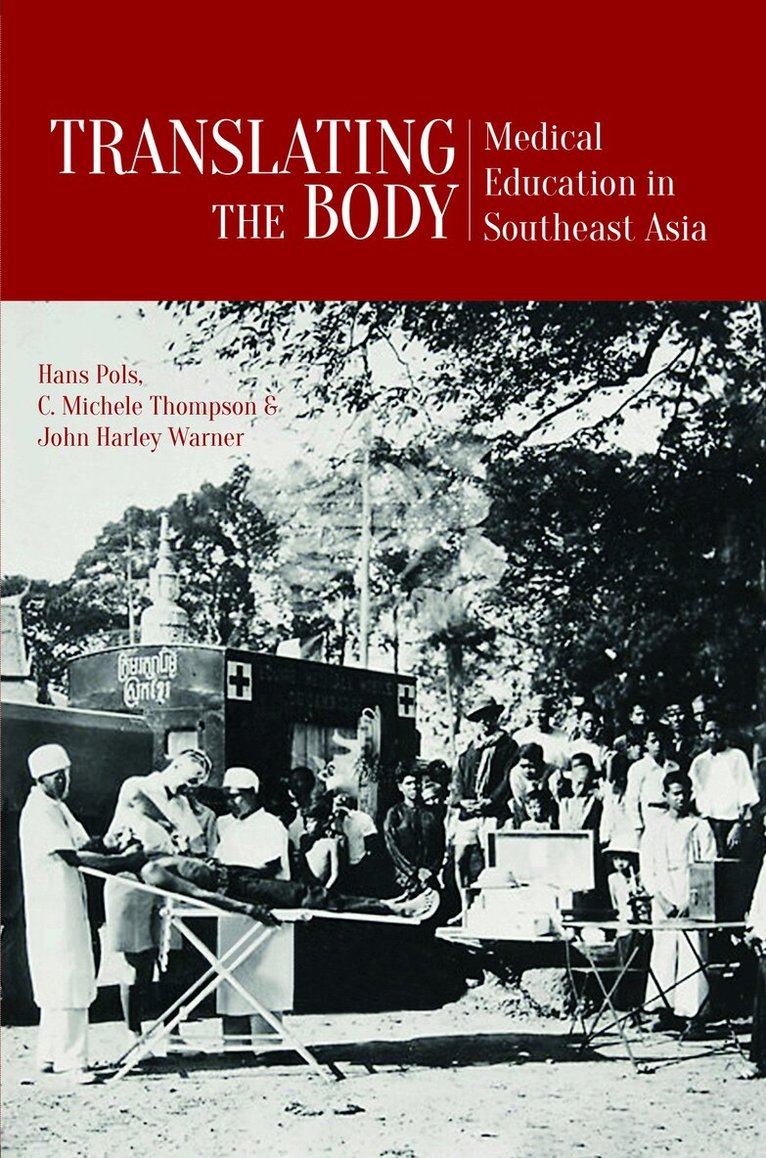
Until recently, receiving a European or North American-style medical education in Southeast Asia was a profoundly transformative experience, as western conceptions of the body differed significantly from indigenous knowledge and explanatory frameworks. Further, European and North American conceptions of the human body had to be translated into local languages and related to vernacular views of health, disease, and healing. This process of medical translation developed in the context of colonialism, which sought to remake colonized societies in a multitude of ways. The contributors to this volume chart and analyze the organization of western medical education in Southeast Asia, public health education campaigns in the region, and the ways in which practitioners of what came to be conceived of as “traditional medicine” in many Southeast Asian countries organized themselves in response.This volume uses “translating the body” as shorthand to call attention to the processes through which medical ideas, practices, and epistemologies are formulated in pedagogical contexts, processes involving both interpretation and transmission. Translation here is a linguistic but also a cultural operation, and in approaching medical education, the book follows recent work in translation studies that underscores the translation not merely of words but of cultures.